A controversial ad and Democratic infighting: What El-Sayed has said about Israel and US services
PolitiFact ·
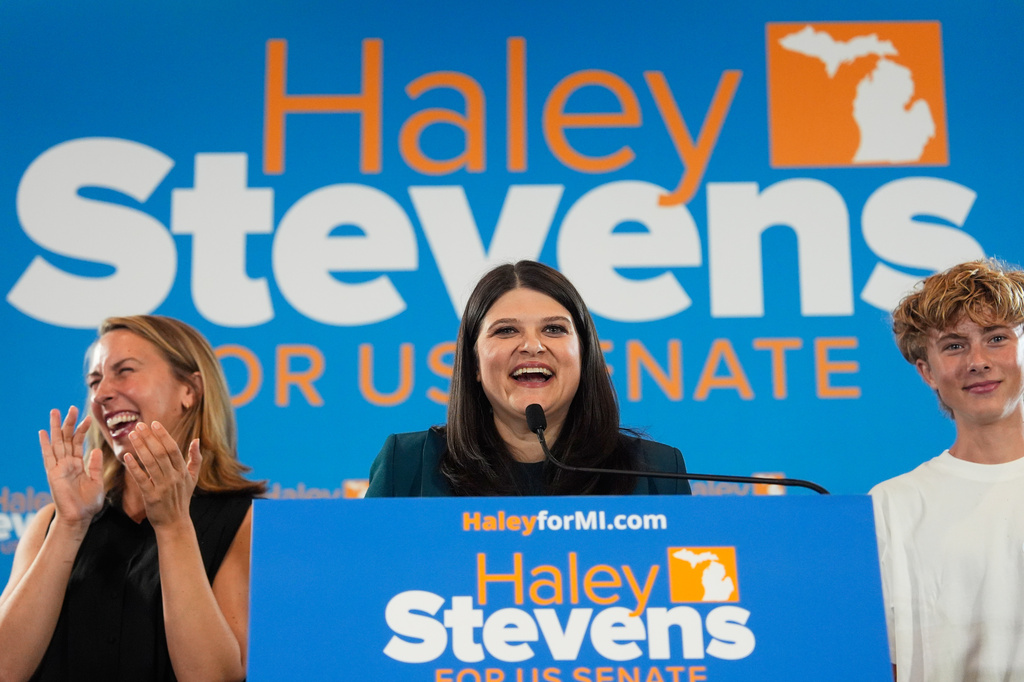
Abdul El-Sayed’s defeated rival in the Democratic U.S. Senate primary, U.S. Rep. Haley Stevens, criticized his statements on Israel and called on him to condemn an ad two days before they were scheduled to appear together at a Detroit church.
Rebellion PAC’s digital ad showed a couple shopping in the grocery store concerned about prices. The woman tells the man to not buy eggs because “we have to set that $7 aside for killing Palestinians.”
The end of the ad states that former U.S. Rep. Mike Rogers, the Republican nominee, “is for they/them” and shows a photo of Prime Minister Benjamin Netanyahu and his allies. The ad says, “Abdul El-Sayed is for you.”
Cenk Uygur, the founder of the left-wing political action committee and co-creator of the media company The Young Turks, first ran a version of the ad in 2024 when he ran for president. He told PolitiFact that the PAC has spent $1,000 on the current digital ad and it has not run on TV, other than in news coverage.
Stevens said in an Oct. 30 social post that she heard El-Sayed planned to condemn the ad after his campaign said it wasn’t affiliated with it.
On the eve of the eve of the eve of our BIG and important election, a unifying moment has arrived, our democratic nominee for U.S Senate disavows the Rebellion PAC ad made by Hasan Piker’s uncle that claims Jews are responsible for America’s economic woes. We have learned from party leaders and emissaries, as reported in the news media that he has.
On Sunday I will join with the Great Democratic leader, Jim Clyburn and Dr El Sayed for a church service in the beautiful city of Detroit.
The political coalition of Black and Jewish voices that have carried Michigan and this country through so many storms to the righteous path of liberal democracy and equal opportunity for all will ring out. Full statement here:
— Haley Stevens (@HaleyforMI) October 30, 2026
“The ad did not invent its argument,” Stevens wrote. “It dramatized one Dr. El-Sayed has made in his own words throughout the campaign: that Israel is the reason Michigan cannot afford schools, health care and childcare.” She called on him to apologize for his statements and to get “Israel out of his explanation for everything Michigan cannot afford.”
U.S. funding for Israel and the Israel-Gaza war has been a hot topic in congressional elections, including in Michigan. Criticizing U.S. aid to Israel, as El-Sayed has done, has become increasingly common in the Democratic base , and, in July, nearly half of House Democrats voted to cut off aid. (The vote failed because of Republican opposition.) Public opinion polls show Americans want to cut or eliminate military aid to Israel.
The planned Nov. 1 event at a Black church was intended to show unity on the left and includes Rep. James Clyburn, D-S.C., in an effort to increase turnout among Black voters who comprise an estimated 11% of Michigan’s electorate.
With news attention on the ad and the Stevens-El Sayed rift, PolitiFact wanted to examine El-Sayed’s statements on Israel funding.
El-Sayed is critical of military aid to Israel, but Stevens’ characterization doesn’t give the full picture.
“El-Sayed has focused primarily on the unfair tax system and high Pentagon spending for the poor state of social services,” said Stephen Zunes, professor of politics and director for Middle Eastern studies at University of San Francisco. “His major critique regarding U.S. support for Israel was about how arms to Israel were being used to commit war crimes and that the U.S. alliance with Israel was hurting America’s standing in the world.”
We reached out to spokespersons for Stevens and El-Sayed and did not hear back. In a statement posted on X late in the day Oct. 30 , El-Sayed said his campaign is focused on defeating Rogers and lowering prices.
“This should be the priority for all of us right now,” he said after referencing the American Israel Public Affairs Committee’s primary support for Stevens. “While Congresswoman Stevens seems intent on relitigating a primary that ended three months ago, let’s all focus on the task at hand.”
https://t.co/NEd1uijz11
— Dr. Abdul El-Sayed (@AbdulElSayed) October 30, 2026
El-Sayed often criticizes the U.S. government funding for Israel and says that it could be better spent on domestic priorities such as education, healthcare and child care.
“The money that we are spending to subsidize apartheid in the West Bank is money that should be used on the West Side (of Detroit),” he said in a recent podcast interview with Daily Show host Jon Stewart . “That’s our money. It should be spent here.”
El-Sayed has called Israel “an affordability issue.” In an Oct. 29 rally in Kalamazoo , El-Sayed mentioned taxes funding foreign militaries alongside consumer spending on gasoline and healthcare.
“It shouldn’t be this hard to pay your taxes and know that that money is going to be spent on you and your kids rather than dropping bombs on somebody else and their kids,” he said.
El-Sayed has said Israel Prime Minister Benjamin Netanyahu encouraged President Donald Trump to begin the war in Iran, which has sent gasoline prices soaring. The U.S. has spent $47.1 billion on the Iran war, according to a recent Pentagon estimate, The Associated Press reported .
El-Sayed has called Israel’s conduct in Gaza a genocide and said the country is perpetrating apartheid in the West Bank.
“We’re paying $5 gas. We’re paying more for groceries, because of war we should not be fighting, at the behest of whom? The government of Israel,” he said in an NBC interview released Oct. 15 .
After the Israel-backed strikes on Iran in February, Iran closed off the Strait of Hormuz, a key oil shipping route. That has sent gas prices up more than $1.20 over their pre-war average . Higher prices at the pump also affect the cost of many consumer goods that need to be transported.
El-Sayed has said that his opposition to sending such dollars overseas is not only about Israel. “I don’t think we should be funding foreign militaries generally,” El-Sayed said in response to a question about Rebellion PAC’s ad, The Associated Press reported . “That’s Israel. It’s also Egypt. It’s also Saudi Arabia and Qatar and (United Arab Emirates).”
El-Sayed doesn’t say Israel is the sole reason for what he says are underfunded social programs. He has criticized the Trump administration for cutting education funding and proposed higher taxes on the wealthy to pay for some programs.
In a September interview with Bloomberg News , El-Sayed proposed both cutting military spending and taxing billionaires when asked how he would pay for universal healthcare.
“So to all the billionaires listening, I think you ought to pay for your fair share and we ought to tax your wealth,” he said. “And I think we should stop fighting wars that we have no business fighting.”
“You do that and you can actually pay for the things that Michiganders and Americans generally need and deserve like healthcare, child care, good infrastructure, and good schools,” he continued.
Foreign military aid comes from the State Department and Defense Department. If Congress decided to cut such aid to Israel, it would not automatically go to any domestic program.
The U.S. provides about $3.8 billion in military aid to Israel annually, and that spending has escalated since Oct. 7, 2023, when Hamas-led militants attacked southern Israel. Analysts have put recent spending at between $16.3 billion and $21.7 billion .
“None of the money came out of any program that supports Michigan,” said Mark Cancian, senior adviser at the Center for Strategic and International Studies.
Should Congress choose to reduce or eliminate aid to Israel, “The savings could be redirected to any number of places, from reducing the $2 trillion deficit to spending on healthcare and childcare, to transportation and infrastructure, to countless other priorities,” said Joshua Sewell, director of research and policy at Taxpayers for Common Sense. “But precisely how Congress would redirect any savings from cuts is anyone’s guess.”
Ben Freeman, an expert on money in politics and defense spending at the Quincy Institute for Responsible Statecraft, said, “Budgets have tradeoffs and opportunity costs, so it is fair to say that if spending on one government function goes up it can put downward pressure on other spending priorities.”