Sharp Left Turn: Democrats Have a Shot to Take Congress on Socialist Momentum
The Intercept ·
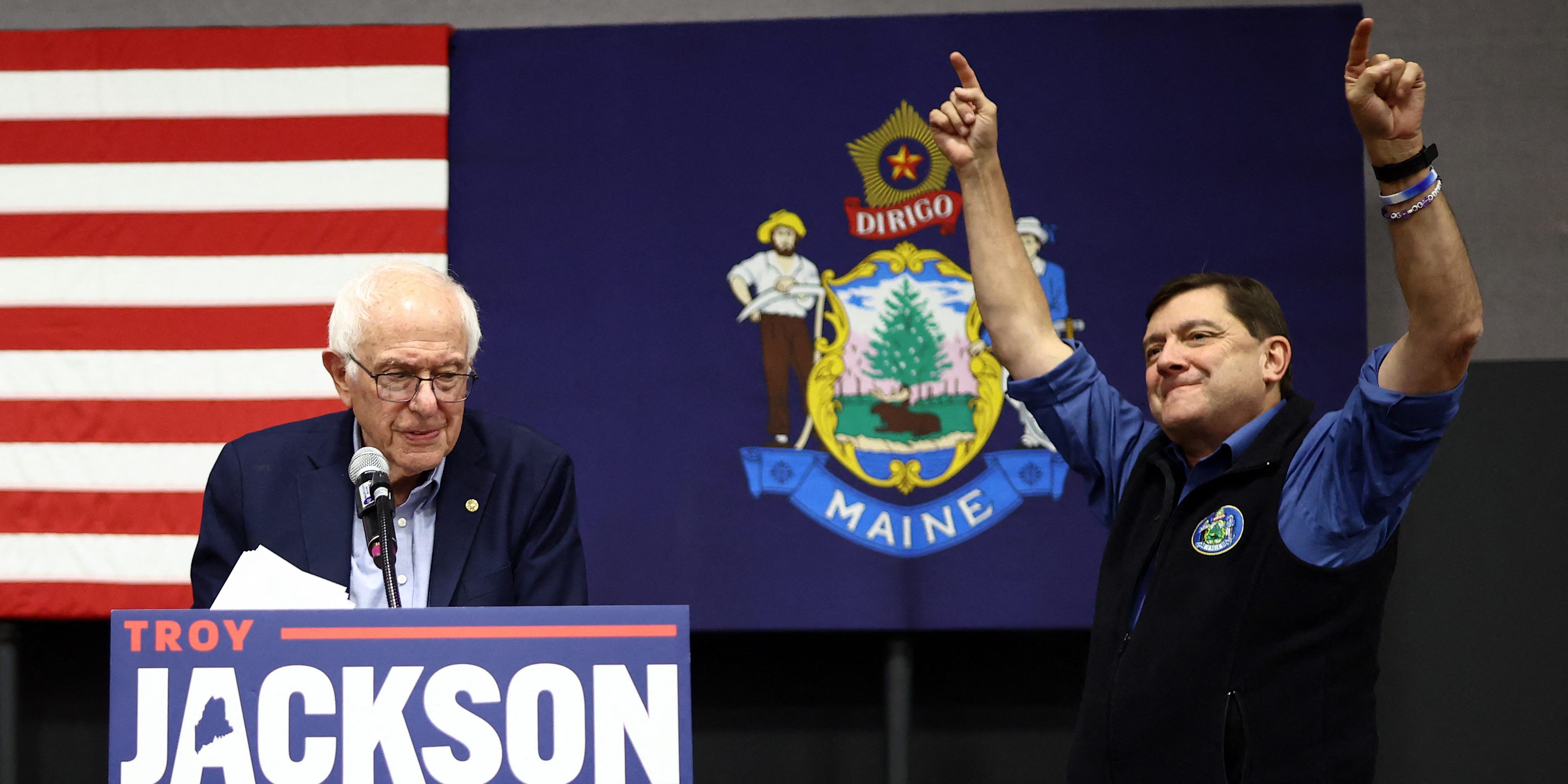
Voters in Maine, Michigan, and Texas said they want to see Democrats deliver Medicare for All, social welfare spending, and lower prices. And fewer campaign mailers. The post Sharp Left Turn: Democrats Have a Shot to Take Congress on Socialist Momentum appeared first on The Intercept .
Democrats are on the verge of reversing their political fortunes. The party is heading into the midterm elections Tuesday under the kind of conditions campaign consultants dream of, after two years wielding hardly more power than a strongly worded letter.
Donald Trump has spent the erratic waning years of his presidency leading his party into a political wilderness by waging a deeply unpopular war on Iran and driving the cost of living ever higher. Republicans who enjoy a governing trifecta have tried to distance themselves from the party’s decision-making and its leader, a once-animating force who has turned himself into a liability. Poll after poll says the same: Democrats are poised to take control of one or both houses of Congress — and spend the next two years thwarting Trump’s agenda.
But after a primary season dominated by an ascendant left wing and a broader rejection of centrist politics , the question isn’t just whether Democrats win on Tuesday. It’s what kind of Democratic Party emerges on Wednesday morning.
“I really like the socialism aspects,” said Gibrel Said, a supporter of Abdul El-Sayed at his closing rally in Detroit Monday night. In the marquee contest serving as a referendum on the Democratic Party’s future , the Michigan Democratic Senate nominee espouses progressive politics and has often been associated with the the left’s agenda-setting socialists , though he doesn’t identify as one . His race has been rocked by the kind of left-versus-right identity crisis that presents a perennial challenge for Democrats.
“One, Medicare for All; two, how do we fund things that help us as constituents,” Said told The Intercept, ticking off things he appreciates about the candidate. Said, who lives in the Arab enclave of Dearborn, Michigan, especially praised El-Sayed’s willingness to buck party leadership and speak out on U.S.–Israel policy . “Instead of tiptoeing around the subject, he very adamantly says, hey there’s a genocide happening here, we shouldn’t send our money.”
Cycle after cycle, in state after state, an insurgent band of Democrats critical of the political establishment’s ties to corporate interests and its unflinching commitment to Israel has had to overcome the barriers erected by its own party’s centrist leadership. Both sides present themselves as the true representatives of working people: the centrists by arguing that more transformative ideas will scare off lower-information voters, the left by saying they represent the masses.
How much of this trickles down to actual voters? On Monday, The Intercept followed canvassers and spoke to voters in Michigan, Maine, and Texas, asking about which issues had permeated and taking the temperature of voter enthusiasm. Some rolled their eyes at the spats that have dominated the headlines, dismissing the idea that eleventh-hour backstabbing would make a difference. Others regurgitated right-wing misinformation. Many complained of too many campaign mailers.
“They’re wicked mean,” said Sharon McDonnell, a supporter of Troy Jackson, the Democratic Senate nominee in Maine. Speaking to The Intercept in the town of Yarmouth, she described one mailer that included a photo of Jackson chomping a cigar and describing him as “evil.” “It’s just nasty.”
In Maine, the party’s left flank seized power in the nominating process for the Democratic Senate candidate — then fought to hang onto it after onetime rising star Graham Platner flamed out after a sexual assault allegation (which he denies). With Jackson, a former state Senate leader, Maine now offers progressives one of two opportunities to test their message at the Senate level, where a candidate has to secure appeal statewide, not just in deep-blue House districts.
The other is Michigan, where the intraparty battle is still raging. Rep. Haley Stevens, D-Mich., demolished her past attempts at fence-mending when she endorsed Republican Senate candidate Mike Rogers on Sunday and abandoned El-Sayed, who beat Stevens in a Michigan primary that saw $30 million in outside spending from the super PAC for the American Israel Public Affairs Committee .
The dustup has had Democrats biting their nails and moderate party leaders making the cable news circuit to demand party discipline — this time, to scold a centrist. The party leads in the polls for 218 of the 435 seats up for grabs in the House of Representatives, but they need to perform well in seven key states — Alaska, Iowa, Kansas, Ohio, and Texas, in addition to Maine and Michigan — if they want to win the Senate.
“I think she’s counterintuitively, perhaps, given people a reason to rally some more,” said Kathleen Britton, an El-Sayed supporter at the Detroit rally on Monday, of Stevens. “I really don’t think it’s gonna help Mike Rogers.”
Earlier that day, in a predominantly Black neighborhood of Detroit, a prominent Black supporter of El-Sayed preparing to knock on voters’ doors described Stevens’s endorsement as an “ego-driven statement.”
Haley Stevens “used a Black church as a prop, and we have seen that time and time again.”
Mike Bland, the executive director of the Black Men Vote PAC, highlighted that Stevens made her public endorsement of Rogers in a Black church in Detroit. He doubted that Stevens, whose criticism of El-Sayed centers primarily on his skepticism of the U.S. relationship with the state of Israel , would be able to pull Black voters to Rogers, a conservative former House representative whose campaign has repeatedly peddled anti-Muslim tropes against El-Sayed.
“How can I say this without cursing? She used a Black church as a prop, and we have seen that time and time again,” Bland said. “Black folks aren’t stupid.”
Over the past month, El-Sayed has rallied with Barack Obama and Kamala Harris, the two most prominent Black politicians in America — and hardly radicals estranged from the establishment power center. At the same time that Stevens was making her endorsement of Rogers public, El-Sayed was attending a get-out-the-vote event at another church in Detroit. The two primary foes were supposed to appear together that day with Rep. Jim Clyburn, D-S.C.
One of the Democrats’ most coveted Senate pickups didn’t present much of an opportunity for the left in the primary, but it has still been characterized by intraparty animosity.
In Texas, where both Democratic Senate primary contenders espoused relatively moderate politics, outgoing Rep. Jasmine Crockett, D-Texas, has declined to campaign with state Rep. James Talarico, though she endorsed him after he beat her in the state’s March Democratic primary.
Talarico has been performing well with Latino voters , a massive voting bloc that helped fuel his primary victory . But Crockett — who, unlike Stevens, is Black — has suggested that Talarico has not done enough to excite Black voters, a demographic she carried in the primary. On a canvassing operation targeting Black voters in the Dallas–Fort Worth area on Monday, few Black Texans who spoke to The Intercept expressed excitement for Talarico. But most had already voted for him, saying they were motivated to do their civic duty.
Black voters frequently discussed concerns over affordability, gas prices, and homelessness. Canvassers told The Intercept they had heard some of those voters express concerns over their perception of Talarico’s policies toward transgender children, at times espousing blatant misinformation, such as the idea that Talarico supported arresting parents who refused to give their children gender-affirming surgeries.
“ I don’t stand for that,” said voter Jermiah Robinson, referring to her belief that Talarico pushed “sex-change” surgery for minors. Like many voters, she cited the cost of living as her most pressing issue. Robinson said she would “want to vote for him if he stands by his words, and he’s actually like ‘Yeah, I’ll help out as far as prices and everything.’”
Talarico appears to have improved his margins with Black voters in the final stretch. According to the Texas Politics Project at the University of Texas, Talarico is leading with 79 percent of the Black vote, signaling a significant increase in support from Black voters from just last month . The conventional wisdom suggests that he could barely ask for a better opponent than the scandal-plagued Republican candidate, Texas Attorney General Ken Paxton.
In 2015, Paxton was indicted on felony securities fraud charges in Texas, in a case that dragged on for roughly nine years, and ended with Paxton being required to do community service and pay restitution. And in 2023, the Texas House of Representatives voted across party lines to impeach him as attorney general for alleged corruption and retaliation against whistleblowers.
Scandal kept rocking the race for Senate in Maine, where longtime Republican incumbent Sen. Susan Collins faces her toughest reelection challenge yet from Jackson. Before Jackson, who lost a race this cycle for the state’s Democratic nomination for governor, there was Platner, hailed early as a working-class champion who faced a series of personal scandals in his successful primary campaign. There was the revelation of a Nazi tattoo that he claimed not to understand until last October. There were crudely worded Reddit posts and stories of cruelty from women he’d dated. One former girlfriend’s allegations of sexual assault ultimately ended his campaign — and set off a scramble to find a replacement that progressives ultimately won by elevating Jackson.
By Monday, Mainers who spoke to The Intercept appeared exhausted by the lengthy, contentious, and expensive Senate race that has dominated the state.
“There’s a lot of fatigue. People are tired of it,“ said Charlie Dingman, who chairs the state Democratic Party. “I have had some conversations at doors with people that have led me to think that the extremely negative and extremely untruthful ads may be backfiring.”
Tyler Echard, in Norway, said he’d already cast an absentee ballot for Democrats down the ticket. He was disgusted with a deluge of political mailers and eager to stop seeing them pile up on his doorstep.
“The amount of mailers we get — just mailers, not just handed at the door but in the mail — especially from the Republican side, the amount of money is probably more than I will make in my lifetime, spent in this election,” Echard said. “At some point, we gotta get legislation because money’s just gonna run everything into the ground. I ain’t got it, so I can’t influence it.”
Frustration with the status quo in Congress could spell the end for Collins’s 30-year career in the Senate. On Monday, a University of New Hampshire poll found Jackson leading Collins by 4 percentage points. And in September, Collins found herself thrust into a scandal of her own, when ProPublica revealed that the FBI anti-corruption squad was investigating an alleged pay-to-play scheme between Collins and a donor eager to secure government contracts.
The Intercept later exposed that, alongside a series of campaign donations, defense contractors cozy with Collins had received lucrative carveouts in defense spending. (Collins has denied wrongdoing in all cases.)
But the incumbent senator has faced controversy and come out victorious before . And some Mainers doubt they’ll see change either way.
“I can’t vote for either side,” said a man, who declined to share his name with The Intercept, walking down a rural road in Norway with a hunting rifle slung over his shoulder. “You can’t trust neither of them.”
Noah Hurowitz reported from Yarmouth and Norway, Maine; Akela Lacy reported from Fort Worth, Texas ; Matt Sledge reported from Detroit, Michigan .
The post Sharp Left Turn: Democrats Have a Shot to Take Congress on Socialist Momentum appeared first on The Intercept .