NASA’s Eyes software: September release notes
NASA Science ·
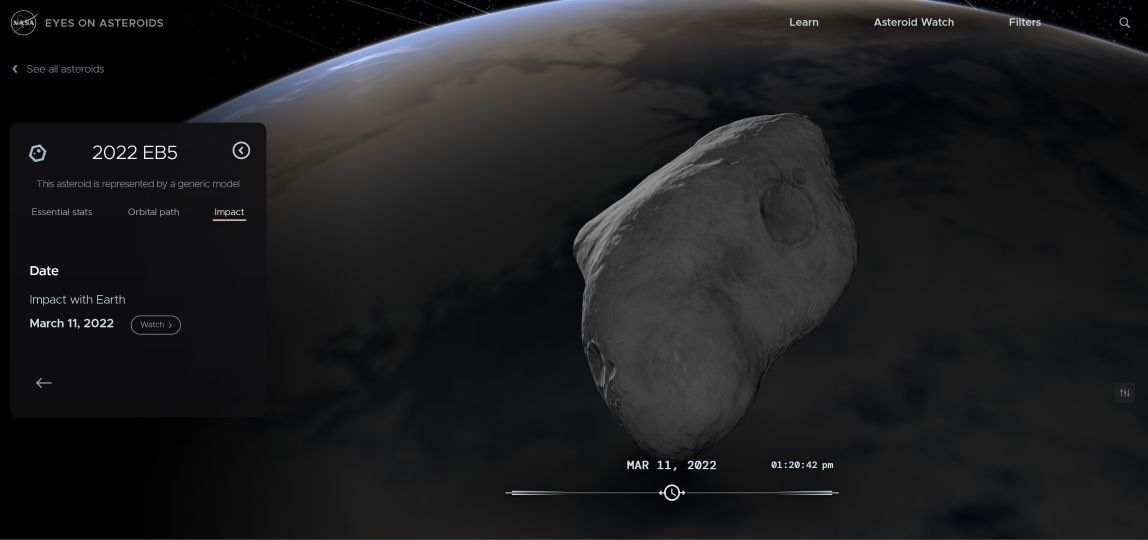
On September 30, 2026, a new version of Eyes on Asteroids was released. This release added a new “Impact” tab on the asteroid information panel, as well as a “Watch” button to see the impact at the time it happened. In addition, for any of the 42,580 Near-Earth Objects (NEOs), there is now a “Watch” […] The post NASA’s Eyes software: September release notes appeared first on NASA Science .
On September 30, 2026, a new version of Eyes on Asteroids was released. This release added a new “Impact” tab on the asteroid information panel, as well as a “Watch” button to see the impact at the time it happened. In addition, for any of the 42,580 Near-Earth Objects (NEOs), there is now a “Watch” button to see the closest approach to Earth, but only if the asteroid comes within 0.05 Astronomical Units ( 7,479,894 kilometers or 4,647, 790 miles ). Usually, those close approaches will still be far away, and this tool give you a way to visualize that in a 3D environment. Please note that the time range represented in Eyes on Asteroids only goes ten years into the future in order to keep accuracy at a high level. So if a close approach is more than ten years from now, we do not show it in 3D.
Any asteroid that actually impacted on Earth in the past will have an Impact tab in the information panel, as well as a Watch button to see the actual incident.
For an asteroid like Apophis, you can see the closest approach to Earth in the future, but only if the distance is less than 0.05 AU.
This release also features an updated story in the “Learn” section, titled “How NASA Protects Earth”. This has a new slide that features NEO Surveyor, which is launching in 2027 and will specifically look for darker asteroids that are harder to spot.
There are dozens of other bugfixes and improvements in this release as well. Please do explore!
The post NASA’s Eyes software: September release notes appeared first on NASA Science .