I tested Bose’s new entry-level soundbar — and while it has no Dolby Atmos, its dialogue clarity beats the Sonos Beam 2 for movies and Netflix shows
Latest from Tom's Guide ·
Erin Bashford is a senior reviews writer at Tom’s Guide. She has a Master’s in Broadcast and Digital Journalism from the University of East Anglia and 7 years of experience reviewing music and events for various publications. She has edited publications such as Outline Magazine’s Guide to Norwich, and she has written for a number of music magazines and websites such as Clash Magazine, Outline Magazine and Dork Magazine. She has a strong interest in audio gear and the music world. As an ex-barista, Erin is passionate about coffee tech. She also loves finding the best cooking hacks and kitchen appliances, including her beloved Instant Pot. In her spare time, you can find her reading, practising yoga, hiking, writing fantasy novels, or stressing over NYT Games.
Price: 3/5 Sound quality: 4/5 Design: 5/5 Features: 4/5 Overall score: 4/5 Best for: Small spaces, small(ish) budgets
Soundbars are expensive. $800, $1,500, heck, I’ve even tested $3,500 models. That’s simply inaccessible for a lot of people. And not to mention size — some of the best soundbars are almost fifty inches long. I certainly don’t have that much space in my living room.
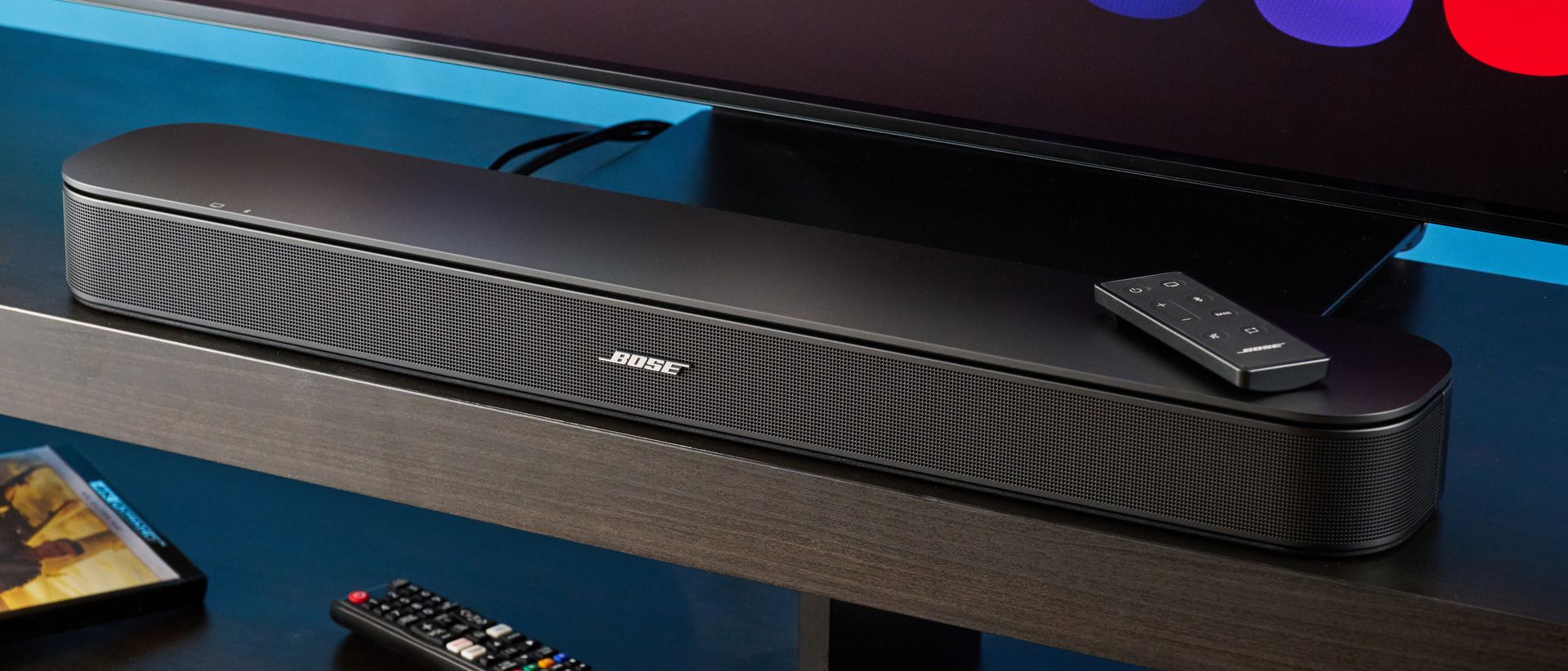
Thankfully, Bose has the answer for us small-budget, small-spaced folk. The Bose TV Speaker 2nd Gen is just twenty-three inches long, making it ideal for cozy living rooms and smaller TVs. Nothing’s changed from the original — it’s still 23 inches long, 2 inches deep, and 4 inches high.
So what’s different? The 2nd Gen has a center tweeter for better dialogue and high-frequency sound separation. Sometimes I read these specs and resist the urge to roll my eyes, but in the TV Speaker 2nd Gen’s case, this new tweeter really does make a difference. I never struggled to hear dialogue, on-screen sound effects are surprisingly distinct, and the extra bass button is impactful.
Price
$299 / £299
Connectivity
HDMI, Optical
Weight
4.4 pounds
Dimensions
23.5 x 2.2 x 4.1 inches
Colors
Black
Subwoofer
No
Dolby Atmos
No
Channel
3.0
There’s a lot I like about the Bose TV Speaker 2nd Gen.
Given its small stature, I wasn’t expecting room-filling sound from the Bose TV Speaker 2nd Gen. I was wrong.
As soon as I set it up with my TCL TV, I had floorboard-quaking sound. I watched three movies on 4K UHD Blu-rays — “Top Gun: Maverick”, “Project Hail Mary”, and “Obsession”, and watched basic stereo TV on Now TV (the U.K.’s HBO) and Netflix.
“Top Gun: Maverick” filled my testing room. I was super surprised by the expansiveness in the upper mids — the synth chords in the soundtrack came through with gusto. The rumbling of jet engines was impactful and didn’t overpower high-frequency sounds like clinking metal wheels and whirring equipment. While the whooshing ropes could have been a little louder, and I wanted a little more impact from the kick drum in the soundtrack, I was extremely happy with this performance — especially considering the soundbar’s 23 (L) x 2 (H) x 4 (D) size.
Dialogue was extremely clear, even in loud action sequences. When Maverick is flying at hypersonic, the rattling cockpit and screeching air resistance didn’t overpower the in-scene mumbled dialogue.
“Obsession” also sounded fantastic. The dialogue was perfectly clear, even in loud bar scenes underpinned with indistinct chatter and diegetic music. Every line filled the room. In quieter scenes, the crickets punctuated the fabric of the scene without overpowering the dialogue.
In “Project Hail Mary”, the soundtrack’s wind instrument sections were particularly overwhelming — in an intentional way. The whirring of the spaceship was audible even over the soundtrack, and I could really feel every layer of sound. Of course, this soundbar doesn’t have Dolby Atmos, but “behind” sounds, such as doors opening, sounded as if they were coming from behind me.
Stereo TV also sounded great. As not everyone has 4K Blu-rays — especially not if you need a small, cheap soundbar like this one — it’s only logical that I test it out on basic TV as well. “Supernatural” on Now TV has a great mixture of action sequences, broody dialogue, and soundtrack.
Even during action sequences, I could hear every word of dialogue. Of course, the overall quality was inferior compared to 4K Blu-rays, with everything a little more muffled.
I also watched “Gilmore Girls” on basic Netflix, which also has the 2.0 stereo audio track. As this is an older show, dialogue was a little softer, but this is also the case when I watch with my Denon Home 550 ($699).
The TV Speaker 2nd Gen has bass boost, which does what it says on the tin. I activated this for all my testing as it massively improved bass. Even with bass boost activated, the soundbar didn’t physically shake or peak, which can be an issue on cheaper models, such as the Ultimea Nova S50 ($129).
Thanks to its 23 x 2 x 4 inch stature, the Bose TV Speaker 2nd Gen would look at home in any cozy living room. At a push, it would look good with a 55-inch TV, but better with a 50-inch or 43-inch. Any bigger and the TV would dwarf the soundbar. If you have a 65-inch TV or bigger but you still want an affordable soundbar, I’d recommend the Samsung B550F ($225), which is 33 inches (and has a subwoofer).
The soundbar is also super light, so don’t worry about carrying the box up stairs or setting it up alone. I’m extremely weak, and I set it up by myself in seconds.
Although I was blown away by the big sound and impressed by the tiny footprint, the Bose TV Speaker 2nd Gen missed out on the perfect 5-star rating for a reason.
The Bose TV Speaker 2nd Gen is $299 from Amazon U.S. and £299 from Amazon U.K. When I saw this price, I did a double take. As Bose’s entry-level soundbar, I think $299 is way too expensive. In the U.K., you can still buy 2021’s Bose Solo Soundbar II for £179, but it’s no longer sold in the U.S.
When the Sonos Ray — Sonos’ entry-level soundbar — is $219, it gets tricky to recommend the Bose. However, I tested the Sonos Beam 2 (a level up from the Ray) back-to-back, and the Bose sounded better. Do with that information what you will.
The original Bose TV Speaker is still available for $279 from Amazon — although I’m not sure how much longer — but, again, this isn’t cheap enough to undercut Sonos’ beginner soundbar.
Similarly, the Sony HT-S100F is one of the best cheap soundbars on the market, and it’s literally $119. Dialogue is clear, and while bass isn’t as powerful as the Bose TV Speaker 2nd Gen, you’re saving $180.
Don’t get me wrong, the Bose TV Speaker 2nd Gen really surprised me with its clarity and depth. However, $299 is still a lot of money for a first soundbar. I’m struggling to recommend it when Sonos and Sony’s entry-level options are so much cheaper.
If you can find the TV Speaker 2nd Gen on sale for around $200, it’s a no-brainer. But if you need a good soundbar for as little money as possible, I’d go for the Sony or Sonos.
While the Bose TV Speaker 2nd Gen has Bluetooth connectivity for streaming music from your phone, the Sonos Ray ($219) has AirPlay too. This means you can stream directly from the Spotify, Qobuz, Apple Music, or Tidal app. Of course, you can connect via Bluetooth, but this can be a little cumbersome. Fiddling around in your phone’s settings versus just clicking play from Qobuz is a no-brainer.
However — and there’s a big however coming — the Sonos Ray doesn’t have an HDMI connection. It connects to your TV using optical. Optical is generally considered to be inferior to HDMI for a few key reasons: optical cannot transfer Dolby Atmos or DTS:X, HDMI allows both audio and video, and if you have a DVD player with only an optical port, you’ll need to use an HDMI for your soundbar as your TV won’t have enough ports.
In short: just check what you need before buying any AV product.
Even so, both HDMI and optical are digital formats, so the audio quality should be around the same. On top of that, the TV Speaker 2nd Gen isn’t capable of Dolby Atmos anyway — it’s just 3.0 channels, while you need a minimum of 3.1.2 for Dolby Atmos — but it’s worth knowing.
I was lucky enough to test the Bose TV Speaker 2nd Gen and the Sonos Beam 2 back-to-back. Honestly? The Bose sounds better. Although the Sonos Beam 2 is more expansive, especially in the soundtrack and bass, its dialogue is a little harsher. I got fatigued faster while listening on the Sonos than the Bose.
High-frequency sounds are more abrasive on the Sonos. For long watching periods, I’d recommend the Bose. And you save $180! I’d also recommend investing an extra $70 in the Bose TV Speaker 2nd Gen over the Sonos Ray due to the latter’s lack of HDMI connection.
Of course, you can save a similar amount over the Bose with the Sony HT-S100F ($119), but the Bose has better bass depth. There’s also the Samsung B550F ($225), although I’ve not personally tested this model, so I can’t definitively tell you it’s better or worse.
Yes, if you value affordability and you have a TV 55 inches or smaller — 100% yes. I was genuinely surprised by the room-filling, powerful sound and the deftly controlled bass. The bass boost mode works really well, enhancing blockbuster movies from good to fantastic .
Sure, I wish there were AirPlay, but this is an entry-level soundbar, so we can’t be asking for the world. Despite the 2nd Gen only just coming out, maybe Bose can add AirPlay onto the 3rd Gen model. Just a thought… (coughBosecough).
Although it’s a little pricier than the Sonos and Sony competition, I wholeheartedly recommend the Bose TV Speaker 2nd Gen. I would happily switch out my Denon Home 550 ($699) for the Bose — and that’s saying something.