2026 Dodge Charger Scat Pack Sixpack Review: This Reboot Is Off to a Poor Start
The Drive ·
The Dodge Charger Scat Pack is trying to stir enthusiasts' souls with six cylinders, but the faithful are angry and want a V8. The post 2026 Dodge Charger Scat Pack Sixpack Review: This Reboot Is Off to a Poor Start appeared first on The Drive .
Bottom line: The 2026 Dodge Charger Scat Pack offers a powerful yet controversial reboot, blending modern performance with design challenges.
It’s been nearly three years since Dodge killed the V8 Challenger and Charger . A year later, the two iconic nameplates were reborn and merged into a single nameplate: an all-wheel-drive Charger with two-door and four-door variants, with electric and gas powertrains. You could say the rebirth hasn’t gone well .
While we wait for the SRT team to shove a V8 back into the Charger with an SRT badge and a huge wing, we now have a turbocharged six-cylinder. One lap of the internet and it’s clear the hatred for this thing is flowing healthily; sales aren’t booming like in the Hellcat days, and Dodge is stuck trying to promote the future while its “Brotherhood of Muscle” clamors for a Hemi.
A week with the 2027 Dodge Charger Scat Pack revealed that the team involved nailed some parts of this reboot but fumbled plenty of others.
The 2026 Dodge Charger is the reborn muscle car the market has struggled to accept for the last year, but now you can put a gas engine back under the hood. If you haven’t heard, those gas motors aren’t the configuration loyal buyers are screaming for , and the electric Daytona lives on, though the cheaper, more powerful electric R/T is DOA .
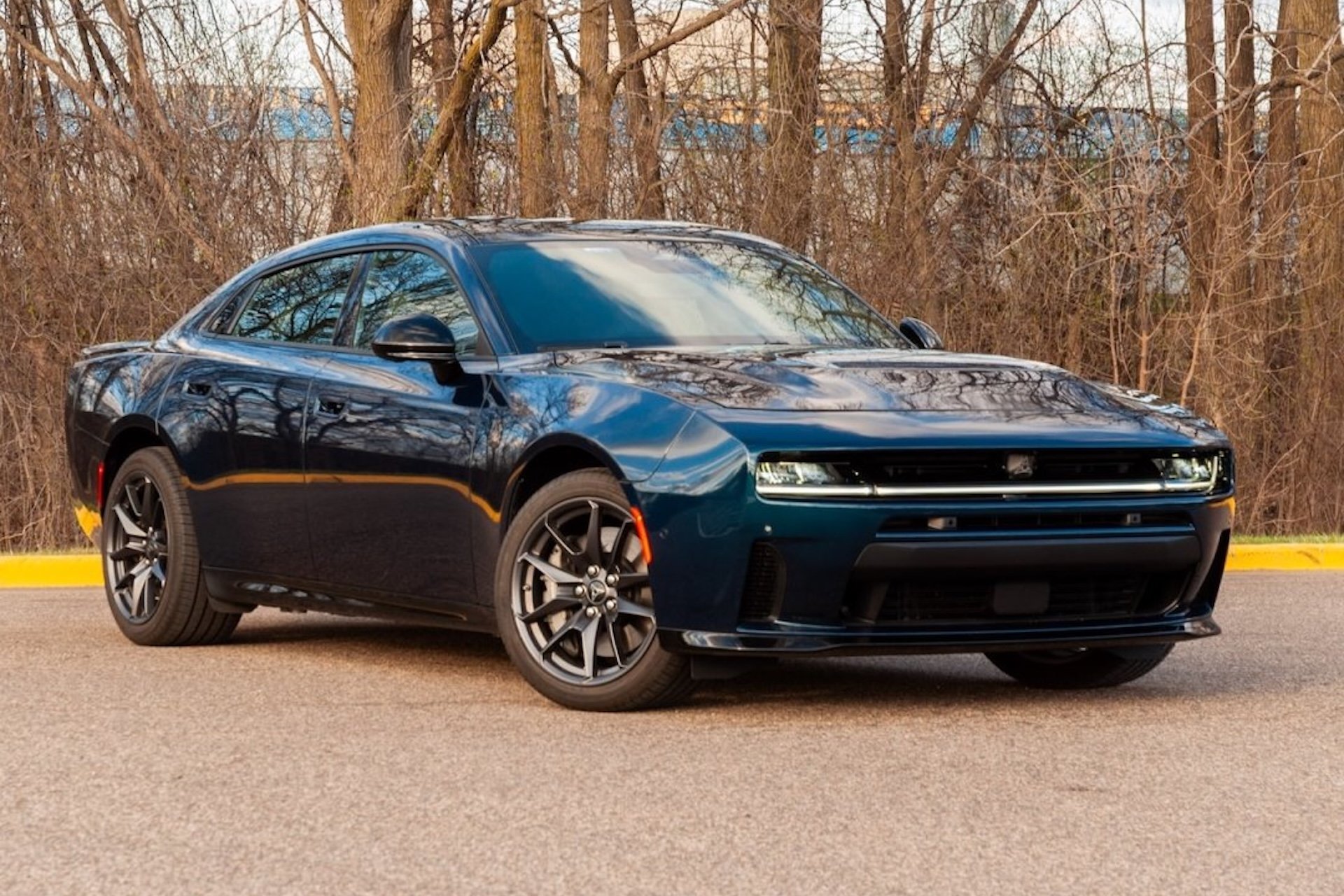
Let’s be upfront: Overall, the new Dodge Charger, in both gas and electric form, looks good. I know this because my 10-year-old told me how cool this thing looks. A mom at my son’s soccer practice walked up and said, “What the heck is this cool car you’re driving?” Her son’s eyes were wide as he stared at the Charger. For context, my son is an absolute car enthusiast, but the mom and her son at soccer practice were not. In an odd plot twist, the four-door Charger actually looks better than the two-door, and it’s the proportions, door lengths, and B-pillar placement working together. The rear three-quarter view of the Charger is the best angle hands down. The side and front three-quarter angles are a bit weird. The front fenders seem a bit off, as if they are too high and not long enough. The older Challenger had the perfect proportions, and those front fenders were long and low.
The new Charger’s sunken LED headlights look straight off a concept car, and I adore the throwback Fratzog three-pointed logo, brought back with LED lighting. It’s a shame the gas-powered Charger ditches the front aero pass-through from the electric model, which is dubbed the R-Wing. The gas-powered Sixpack features a hood bulge so the hood clears the turbo-six engine. The heat extractor also has Sixpack etched into the vent.
Inside the modern Charger is a mixed bag. The eye-catching centerpiece is the neat textured plastic that wraps around from the front door panel across the dashboard. It’s backlit with inset LEDs, which are part of the Attitude Adjustment system, a real line item on the car’s window sticker . It looks slick in photos, but in reality it looks and feels like cheap hard plastic. The plastic covering the backsides of the front high-back seats is even cheaper-looking and feeling. Insult to injury: these are the optional performance seats, and they’re $1,150. The pistol grip shifter is a neat throwback touch against the modern 16.0-inch digital gauge cluster and 12.3-inch touchscreen infotainment system. The latter runs Stellantis’ easy-to-use Uconnect 5.0 system, but I found it unusually glitchy, with CarPlay often failing to load. The interface was laggy, and that’s before we address the car bricking itself while driving three times in a handful of days of testing because of a body control module software issue.
I thought the movement of the digital speedometer appearing to have notchy movement, as if it was mechanically driven, was a software glitch because the tachometer moved smoothly. Still, a Dodge spokesperson confirmed this was designed and programmed intentionally. It’s a choice. Someone also decided it was a good idea to have the digital speedometer needle look like a lightning bolt in this gas-powered car. And to enrage people, the touch-sensitive climate control buttons have haptic feedback that vibrates so you know the “button” was engaged.
This is all before you consider that it is over 17 feet long; you feel like you’re sitting on the floor and can’t comfortably fit three across in the pinched rear end. The packaging is a disaster because it was put on a new platform, STLA Large, shared with the electric Jeep Recon and Wagoneer S, and is now being rebranded as STLA ONE, and has to run on a gas powertrain, an electric powertrain, and an extended-range electric powertrain. The fact that this massive hatchback has 22.7 cubic feet of cargo space behind the second row, and that expands to 38.5 cubic feet with the second row folded, is impressive and useful.
The Charger R/T gets the 3.0-liter turbo-six with 420 horsepower and 468 lb-ft of torque thanks to 22 psi of boost. The Scat Pack tested gets the High-Output model, which ups boost and huffs 30 psi through 54-mm Garrett GT2054 turbochargers, taking power output to 550 hp and 531 lb-ft of torque. An eight-speed automatic is the only transmission option, and all-wheel drive is standard, though a disconnect feature and line lock feature enable burnouts at the push of a button. This is still America, after all.
The high-output six delivers a 0-60 mph sprint of 3.9 seconds, a 12.2-second quarter-mile time, and a top speed of 177 mph. This is probably a good moment to remind everyone that the last-generation V8-powered Scat Pack had only 485 hp, 475 lb-ft of torque, and, in standard non-wide-body form, took 4.5 seconds to reach 60 mph.
The new Scat Pack and its turbo-six, which is truly a gem of an engine, deliver a mixed experience at best. The engine sounds great whether at idle, on cold start when the electronic dumps open, and definitely under full throttle. It’s like an American 2JZ, but with a bit of N54 BMW snort.
Off the line, the turbos spool instantly and the power whallops you. Lag isn’t really a factor here. In fact, the engine revs climb so quickly that engaging the paddle shifters often hits the limiter because the paddles don’t shift fast enough. When left to its own devices, the transmission snaps off shifts quickly and cleanly. Manual shifting becomes a mess and downright frustrating, to the point I quit trying.
The ride is firm, bordering on too firm for a big bruiser. This Dodge Charger reboot in Scat Pack form isn’t a cush highway cruiser, but the adaptive dampers keep it from getting skittish over broken Midwest pavement.
The hard truth is that this thing weighs 4,865 pounds in Scat Pack form, and it feels like it at all times. There’s no escaping the feeling of this mass, and no magic feats of engineering, like with Rivian or various German automakers, will mask this.
In a review about a Dodge Charger, especially a Hemi-powered model, it would be commonplace to mention some sort of eye-watering fuel economy situation. That won’t be happening today. Despite the healthy power output, the Scat Pack with the high-output turbo-six has EPA fuel economy ratings of 16 mpg city, 23 mpg highway, and 19 mpg combined. Certainly no Hellcat- or 392-powered Charger or Challenger came close to that. This Scat Pack averaged 18.4 mpg over 282 miles of mixed suburban driving.
The 2026 Dodge Charger Scat Pack costs $59,685 including a ridiculous $1,995 destination fee. The After Dark blue car I tested had the $4,995 Customer Preferred Package 22B, which added everything from ventilated front seats and heated rear seats to a head-up display and power-operated rear liftgate, along with the $1,150 High Performance Seat Package, $1,295 Blacktop Package, and the 20-inch wheels for $1,195, which took the price to a staggering $68,320. In fact, the original Challenger Hellcat cost about $60,000 while the original Charger Hellcat cost about $6,000 more.
In April, Dodge CEO Matt McAlear told The Drive , “It’s way too early” to deem whether the latest Charger is a sales dud, and “I’m still excited. I’m still bullish on this car.” McLear said the reason is that “I think it offers something that no one else sees coming in the industry, and it wakes up some mundane car segments that there aren’t many of left.” The man’s not wrong.
The four-door 2026 Dodge Charger is playing in no man’s land.
Nothing on the road looks like the new Charger. The high-output turbo-six could very well become a legendary engine if people would give it a chance. Those who swear by “Mopar or no car” might not be willing to give this thing a shot, but they might be prejudiced. The kids think this thing is rad, and inherently, a muscle car is full of compromise. Change is hard.
Stellantis provided The Drive with a 7-day loan of this vehicle for the purpose of writing this review.
The 2026 Dodge Charger Scat Pack looks cool, but the reboot is off to a rough start.
The post 2026 Dodge Charger Scat Pack Sixpack Review: This Reboot Is Off to a Poor Start appeared first on The Drive .