DJI Mic Mini 2S review: Flagship audio power without the flagship price tag
Latest from Tom's Guide · · g2653822
Ashley Thieme is a staff writer on the Reviews team at Tom’s Guide where she tests out the latest tech so you can know what’s going to be worth your time and money. She has a master’s degree in Magazine Journalism and a bachelor’s degree in Journalism, Media and Sociology from Cardiff University. She has bylines in titles including Women’s Health UK, sharing the latest health and wellness news stories, and Virgin Radio UK, providing the latest entertainment news and working on celebrity interviews. She has experience reporting on a variety of topics including music, literature, motorsport, entertainment and health. In previously published work, she has reviewed live music events, books, and wellness products. She values the importance of tech enhancing your life rather than taking over, and as a music fanatic, she is always looking for the best way to listen to new music releases. Discovering the top audio equipment that enhances sound quality and provides optimum comfort is what Ashley does best. In her spare time, Ashley enjoys hitting her reading goals on Goodreads by getting into the latest novels with a cup of tea as well as getting out in the Welsh mountains for a good hike on the weekend.
Price: 4.5/5
Audio quality: 4/5
Design: 4/5
Features & connectivity: 5/5
Battery life: 4.5/5
Overall score: 4.4/5
Best for: Casual content creators
I’m no YouTube sensation, but when I’m doing something exciting with friends and family, I like to make videos to remember the moment. And while I previously used my phone, I’ve discovered that adding a few gear upgrades makes all the difference. Using one of the best microphones for clear audio is one of the best upgrades I’ve made.
The DJI Mic Mini 2S is essential for content creators due to its great audio quality with environmental noise cancellation, making sure nothing gets in the way of your sound. The battery life is also impressive, and the mic is great value for money since you’re getting near flagship features at a fraction of the price.
It’s worth noting that the mic may not be suited to the most professional settings since it struggles with popping plosive sounds. The receiver is also a little bulky. To find out more, keep reading this full DJI Mic Mini 2S review.
Price
$169
Transmitter dimensions
1.13 x 1.10 x 0.53 inches
Transmitter weight
0.42 ounces
Receiver dimensions
1.83 x 1.17 x 0.76 inches
Receiver weight
0.67 ounces
Charging case dimensions
4.19 x 2.33 x 1.67 inches
Charging case weight
5.64 ounces
Microphone type
Omnidirectional
Built-in storage
14.5GB
Connectivity
Bluetooth 6.0
Transmission range
Up to 1,312 feet (400 meters)
Battery
Up to 40 hours
Internal recording
32-bit
The audio quality with the DJI Mic Mini 2S is great, and the environmental noise cancellation makes it easy to use. You don’t need to worry about any unwanted background noise. The battery life is more than enough for day-to-day use, and the price is very attractive compared to other mics in the DJI range, such as the DJI Mic 3, which costs £259.
With 32-bit float audio capture, the DJI Mic Mini 2S can record a huge dynamic range — more than the human ear can hear. So, if there are quieter parts of the recording that are important, it's very easy to boost these in post-production. It also means that screeching sounds, like screams, for example, won't be clipped, and instead can simply be made quieter in post.
This is a feature of the DJI Mic 3, but not the earlier Mic Mini models, so having a flagship feature on a cheaper product like the 2S is nothing to be sniffed at.
The mics have 14.5GB of internal storage, which means they can hold around 22 hours of 32-bit float audio, or 28 hours of 24-bit float audio recording.
The microphone records sound, and especially airy sounds known as fricatives and sibilance, very well. These include sounds such as ‘s’, ‘sh’ and ‘f’. Sounds like this tend to cause whistling in the microphone, which is harsh for listeners, but that wasn’t an issue with this microphone.
As you can hear in the audio recording above, the words are clear without any distortion. However, plosives are a different story, and I’ll discuss that later on.
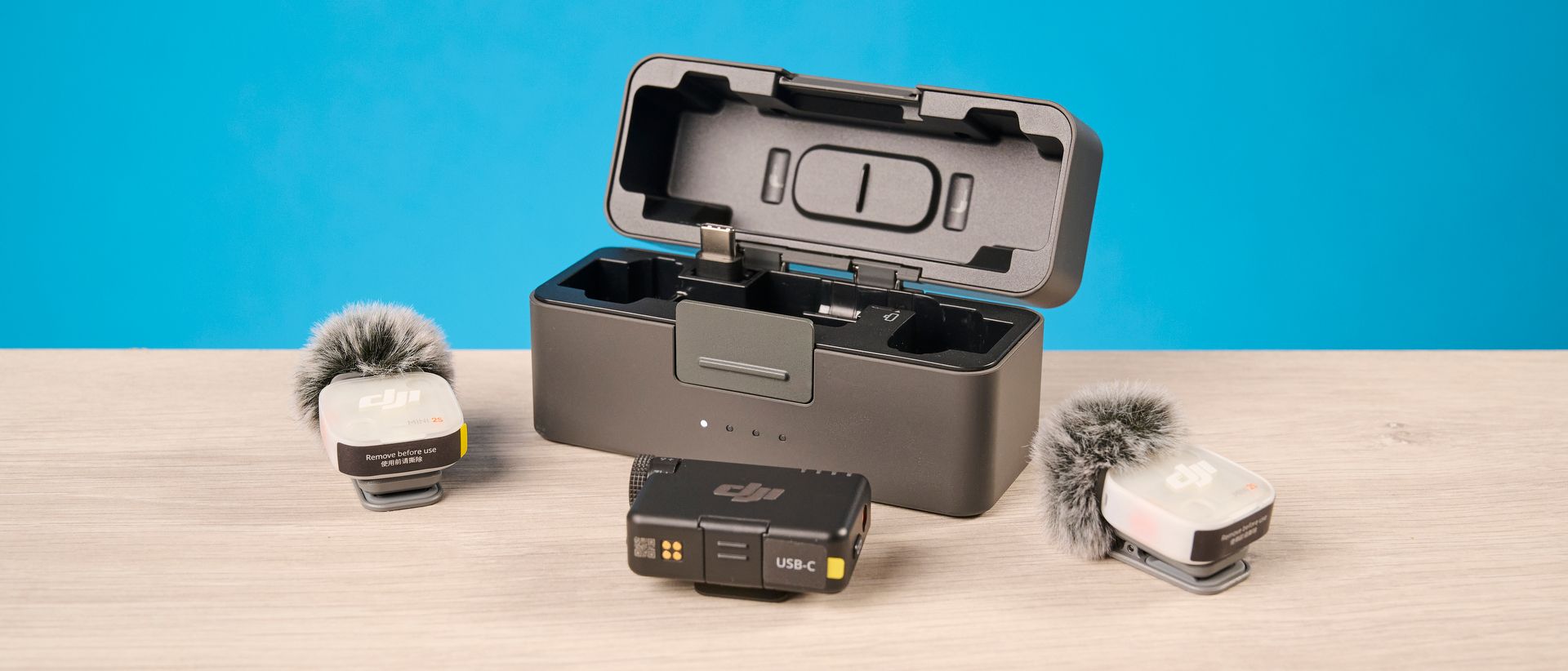
Connectivity with the DJI Mic Mini 2S couldn't be easier. The most straightforward way to use the plug-in USB-C receiver, but if you have a DJI camera you open the door to the DJI OsmoAudio Ecosystem.
When using the mic as part of the ecosystem, you can connect to any DJI devices without needing the receiver. You can also connect to traditional cameras using a 3.5mm cable, USB-C or simply via Blueutooth.
The transmitters and receiver of the DJI Mic Mini 2S have backward compatibility with older models, too. These include the Mic Mini and Mic Mini 2 transmitters, and you can connect up to four. You can mix and match, allowing you to upgrade your older setup with the latest noise-cancelling capabilities and 32-bit float rate by simply buying a Mic Mini 2S transmitter.
When I made the recording you can listen to above, I had my work laptop in front of me. As any remote worker will know, it tends to pop and ping with notifications almost eternally, and it was no different when I was delicately performing my tongue twisters.
I had to stop to re-record the clip a few times because of the notifications, but I finally decided to just keep going, and to my surprise, there wasn’t a single notification sound on the finished recording. The DJI Mic Mini 2S microphones use two-level noise-cancelling technology, which identifies and reduces unwanted background noise. The standard Mic Mini 2 struggles a little here, making the audio sound underwater, so the 2S is certainly an upgrade.
Each DJI Mic Mini 2S transmitter has 11 hours of battery life, which is more than the eight hours of the DJI Mic 3 . The receiver of the Mic Mini 2S holds 10 hours of battery and the charging case gives a total of 40 hours of runtime.
This is more than enough battery for my usage, which is talking to a camera three times a week, and recording voice-overs for my videos. And for amateur creators taking the microphone out on a weekend-long adventure, it has enough power to carry you through most recording stints without reaching for a power pack.
The DJI Mic Mini 2S is available for purchase in the U.K. for £169 from Amazon or the DJI online store. This is the version I tested, with two transmitters, but you can also get a cheaper version with one transmitter for £79 .
Unfortunately, you cannot purchase the Mic Mini 2S in the U.S. just yet due to ongoing regulatory and import restrictions against DJI, but you can still buy the older DJI Mic Mini for $99 at Amazon U.S.
Depending on what you need the mic for, you could opt to get the DJI Mic Mini 2, but this only connects two mics to the receiver, whereas the 2S can connect four.
If you want the flagship DJI Mic 3, you’re going to be paying £259. Going for a cheaper option and getting similar battery life, the same core mic components, and a similar level of environmental noise performance is — to me — a no-brainer.
Although this is one of the best microphones for content creation, it comes with two minor flaws. The letter ‘p’ is picked up very strongly by the microphone, and the receiver is a bit too bulky.
Although the audio is generally very impressive, when it comes to plosives, the microphone seems to struggle. These are notoriously difficult sounds, including the likes of ‘p’, ‘b’, ‘d’ and ‘g’. The most noticeable issue was with the ‘p’ sounds at the start of words, which sounded very harsh. I could hear the air pushing into the microphone.
This makes listening quite tiresome, as the pinching and popping sounds will put people off listening to the audio. This issue isn’t present in the DJI Mic Mini 2. It’s worth noting that these sounds can also be due to microphone etiquette (how close you hold the microphone to your mouth), so your performance will be better or worse depending on how you use the microphone.
This isn’t the end of the world, but the plug-in receiver for the DJI Mic Mini 2S is quite bulky. Depending on what it’s plugged into, it can make your device top-heavy or sit awkwardly on the table. When plugged into my phone, I can’t stand the phone up or lay it flat, which makes it feel a little cumbersome.
For ease of use, the Insta360 Mic Air is a better choice because it’s less bulky. This makes it more comfortable for longer recording sessions.
So, how does the DJI Mic Mini 2S measure up against its competitors? It certainly holds its own, and although it costs more than the budget Insta360 Mic Air (£69), I think it’s worth the extra spend. The DJI Mic Mini 2 (£89) is a lot cheaper than the 2S, but it’s still worth the extra spend if you’re planning to record in noisy environments and want to keep ambient sound out of your audio. The additional AI noise cancellation technology is what steps up this microphone, as it makes editing audio in post-production far easier.
I think the DJI Mic Mini 2S is the perfect option for anyone who wants to up their content game but is new to wireless microphones. Another good option is the Rode Wireless Micro for £139, as these clip-on microphones are also good for filtering ‘pop’ sounds, but for professional video makers, the DJI is still the best choice for quality.
The DJI Mic Mini 2S microphone has great audio quality. The environmental noise cancellation technology silenced all outside noise in my recordings, and it isolated my voice so it was crystal clear. The microphones also have a long battery life, and with the charging case you can get up to 40 hours of use. I think this microphone is great value for money as you get all of the perks of the flagship DJI models at a fraction of the price.
Though I love the microphones, there are obvious popping sounds when pronouncing plosives. The receiver is also bulky, so you’ll need to keep this in mind depending on the device you’re transmitting to.
I recommend the DJI Mic Mini 2S for content creators who need to level up their audio, especially if a lot of their work is done outside with lots of ambient sound.