Apple’s new MacBook Pro just smashed our lab's display brightness records
Latest from Tom's Guide ·
null
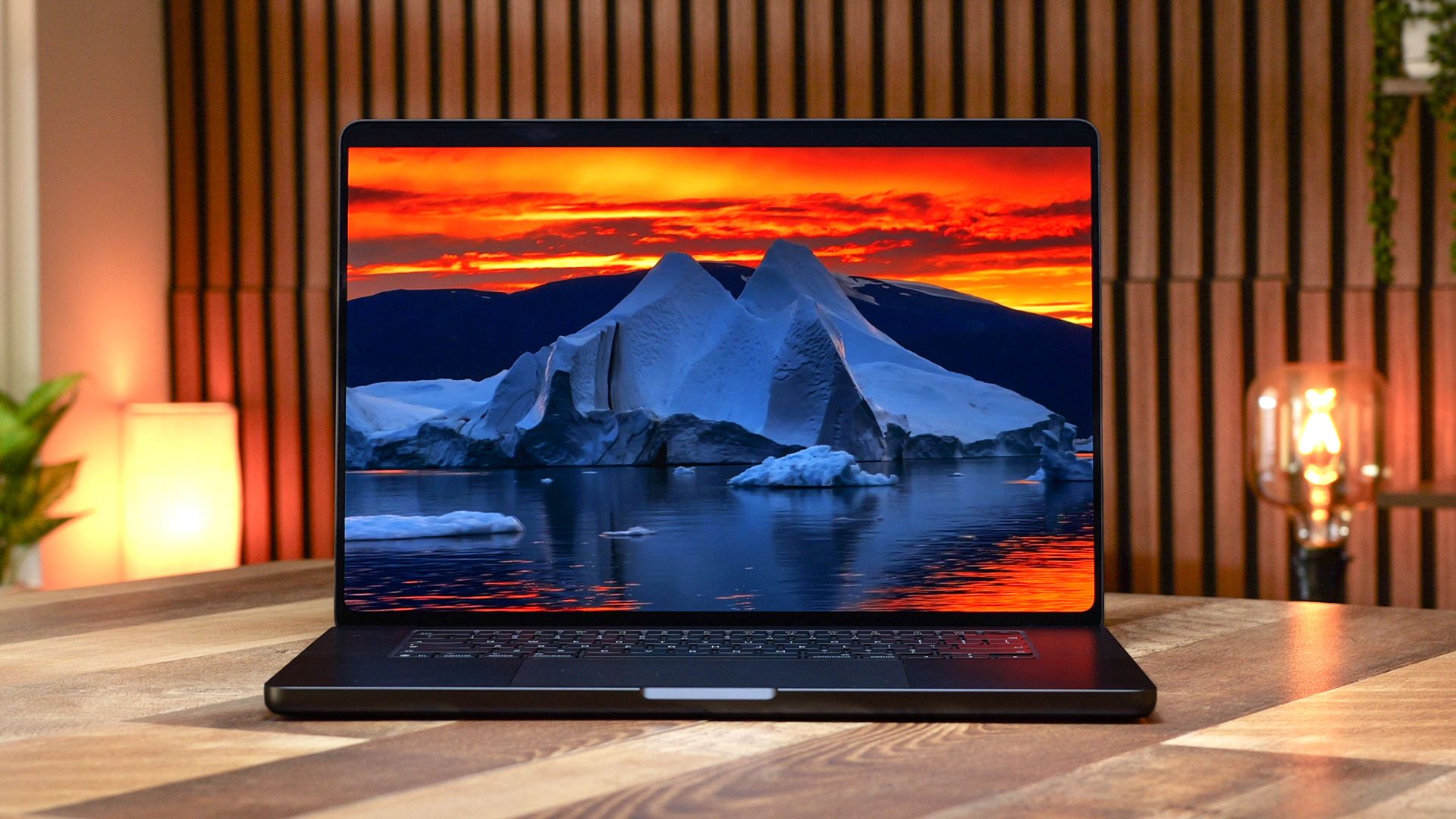
The screen on the new MacBook Pro with PROLED XDR display is downright impressive. We measured close to 2,000 nits of brightness using a 10% HDR pattern. As someone who lab-tests every laptop that comes through Tom's Guide for review, I immediately wondered how Apple's latest display would stack up against the competition.
The numbers don't lie. After digging through our benchmark spreadsheets and comparing the results against 80 laptops tested in our lab this year, I can confidently say that Apple's latest MacBook Pro is the brightest laptop we've tested in 2026.
Everyone conducts display testing differently and uses different equipment, so results can vary by equipment and a publication’s testing standards. This is why it is important to understand how we test.
At Tom’s Guide, we test both a display's SDR and HDR performance. For SDR brightness testing, we display a white image on the screen, set the brightness to 100%, and measure it using our Klein K10-A and DisplayCal software.
For HDR testing, which is where we test a laptop’s maximum brightness, we use the same software and colorimeter, paired with copies of HDR test patterns. With the screen at 100% brightness, these patterns play as a movie in the laptop’s native movie player. We use 10%, 40%, and 100% HDR patterns. These patterns fill the screen with the corresponding percentages on a black background while playing.
And a lab tester’s note. The 10% window is a commonly used benchmark for evaluating peak HDR brightness, particularly in television testing. Smaller windows, such as 2% or 5%, can sometimes produce higher peak brightness readings, while larger windows help illustrate how a display handles brighter content across more of the screen.
In two of those HDR patterns (10% and 40%), the 16-inch MacBook Pro with the PROLED XDR display beat the list of 79 laptops that went through our lab this year. I am talking about both Mini LED and OLED displays. Now that’s impressive!
The 16-inch MacBook Pro with the PROLED XDR display is Apple’s current flagship, so it is our primary comparison point. On that unit, we measured 1,949 nits with a 10% pattern and 1,965 nits with a 40% pattern. This sets a new record for us in the lab.
Coming in second is the new Surface Laptop Ultra with RTX Spark . Equipped with a mini-LED display, it reaches 1,444 nits at 10% and 1,311 nits at 40%. In third place is the LG Gram 16, which is also an OLED laptop. It measured 1,067 nits at 10% and 1,033 nits at 40%.
As you can see, Apple's HDR results are nowhere close to what we measured on the Windows-powered OLED laptop. In fact, the new MacBook Pro is nearly twice as bright as LG's laptop.
MacBook Pro w/ PROLED (16-inch)
Surface Laptop Ultra with RTX Spark
LG Gram 16 (2026)
Nits (Brightness in 10% pattern HDR)
1,949
1,444
1,067
Nits Brightness (In 40% pattern, HDR)
1,965
1,311
1,033
Even more remarkable, Apple is outdoing itself. In our testing, the miniLED display on the Apple MacBook Pro 16-inch M5 Pro reached 1,427 nits on a 10% pattern and 1,444 nits on a 40% pattern. The new PROLED panel takes Apple's performance to an entirely new level.
What's also impressive is how consistently the new MacBook maintains its brightness. At 10%, we measured 1,949 nits, and increasing the illuminated area to 40% pushed that figure to 1,965 nits. That's a difference of just 16 nits. This shows Apple's new display isn't just producing impressive peak brightness in smaller HDR highlights; it's maintaining it across a much larger portion of the screen for a better HDR picture overall.
As someone who occasionally reviews TVs for Tom's Guide , I couldn't resist putting these numbers into another perspective. How does Apple's latest laptop compare with some of the brightest OLED TVs we've tested?
To be clear, this isn't an apples-to-apples comparison (pun intended). We test televisions in one of their most color-accurate picture modes, Filmmaker Mode, which can limit peak brightness. Meanwhile, our laptop brightness testing prioritizes maximum output. Nevertheless, it's an interesting comparison.
Currently, the brightest OLED TV we tested in Filmmaker Mode with a 10% pattern in HDR is the LG G6, which reaches 2,932 nits. Second among OLED TVs is the Samsung 65-inch S95H OLED TV, which reaches 2,721 nits. A budget OLED TV like the Samsung S90H , meanwhile, reaches 1,496 nits.
MacBook Pro w/ PROLED (16-inch)
LG G6 OLED TV (Filmmaker Mode)
Samsung 65-inch S95H OLED TV (Filmmaker Mode)
Samsung S90H OLED TV (Filmmaker Mode)
Nits (Brightness in 10% pattern HDR)
1,949
2,932
2,721
1,496
Of course, other TV technologies are on the market. The Hisense UR9 currently holds the brightness record. Using Mini LED technology, it reached 4,370 nits — the brightest TV we tested to date.
Considering flagship OLED TVs cost nearly as much as a fully specced MacBook Pro, seeing Apple push nearly 2,000 nits on a portable laptop display says a lot about what you’re getting. It’s nearly TV-level quality.
Raw brightness is only half the story because image presentation and human perception matter just as much. Apple claims a 10,000,000:1 contrast ratio on these new OLED panels, and in person, it truly shows.
When lab testing at home, I had the Lenovo Yoga 9n with an OLED panel on the right, my personal mini LED MacBook Pro M3 Max on the left, and the new MacBook Pro with a PROLED XDR display in the middle. A 4K HDR nature video was playing as I peeked at the screens, and it was obvious which was the best.
On one screen showing a parrot, the difference was immediately noticeable. The new MacBook delivered particularly striking detail in the parrot’s individual feathers, and the greens looked more vibrant. Compared with the Mini-LED MacBook Pro and the Lenovo Yoga 9i, the image on Apple's new display looked considerably more lifelike.
As a final note, my colleague watched the “Dune: Part Three" trailer on the 16-inch MacBook Pro with the PROLED XDR display. While standing behind him as he took pictures, I paid close attention to skin tones and color rendition on the MacBook’s screen, as I do when reviewing a TV.
Having personally tested more than two dozen TVs this year, I can say the color reproduction was particularly impressive. In our lab tests, it covered 99.9% of the sRGB color gamut, which is why I came away with the impression of natural-looking skin tones and that exceptionally wide range of colors in the parrot video.
I was impressed by how closely the overall presentation reminded me of some of the best displays I've evaluated. Apple wasn’t playing around this year, and they have set the bar sky-high for the rest of the industry.