Do humans really have a ‘lizard brain’ lurking beneath our rational minds?
The Guardian ·
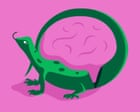
It’s a powerful analogy that captured the popular consciousness, but the biological reality may be quite different Humans have a cognitive quirk for the number three. Think of the many stories that use it, from The Three Little Pigs to Goldilocks and the Three Bears and The Three Musketeers. Public information and political campaigns use it for impact and ease of recall (“Stop, look and listen”; “See it. Say it. Sorted”; “Reduce, reuse, recycle”). And then there are psychological or philosophical frameworks: Freud with his id, ego and superego; Plato’s three parts of the human soul; the Holy Trinity. Well, it turns out neuroscience isn’t immune from tri-mania. In 1959 Paul D MacLean set out a new way of thinking about the evolution and function of the brain, which he christened the “triune” – three-in-one – model. It quickly became one of best known and most enduring concepts in human biology. His idea was that a trio of distinct brains are layered inside our skulls, one on top of the other, all fighting to generate our feelings and thoughts. Continue reading...
It’s a powerful analogy that captured the popular consciousness, but the biological reality may be quite different Humans have a cognitive quirk for the number three. Think of the many stories that use it, from The Three Little Pigs to Goldilocks and the Three Bears and The Three Musketeers. Public information and political campaigns use it for impact and ease of recall (“Stop, look and listen”; “See it. Say it. Sorted”; “Reduce, reuse, recycle”). And then there are psychological or philosophical frameworks: Freud with his id, ego and superego; Plato’s three parts of the human soul; the Holy Trinity. Well, it turns out neuroscience isn’t immune from tri-mania. In 1959 Paul D MacLean set out a new way of thinking about the evolution and function of the brain, which he christened the “triune” – three-in-one – model. It quickly became one of best known and most enduring concepts in human biology. His idea was that a trio of distinct brains are layered inside our skulls, one on top of the other, all fighting to generate our feelings and thoughts. Continue reading...