NASA, Energy Department Advance New Era of Nuclear-Powered Exploration
NASA ·
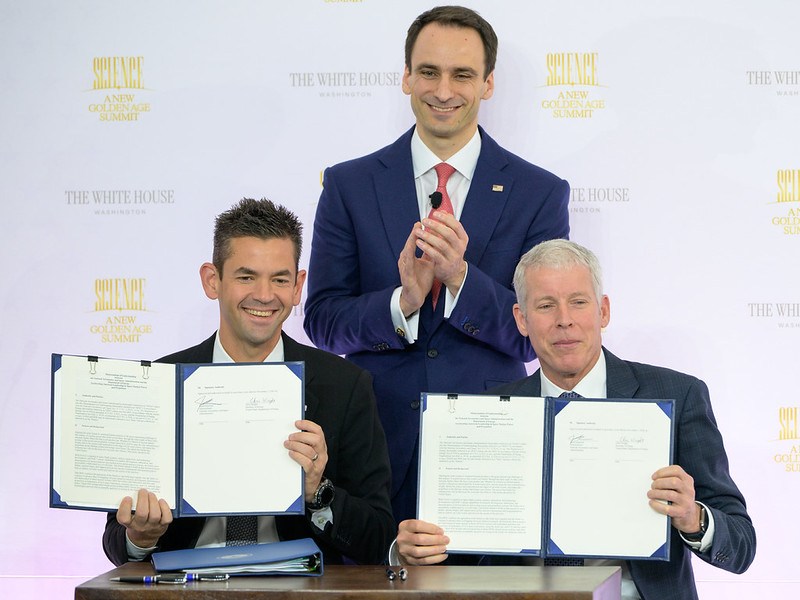
As the Golden Age of deep-space exploration begins, NASA and the U.S. Department of Energy are advancing the development of safe, reliable, next-generation nuclear technologies for space. Together, the agencies will supercharge civil space exploration, unlock bold scientific discovery, and solidify American leadership in space nuclear power and propulsion.  “We are entering the ‘Nuclear NASA-era,’ […]
As the Golden Age of deep-space exploration begins, NASA and the U.S. Department of Energy are advancing the development of safe, reliable, next-generation nuclear technologies for space.
Together, the agencies will supercharge civil space exploration, unlock bold scientific discovery, and solidify American leadership in space nuclear power and propulsion.
“We are entering the ‘Nuclear NASA-era,’ which represents a major transformation for space exploration,” said NASA Administrator Jared Isaacman. “Nuclear power will allow us to go farther, operate longer, and field more capable spacecraft and instruments than ever before. The work we’re doing today is laying the foundation for the fission-powered spacecraft of tomorrow and opening an entirely new frontier for exploration and discovery.”
The new Memorandum of Understanding, “Accelerating American Leadership in Space Nuclear Power and Propulsion,” was signed Thursday between NASA and DOE, and establishes a framework for end-to-end collaboration. The agreement unites both agencies across the full spectrum of space nuclear development, spanning advanced research and fuel production to rigorous testing, launch integration, and operations. Across all these efforts, an uncompromising commitment to safety remains the central pillar.
The signing took place between Isaacman and U.S. Secretary of Energy Chris Wright during the Golden Age Summit, hosted by the Office of Science and Technology Policy at the Donald J. Trump Institute of Peace in Washington, and is effective Sunday, Nov. 1.
“Thanks to President Trump, America’s nuclear renaissance is reaching a new frontier,” said Wright. “The Energy Department is proud to partner with NASA as we help American space missions reach uncharted territory.”
President Trump’s December 2025 Executive Order on Ensuring American Space Superiority directs NASA to develop a launch-ready lunar surface reactor by 2030, a goal toward which NASA, partnering with DOE, is making steady progress. This pivotal agreement fortifies existing collaborations on fission and radioisotope power systems, propelling NASA’s vision for a sustained human presence on the Moon and accelerating the breakthrough technologies to enable our mission.
When NASA’s Space Reactor‑1 Freedom launches in 2028, nuclear propulsion will advance from laboratory research to operational deep‑space application. This milestone paves the way for Lunar Reactor‑1, the fission surface power system that will sustain the future Moon Base through darkness and shadow. Nuclear power will energize habitats, communications, instruments, rovers, resource usage, and critical lunar infrastructure, and it will be essential for the demanding energy needs of future Mars missions.
Together, SR‑1 and LR‑1 form the foundation of a robust domestic nuclear‑space industrial base. These programs are poised to power permanent lunar outposts, enable exploration of distant worlds, and cement American leadership in space for generations. These endeavors will expand humanity’s reach toward Mars, reinforce American preeminence in deep space, and pioneer innovative technologies that yield benefits here on Earth.
In addition to fission power, NASA continues to expand its use of radioisotope power systems. The Dragonfly mission to Saturn’s moon Titan, scheduled for launch in 2028, will rely on a Multi‑Mission Radioisotope Thermoelectric Generator and 24 Light Weight Radioisotope Heater Units to power and warm the car‑sized rotorcraft. Dragonfly will fly to various locations on Saturn’s moon Titan and investigate the moon’s habitability.
NASA and DOE additionally plan to support ESA’s (European Space Agency) Rosalind Franklin Mars rover studying the potential for past and current life on the Red Planet, by providing 24 similar heater units to maintain instrument temperatures in the extreme cold of the Martian environment.
To learn about Nuclear NASA, visit:
https://www.nasa.gov/ignition
-end-
Camille Gallo / Elizabeth Shaw Headquarters, Washington 202-358-1600 camille.m.gallo@nasa.gov / elizabeth.a.shaw@nasa.gov