For students with their sights set on space medicine, a new community takes flight
MIT Division of Student Life ·
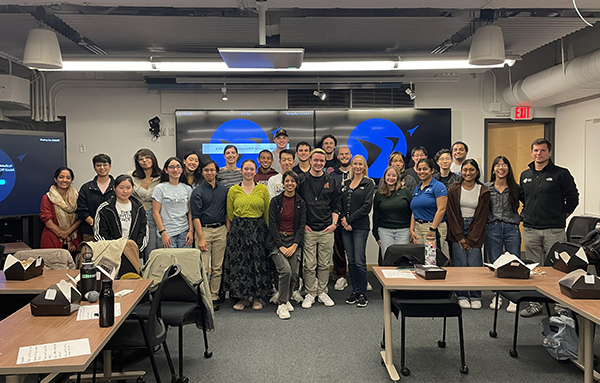
Connecting health and space science enthusiasts Since its launch two years ago, MIT’s Doctors Without Gravity club has already amassed more than 100 student members. The club was co-founded by graduate students Anna Wadhwa and Nicole McGaa, who now serve… The post For students with their sights set on space medicine, a new community takes flight appeared first on MIT Division of Student Life .
Connecting health and space science enthusiasts
Since its launch two years ago, MIT’s Doctors Without Gravity club has already amassed more than 100 student members. The club was co-founded by graduate students Anna Wadhwa and Nicole McGaa, who now serve as president and vice president, respectively.
Bringing together students from MIT and Harvard who are interested in the intersection of medicine, health, and space exploration, Doctors Without Gravity is the student chapter of the Aerospace Medical Association (AsMA) and the Aerospace Medical Student and Resident Organization (AMSRO).The club is open to both undergraduate and graduate students from both institutions.
Students interested in the club do not need to be aero/astro, biology, or pre-med majors, says Wadhwa, noting that the club also has many mechanical engineering students interested in spacecraft mechanics, for example. Wadhwa adds that all majors are welcome to join.
“We want to help increase student awareness and education about aerospace medicine as a potential field that people can study and pursue for a career,” says Wadhwa, who is part of the Aerospace Physiology Lab and pursuing a PhD in aeronautics and astronautics at MIT before returning to Harvard Medical School to complete her medical degree. “We hope to achieve this by connecting the existing communities that are already in place at Harvard, MIT, and Boston by hosting events, lightning talks, and our annual Symposium.”
Building a community around space medicine
To bring community members together, Doctors Without Gravity hosts general social events where members can get to know one another and network in a casual setting. They also hold workshops and fireside chats with faculty, researchers, physicians from Massachusetts General Hospital, and residents in training, so students can ask questions, learn more about their research, and ask for career advice. “It’s a great way to get students plugged into the Boston area network of people interested in space medicine,” says Wadhwa.
The club’s Director of Science Communications, Maryam Hiradfar, a graduate student in the Harvard Biophysics Program, says the club’s interdisciplinary membership is one of its greatest strengths.
“Members are a diverse group of students who can all learn from one another. We have members who are not doing active space research or space life research, including myself, but I think just being able to spark that interest in them and hopefully give people direction to get involved in that kind of research if they’re interested.”
She adds, “Members of the club pursue a wide variety of fields after graduating, including medical consultants, physicians, and research. Some people go into academia and research. There are numerous ways to explore space medicine; it doesn’t have to be just as a flight surgeon at NASA. People interested in the field also work at Mission Control to monitor astronauts’ health not only while in space, but also on a daily basis, while others do contract work for SpaceX or Axiom Space.”
The club also helps students learn about career opportunities as they arise. Wadhwa notes that if SpaceX, NASA, Axiom Space, Blue Origin, or other groups reach out to the club with job or internship possibilities, the information is quickly passed along to its members.
Faculty advisor, MIT Associate Professor and Director, Aerospace Physiology Lab, Lonnie Petersen, MD, PhD, adds, “Doctors Without Gravity brings together curious students from many different fields who share an interest in advancing medical care beyond Earth. As faculty advisor, I am proud to support these students, expand their network, and provide opportunities for them.”
Researching the effects of spaceflight on the human body
Hiradfar is conducting research in the Integrated Positron Emission Tomography and MRI lab at the Martinos Center for Biomedical Imaging. Much of her time is spent scanning patients on a total-body positron emission tomography system. She does everything from scanning to adapting and developing conventional analysis pipelines and algorithms to analyze this new type of whole-body scan.
Wadhwa is conducting research in the Aerospace Physiology Lab with Petersen. Her work specifically focuses on how the brain reacts to spaceflight, because astronauts experience fluid shifts while in space, and it is crucial to understand how those changes affect brain health. She is studying this both on a cellular and a systems level.
Both Wadhwa and Hiradfar say they would like to take flying lessons one day, but their schedules are too busy at the moment.
Helping colleagues with a study, Wadhwa did have the opportunity to take a ride in a centrifuge, accelerating from 1G to 4G − the equivalent of 88 mph.
“The test was designed to simulate the dynamics of flight maneuvers of a jet, in order to study patient physiology. It would go up for five seconds and then back down and then up and down. At the end, you do feel like you just got off a roller coaster, and I had to stay really still for a few minutes after the centrifuge finished,” she says.
Upcoming Events
Doctors Without Gravity is already planning for their 2027 Symposium to be held during Massachusetts Space Week , April 19-25. Additional details will be announced as they become available.
At last year’s annual Symposium, the keynote speaker was MIT professor Dr. Dava Newman, Apollo Program Professor and Director, Human Systems Lab, who brought some samples of flight testing materials for everyone to see and touch. In 2025, the keynote was given by Dr. Erik Antonsen, Director of the Mass General Brigham Space Medicine Fellowship.
For students interested in exploring the possibilities of aerospace medicine, Doctors Without Gravity offers a place to learn, make connections, and discover the many paths into the field. Students may join the group’s mailing list by sending an email to: amsro-exec@mit.edu.
The post For students with their sights set on space medicine, a new community takes flight appeared first on MIT Division of Student Life .