At New York Climate Week 2026, MIT connects with a global network
MIT News · · g5128581
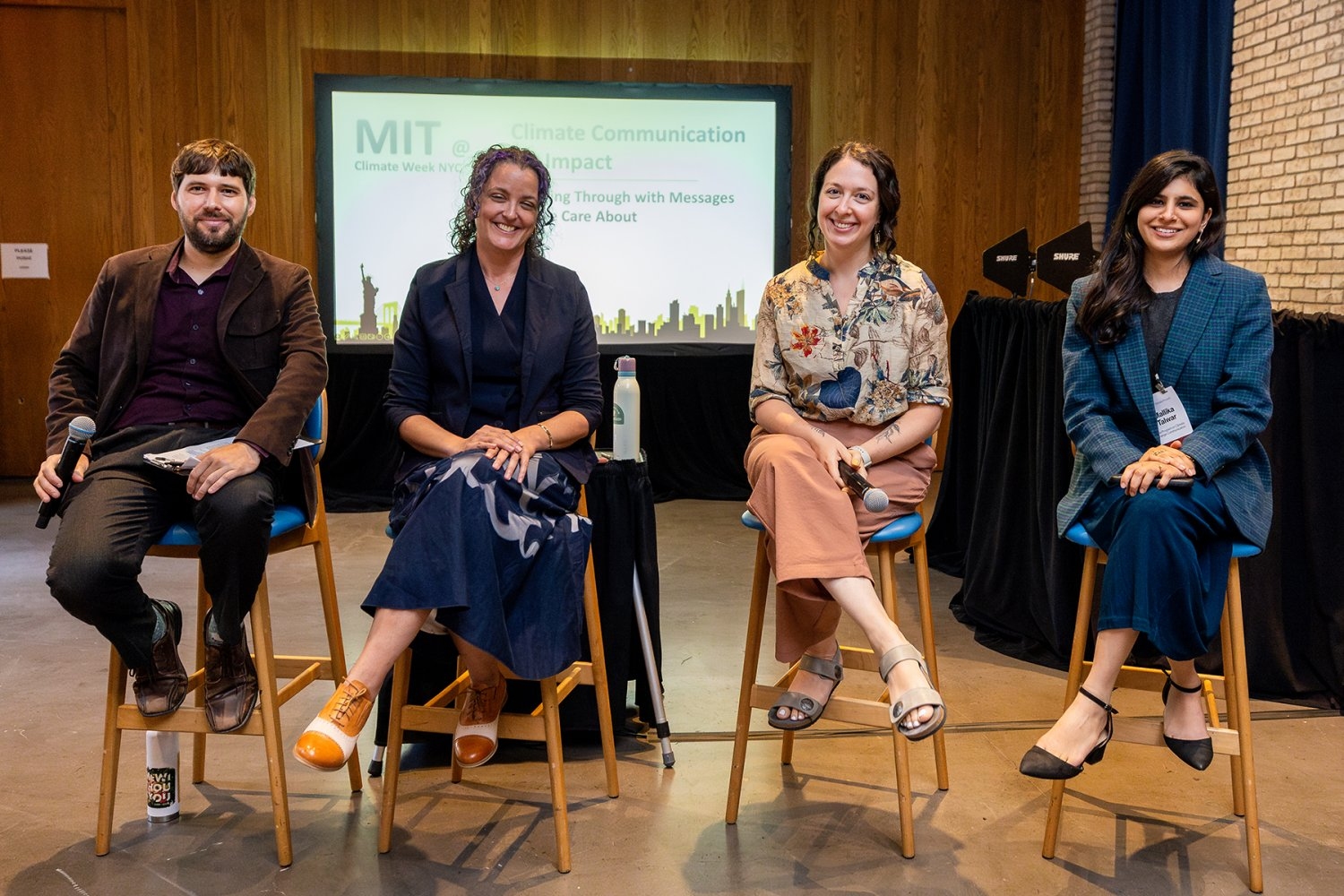
A cross-section of the MIT community convened discussions on topics ranging from data centers and super pollutants to agriculture and education.
Each year, Climate Week NYC brings together more than 100,000 people in more than 1,000 events across the city to discuss climate challenges, explore solutions, and spur action. Participants come from industry, academia, philanthropy, nonprofits, government, and finance and venture capital. And this year, the mix included a strong, cross-campus presence from MIT.
The MIT community could be seen multiple days during Climate Week, with appearances by Evelyn Wang, vice president for energy and climate, at the official opening ceremony discussing artificial intelligence and the climate equation; an event co-hosted by MIT and the Bezos Earth Fund on climate innovation; and 14 sessions organized by the MIT Climate Project and eight MIT departments, labs, centers, and initiatives — including the Abdul Latif Jameel Water and Food Systems Lab (J-WAFS), the MIT Sloan Sustainability Initiative, the Center for Transportation and Logistics (CTL), MIT Lincoln Laboratory, MIT Open Learning, the MIT Initiative for New Manufacturing (INM), the MIT Climate Policy Center, and the Priscilla King Gray (PKG) Center for Social Impact.
“The MIT Climate Project is a whole-of-MIT mobilization, but no single institution can deliver the climate solutions the world needs — from reducing greenhouse gas emissions to adapting to a changing climate and building more-resilient communities and systems,” said Wang, who is also the Ford Professor of Engineering in the Department of Mechanical Engineering. “Climate Week New York is important because it convenes the range of stakeholders and sectors that must work together to confront these challenges. When we connect the MIT community with this global network, we uncover powerful possibilities to strengthen not only our own efforts, but the world’s capacity for change.”
One location, numerous events
Climate Week NYC was held Sept. 21-27 at venues across Manhattan and other New York boroughs. Utilizing multiple spaces at the Dream Downtown Hotel in the Chelsea neighborhood of Manhattan, the MIT coalition attracted more than 700 attendees for events ranging from small, private conversations to workshops and panel presentations.
Larger sessions included “The Future of Data Centers: Technologies to Change the Paradigm.” “Data centers are at an inflection point, facing interconnected technical, operational, economic, and community constraints that demand cross-sector dialogue and innovation,” says Gang Chen, the Carl Richard Soderberg Professor of Power Engineering and faculty director of the Climate Project at MIT.
Chen, who leads the Data Centers of the Future frontier for the Climate Project, convened a panel of experts across research and industry to address technologies that can change the paradigm. “Technology can't solve all the challenges we’re facing with data centers, but technology has a significant role to play in shaping a future role that is more sustainable and better for the communities that are home to these facilities,” Chen says. “This session was a productive conversation on data center challenges and the potential solutions to overcome them.”
The workshop “Next-Generation Super Pollutant Solutions: Challenges and Opportunities,” hosted by Jesse Kroll, a faculty director and lead for the Super Pollutants frontier for the Climate Project, convened speakers from the Environmental Defense Fund, Spark Climate Solutions, and across MIT labs and initiatives.
Accounting for nearly half of all global anthropogenic warming to date, super pollutants currently lack viable solutions for adequate abatement. Many super pollutants have shorter atmospheric lifespans than carbon dioxide, with solutions providing an “emergency brake” to decrease peak warming in our lifetimes. Investments in tackling super pollutants can generate economic benefits, including lowering health-care costs and increasing productivity, and require cross-disciplinary teams to develop and advance the next-generation solutions to meaningfully address super pollutant emissions.
“Super pollutant mitigation is getting a lot of attention as an ‘emergency brake’ for near-term climate warming. But a huge fraction of our super pollutant emissions simply cannot be mitigated with current technologies and approaches,” said Kroll, the Peter de Florez Professor in the Department of Civil and Environmental Engineering. “Our session focused on the innovation — technical and otherwise — needed to tackle these hard-to-abate pollutants.”
Other events included:
Rethinking the climate innovation pipeline with the Bezos Earth Fund
A critical climate challenge is moving from breakthrough technology to real-world impact at scale. MIT and the Bezos Earth Fund brought together leaders from industry, venture capital, government, academia, philanthropy, and startups to explore solutions for a stronger innovation pipeline.
A panel of MIT faculty and alumni spinout leaders Asegun Henry, Seonghoon Woo, Ariel Furst, and Assil Halimi, moderated by Ray Rothrock, venture capitalist and life member of the MIT Corporation, explored the period between a promising scientific invention and commercial deployment. For many breakthroughs that can benefit climate and nature, that journey requires more early-stage science and engineering research, specialized testing infrastructure, validation, patient capital, and pathways to demonstration and pilot projects.
“A breakthrough in the lab is not yet impact in the world. For climate and energy technologies, we need to think about the entire journey — from discovery and invention through validation, commercialization, and deployment — and build better pathways through the gaps along the way,” Wang said in a conversation with Tom Taylor, Bezos Earth Fund president and CEO.
Tapping into global nexus to find and scale solutions
New York Climate Week is a global nexus for climate, where the connections required to develop, test, and scale potential solutions form. Across the board, MIT sessions addressed the need for solutions to be large in magnitude, technically feasible, and contextually realistic.
“Even when a technology is low-cost, it doesn’t mean it will diffuse naturally or get widely adopted,” said Claire Walsh, global director of policy and communications at MIT’s Abdul Latif Jameel Poverty Action Lab. “Frontier technologies are often more expensive to start, so that means it’s even more important for scientists and engineers to think about end user adoption, and their incentives and constraints, from the start.”