MBA Voices: Beyond The Land Acknowledgement: Putting Indigenous Partnership At The Center Of Our Case Competition
Poets&Quants ·
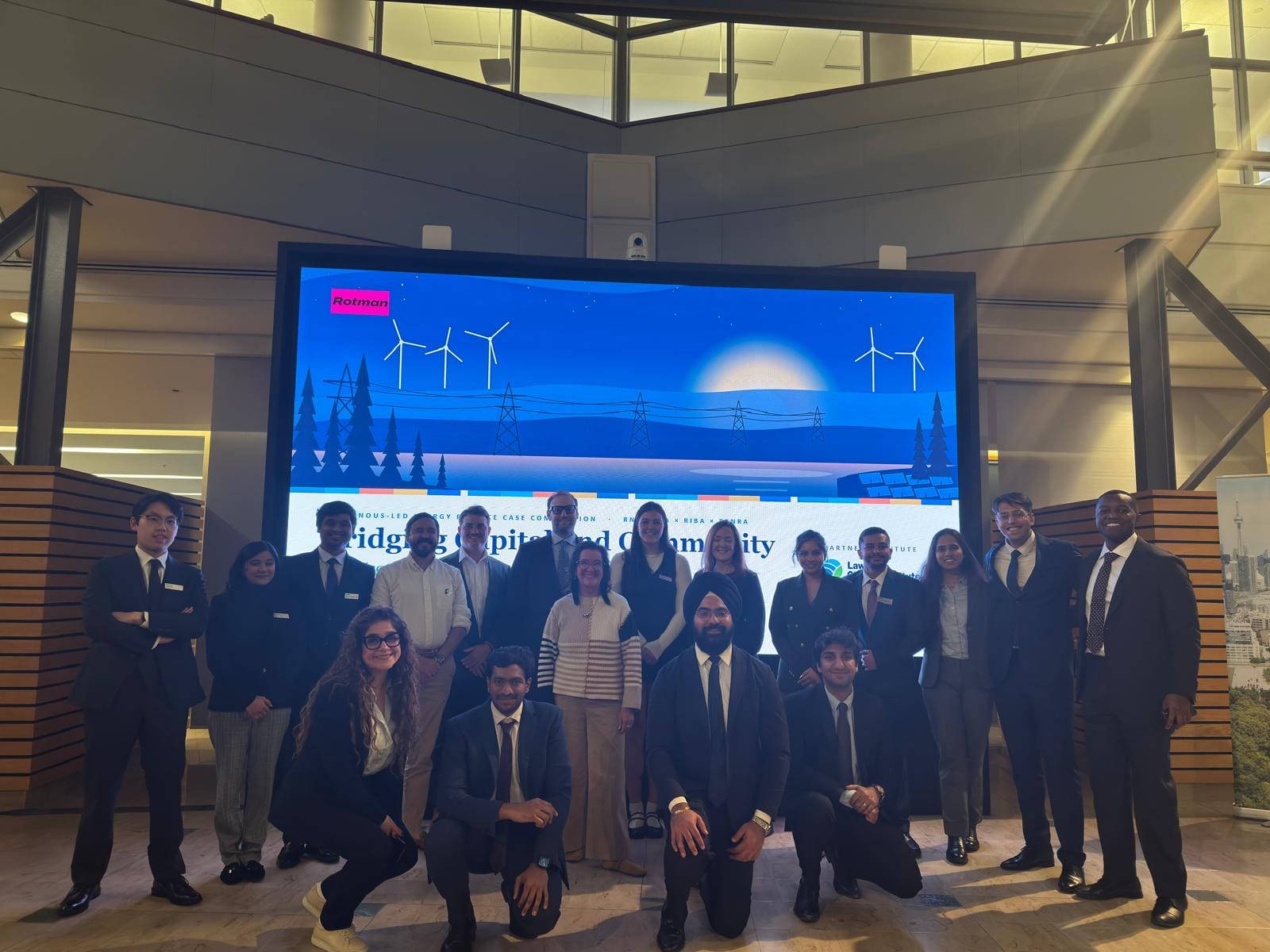
Winning teams and judges at the competition — Bridging Capital and Community: Financing Indigenous-Led Renewable Energy in Canada Events at the Rotman School of Management often start with a ‘land acknowledgement’: a few sentences ... The post MBA Voices: Beyond The Land Acknowledgement: Putting Indigenous Partnership At The Center Of Our Case Competition appeared first on Poets&Quants .
Winning teams and judges at the competition — Bridging Capital and Community: Financing Indigenous-Led Renewable Energy in Canada
Events at the Rotman School of Management often start with a ‘land acknowledgement’: a few sentences to remind students that the university is situated on the traditional land of the Huron-Wendat, the Seneca, and the Mississaugas of the Credit.
As President of Rotman’s sustainability-focused student club, Net Impact (RNI), I felt a little self-conscious reading this aloud at our inaugural event. Land acknowledgements can feel tokenistic and trite in the absence of any further discussion of the often-shameful history of settler Canada’s relationship with Indigenous communities: First Nations, Inuit, and Métis peoples. This year, our club promised students the opportunity to delve deeper on this topic. Here’s what I learned when we put Indigenous-led energy financing at the centre of our annual case competition.
I arrived at Rotman as an aspiring energy sector leader whose career-to-date had been spent in the United Kingdom. As a result, I lacked insight into the fundamental role Indigenous communities play in Canada’s energy transition. I’ve since learned that Indigenous communities have led the development of much of Canada’s clean energy infrastructure. To take just one example, the Six Nations of the Grand River Development Corporation was instrumental in establishing the Oneida Energy Storage project, which doubled Ontario’s electricity storage capacity. Indigenous leadership is driving renewable energy development from coast to coast to coast.
Indigenous equity involvement is table stakes in Ontario’s energy sector – aspiring leaders must engage
During conversations with leaders in Canada’s energy sector, I learned that Indigenous equity ownership is table stakes for major energy infrastructure projects today. This represents a progression from the cursory consultation, which defined much of Canadian infrastructure development on Indigenous lands for decades (and still persists in some contexts). I’m often reminded of Giant Mine in Canada’s Northwest Territories, which poisoned the land of the Yellowknives Dene First Nation for decades. Disruptive, even deadly, energy and extraction projects failed to deliver benefits for Indigenous communities and cast a long shadow into the present day.
Joint ownership was also table stakes for our case competition
Our club’s VP of Partnerships, Wale Adio-Yinusa, suggested we build our flagship annual case competition around the theme of financing an Indigenous-led renewable energy portfolio. I was keen to engage, but felt the weight of this legacy. As a settler Canadian (i.e. not Indigenous), learning about Indigenous history and perspectives can surface uncomfortable emotions: guilt, shame, and fear of saying or doing the wrong thing. Canada’s national project of reconciliation depends on settlers pushing past this, bringing our best intentions and our humility to the table, and learning from the real experts. To that end, we were immensely fortunate to partner with the Rotman Indigenous Business Association (RIBA). Led by JD/MBA students Evie Bell (club founder) and Jade Victor (club VP and a member of the Skowkale and Cheam First Nations), RIBA’s partnership was instrumental in developing and delivering a suitable case.
Our prompt centered on a fictionalized coalition of First Nations communities with the resources and ambition to develop a portfolio of renewable energy projects. Students were tasked with providing advice on structuring finance, developing an engagement strategy to secure community consent for the proposed financing arrangement, and articulating how a deal should structure risks and rewards to ensure lasting community benefit. Jade collaborated with Wale to co-create this prompt, which avoided the ‘deficit discourse’ (narratives that paint First Nations communities as lacking in resources and in need of assistance). Jade also hosted an informative webinar, which introduced students to concepts, including epistemological safety, that guided them to pursue in-depth research on cultural practices and governance structures to inform their proposals.
We also benefited from the partnership of the Rotman Finance Association (RFA) and Rotman Energy and Natural Resources Association (RENRA). RFA executives Augusto San Miguel and Navika Nayar proved invaluable. They developed a financial template, which gave teams a structured foundation on which to build their project portfolios, and hosted a webinar to introduce key concepts (e.g., debt service coverage ratios, renewable energy load factors). Augusto’s support for the case competition was prompted in part by his experience as an Investment Banking Summer Associate at RBC Capital Markets, where he saw firsthand how important Indigenous-led energy projects are in Canadian infrastructure finance.
An inspiring sponsor set an example for teams
We were fortunate to secure the sponsorship of Fortis Inc., which provided a generous prize pot and enabled a well-attended final round event. I reached out to this major Canadian electricity infrastructure developer because they have a reputation for respectful collaboration with First Nations communities. The firm was selected by a coalition of 24 First Nations as the partner of choice to develop the Wataynikaneyap Power project, a 1,900+ kilometre transmission and distribution project connecting 22 substations in northwestern Ontario. Wataynikaneyap Power formed the basis of our briefing to teams, showcasing what thoughtful partnerships can achieve. We were also fortunate to receive sponsorship from the Lawson Climate Institute at the University of Toronto.
A stellar cast of judges
I was absolutely blown away by the expert panel of judges who loaned us their time. We hosted:
Each judge brought a unique perspective, drawing on their academic, professional, and personal experiences to prompt students to grapple with the nuances of the case. I’m sure that their patience, encouragement, and insights helped inspired students to delve even deeper on the topics – I know I was.
A look at the night itself
The true highlight for me was watching the finals. Fortis VP Tanya Finlay, who had flown all the way from Newfoundland to attend the event, shared insights on Fortis’s approach to partnering on the Wataynikaneyap Power project. Colin Lamont of the Lawson Climate Institute showcased efforts to advance climate solutions in Ontario’s north…then teams took to the stage! The most painful part of the case competition had been whittling down fourteen excellent submissions to select four finalist teams. RIBA, RFA, and RNI had jointly reviewed the presentations, grading our respective portions. It was not an easy task.
In the era of AI, it was refreshing to see how much original, critical thought had gone into students’ presentations. The diversity of financial models, mix of portfolio technologies, and thoughtful proposals for community engagement demonstrated that teams had seized the opportunity to learn. Let highlight just three examples:
* The best submissions anchored the fictional case in real communities, applying research on their unique cultural, legal, and historical context. Our second-place team, Well Covenanted, put the portfolio in Treaty 3 territory and followed the Nations’ existing consent law, Manito Aki Inakonigaawin. It also paused sessions during the manoomin (wild rice) harvest, offered sessions in Anishinaabemowin, and gave hydro a separate consent decision because of the contentious legacy of early hydro projects in the territory, which involved the forced displacement of First Nations communities.
* Northshore Capital used an inventive “partnership flip” financing model, wherein the Nations own 60% at close, the partner takes 80% of cash until it earns a 10% return, then drops to 5%, and the Nations buy that last 5% at a price fixed at signing.
* Both teams built in flexibility for each Nation’s decision-making, with lender deadlines moving to fit consent decisions. Well Covenanted costed engagement before close at about $2M, covering liaisons, independent advisers, and contingency. Northshore used four consent gates, adapted outreach to each Nation and agreed an independent advisory budget at the first gate. Both paid Elders for their time and created Nation-owned entities to continue engagement and training after close.
Ultimately, ‘Northshore Capital’ emerged victorious, earning its members Arbaz Sultan, Vinaya Joshi, Amogh Deshpande, and Palak Saini a well-deserved $3,000 first prize.
Isabel Duchesne
Moving toward a reconciliation-ready curriculum
In the days after our finals, I reached out to our winning teams to seek their reflections on the case competition and pass their words of thanks onto our sponsors. A common theme among several of our winners was their appreciation, as newcomers to Canada, for the opportunity to learn more about working with Indigenous communities.
As business analyst Vinaya Joshi put it, “Participating in this case competition has been one of the most memorable and rewarding experiences of my MBA journey so far. … It was fascinating to understand how different First Nations balance their individual priorities, cultural values, and long-term goals while working together on a shared project. This was something I knew relatively little about before the competition, and I genuinely appreciated the opportunity to learn more.”
Mwangi Thuita, whose resume includes roles at the Permanent Mission of Kenya to the United Nations and major US foundations, learned from real-world precedent. “Researching Treaty 3 governance and precedents like the Wataynikaneyap Power partnership showed me how Indigenous equity ownership can turn a community from a stakeholder into a partner, and how much careful engagement shapes whether a project succeeds.”
Arbaz Sultan, an international student whose background is in consulting, shared this reflection: “I especially valued learning about Indigenous communities, their relationships with government, and how their values and decision-making processes shape project strategy.”
Finally, Gayatri Konduri, a management consultant, gained insight into how social and historical considerations influence business relationships today. “Researching Indigenous communities and Canada’s history introduced me to concepts such as Eurocentrism, tokenism, and pan-Indigenism. I realized how easily businesses can unintentionally prioritize Western approaches to decision-making, mistake symbolic consultation for genuine engagement, or assume that all Indigenous communities share the same priorities. Understanding the historical context of residential schools, the Sixties Scoop, and discriminatory legislation also helped me appreciate why trust cannot simply be assumed in business relationships.”
I hope that, in the future, Indigenous perspectives can be further incorporated into Rotman’s core curriculum, so that all students can prepare themselves to be true partners in Canada’s reconciliation efforts. For the time being, I’m grateful that this collaborative effort brought about one such learning opportunity.
Isabel Duchesne is a second-year MBA candidate at the University of Toronto’s Rotman School of Management . She currently serves as the President of Rotman Net Impact and is undertaking a research project on impact investing as an Institute for Gender and the Economy Student Fellow. In her first year, she held the RBC x Rotman Sustainable Finance Student Fellowship. Prior to Rotman, she spent a decade in the UK, where she managed climate and energy policy teams in the British Government. Before that, she worked in international development at a reproductive healthcare NGO. She holds degrees from Cambridge and the University of Toronto. Reach out to her on LinkedIn here .
DON’T MISS: MBA VOICES: LESSONS ON HOSTING A PANEL ON AN UNFAMILIAR TOPIC
The post MBA Voices: Beyond The Land Acknowledgement: Putting Indigenous Partnership At The Center Of Our Case Competition appeared first on Poets&Quants .