Vega Island Frozen in Fright
NASA Science ·
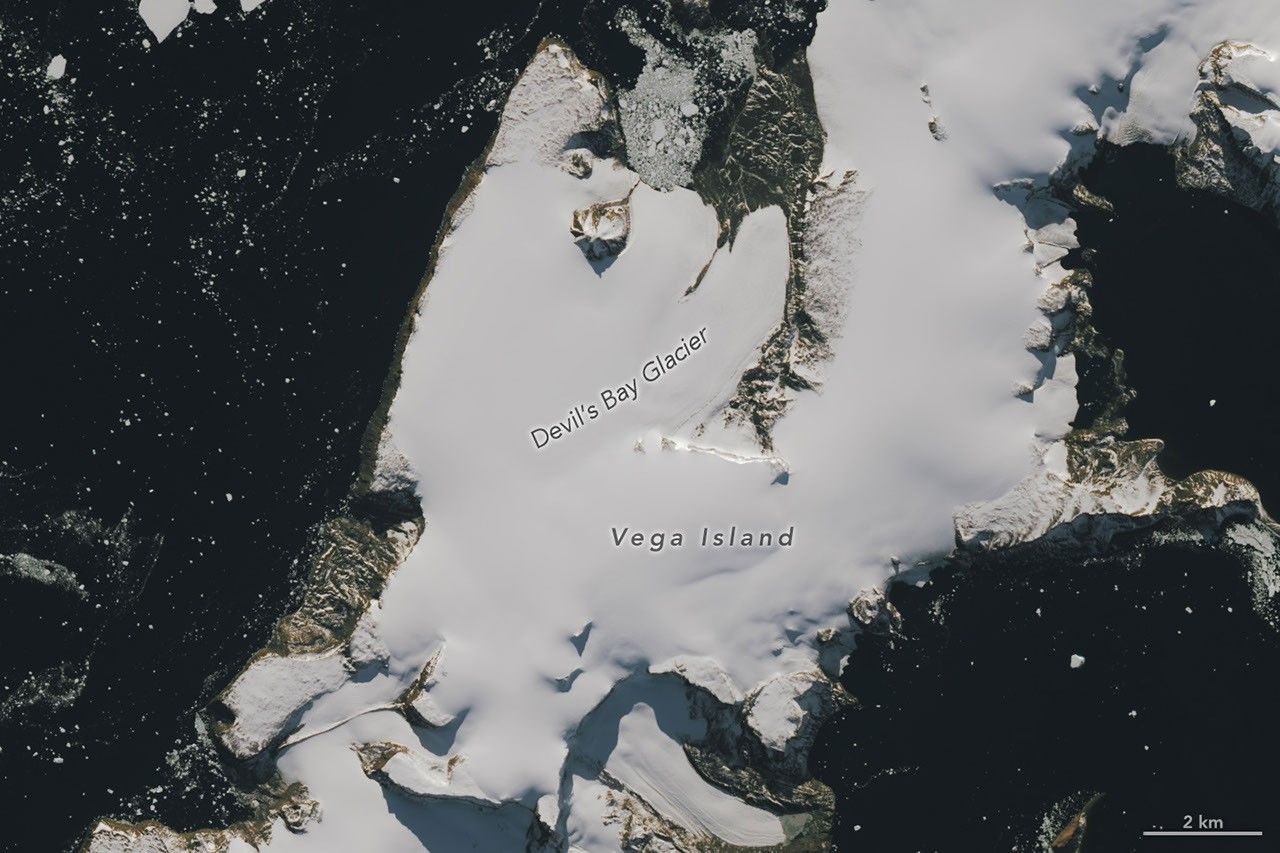
The sight of an icy skull-like visage on the Antarctic island could make one’s blood run cold. The post Vega Island Frozen in Fright appeared first on NASA Science .
Science Earth Observatory Vega Island Frozen in Fright Earth Earth Observatory Image of the Day EO Explorer Topics All Topics Atmosphere Land Heat & Radiation Life on Earth Human Dimensions Natural Events Oceans Remote Sensing Technology Snow & Ice Water More Content Collections Global Maps World of Change Articles Earth Matters Blog Blue Marble: Next Generation EO Kids Mission: Biomes About About Us Subscribe 🛜 RSS Contact Us Search March 22, 2025 October 10, 2026 Part of an ice-covered Antarctic island has the appearance of a grinning skull in profile, with a rock outcrop as an eye socket and lateral moraine as a mouth. NASA Earth Observatory / Lauren Dauphin Part of an ice-covered Antarctic island has the appearance of a grinning skull in profile. Some of the face has a gray appearance where seasonal snow is gone and bare ice is exposed. NASA Earth Observatory / Lauren Dauphin March 22, 2025 October 10, 2026 Part of an ice-covered Antarctic island has the appearance of a grinning skull in profile, with a rock outcrop as an eye socket and lateral moraine as a mouth. NASA Earth Observatory / Lauren Dauphin Part of an ice-covered Antarctic island has the appearance of a grinning skull in profile. Some of the face has a gray appearance where seasonal snow is gone and bare ice is exposed. NASA Earth Observatory / Lauren Dauphin March 22, 2025 October 10, 2026 Curtain Toggle 2-Up Shrouded in ice in the lonely Weddell Sea, Vega Island is an eerie sight to behold. On this speck of land east of the Antarctic Peninsula, ice, rock outcrops, and glacial moraines combine to create the appearance of a smirking skull in profile looking toward Devil Island.
These images show Vega Island’s creepy countenance at the start of austral autumn (left) and in spring (right). They were acquired with the OLI (Operational Land Imager) on Landsat 9 on March 22, 2025, and October 10, 2026, respectively. (Clouds obscured the island in March 2026.) A nunatak jutting out of the ice has the appearance of an eye socket, a lateral moraine forms a mouth, and Bahía del Diablo (Devil’s Bay) Glacier constitutes a jawbone. In the March 2025 image, a layer of snow coats the ice, which is typical of the region’s wettest month. That contrasts with the October 2026 image, when snow is absent from large areas and darker ice surfaces are visible.
Above-average temperatures in winter 2026 —particularly in June —were partly responsible for so much bare ice in October , said glaciologist Mauri Pelto of Nichols College. The ice exposed on Vega and nearby islands indicates limited new snow accumulation over the winter, further reduced by sublimation and wind scouring, he said. “The winter season was no treat for these glaciers.”
The melt season ahead may also be more trick than treat. Bare ice is darker than snow and absorbs more solar energy, meaning that melting is poised to speed up as the days grow longer and warmer. “Even a thin cover of new snow from a spring storm would be helpful in the short run,” Pelto said. “When entombed in snow and ice, the skull is preserved. But when exposed to melt, it weathers away, which will lead to a changing jawline and expanding eye socket.”
The first comprehensive mapping of Vega Island’s ice was aided by Landsat imagery. In a study published in 1982 , scientists described the island’s four ice caps with protruding rocky cliffs and outlet glaciers. They leveraged early Landsat observations along with aerial photos and topographic maps to catalog 29 glaciers on Vega.
Of those glaciers, Devil’s Bay Glacier has been closely monitored since the austral summer of 1998-1999, with researchers measuring an overall decline in its mass. Satellite images acquired in recent decades show ice loss from other glaciers on the island as well, with increased areas of exposed bedrock.
Long before scientists began tracking its glaciers, Vega was a bright spot in a tale of terror born out of early exploration of the area. The Swedish Antarctic Expedition of 1901-1903 set out to study the geography, geology, climate, and wildlife on and around the eastern Antarctic Peninsula. The party became split into three groups during their explorations, isolated for a winter in different locations. Adding to the horror, they lost their ship to the pack ice. Cape Well-met, as it would come to be known, off the “forehead” of the Vega Island skull, was the site of a happy reunion of two of the groups in spring 1903. Soon thereafter, an Argentinean expedition rescued the survivors of the ordeal.
NASA Earth Observatory images by Lauren Dauphin, using Landsat data from the U.S. Geological Survey . Story by Lindsey Doermann.
JPEG (303.91 KB)
October 10, 2026
JPEG (383.70 KB)
References & Resources From a Glaciers Perspective (2026, October 24) Snow Free Glacier Surfaces on Antarctic Peninsula October 2026 . Accessed October 28, 2026. From a Glaciers Perspective (2012, January 22) Northwest Vega Island, Antarctica Glacier Retreat . Accessed October 28, 2026. Rabassa, J., et al. (1982) Glacier Inventory of James Ross and Vega Islands, Antarctic Peninsula . Annals of Glaciology , 3, 260–264. Skvarca, P., et al. (2004) Mass balance of ‘Glaciar Bahía del Diablo’, Vega Island, Antarctic Peninsula . Annals of Glaciology , 39, 209–213. South-Pole, Otto Nordenskjöld . Accessed October 28, 2026. Swoop Antarctica (2024, October 8) The greatest Antarctic survival story you’ve never heard of . Accessed October 28, 2026. World Glacier Monitoring Service (2025) Glaciar Bahía del Diablo . Accessed October 28, 2026. You may also be interested in: Stay up-to-date with the latest content from NASA as we explore the universe and discover more about our home planet.
In summer 2026, a substantial iceberg calved from Petermann Glacier in northwest Greenland and swiftly drifted into Nares Strait, colliding…
Article A Bare Summer for Barnes Ice Cap 4 min read The expanse of glacial ice on Canada’s Baffin Island lost its snow cover quickly and early in summer 2026, revealing…
Article Pasterze Hangs on as Austria’s Largest Glacier 4 min read One narrowing icefall remains the linchpin for the Alpine glacier—and it may not be long for this world.
Article 1 2 3 4 Next Keep Exploring Discover More from NASA Earth Science Subscribe to Earth Observatory Newsletters Subscribe to the Earth Observatory and get the Earth in your inbox.
NASA's Earth Observatory brings you the Earth, every day, with in-depth stories and stunning imagery.
Explore Earth Science
Open access to NASA’s archive of Earth science data
The post Vega Island Frozen in Fright appeared first on NASA Science .