Voyager 1 makes the jump to light speed, sort of
Nextgov/FCW - All Content ·
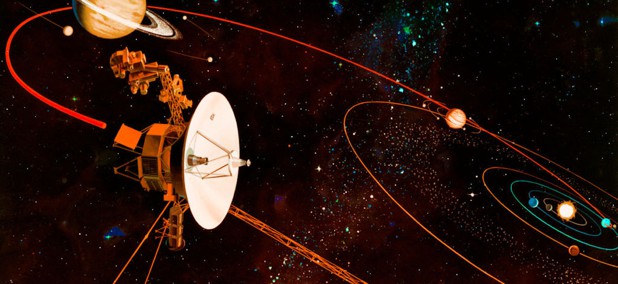
NASA’s farthest spacecraft has become the first human-made object to reach a distance of one light-day from Earth, creating a 48-hour communications loop for engineers still operating the onboard technology from 1977.
Science fiction has spoiled us when it comes to space travel. On Star Trek, the Enterprise jumps to warp speed and crosses distances measured in light-years before the next commercial break. NASA has finally reached a somewhat more modest milestone, but one that is still pretty remarkable.
For the first time, the distance between Earth and one of humanity’s spacecraft can be measured by how far light travels in an entire day. Voyager 1 crossed the one-light-day mark on Nov. 18, putting it more than 16 billion miles from Earth. Light and radio signals travel about 186,000 miles per second, but even at that speed a command from NASA now needs roughly 24 hours just to reach the spacecraft.
One light-day isn’t quite warp speed, but it’s a start.
The milestone also creates one of the strangest legacy technology problems imaginable. NASA is still operating hardware launched in 1977, so even asking Voyager whether a command or repair worked can now require about two days for the question and answer to make the round trip.
To put Voyager’s age in perspective, when it launched in 1977, CB radios were still a booming hobby with about 15.5 million installed in cars and homes across the country according to the FCC . The impressive Apple II personal computer had just arrived with an astonishing 4 KB of memory. And a little-known sci-fi franchise called Star Wars launched the same year to great acclaim, and was still causing long lines to form outside many local theaters.
Nearly half a century later, most of the technology from that era has long since become museum material, while Voyager 1 is still working more than 16 billion miles from home. And it has accomplished quite a bit along the way.
Voyager 1 launched on Sept. 5, 1977 as part of a twin-spacecraft mission that transformed scientists’ understanding of the outer solar system. Voyager 1 explored Jupiter and Saturn before heading outward, eventually becoming the first spacecraft to enter interstellar space in 2012. Voyager 2 followed in 2018 after taking a different path that also carried it past Uranus and Neptune. Both probes continue to return scientific observations from beyond the heliosphere, the protective bubble of particles and magnetic fields created by the sun.
Keeping Voyager operating for this long has required increasingly creative engineering. In 2024, NextGov/FCW Managing Editor Edward Graham reported on one particularly impressive example. Voyager 1 had stopped transmitting readable data after a malfunctioning chip corrupted portions of the code in its flight data subsystem. NASA engineers could not repair the chip from more than 15 billion miles away, so they devised a way to relocate the affected code into functioning sections of the spacecraft’s memory. At the time, engineers had to wait about 22.5 hours for their command to reach Voyager and another 22.5 hours to learn whether their fix worked.
It did, and Voyager has kept moving ahead ever since then, although the challenges also continue to grow.
One of the biggest problems now is simply keeping the lights on. Voyager gets its electricity from radioisotope thermoelectric generators that convert heat from decaying plutonium into power. NASA says the probes lose about 4 watts of available power every year, forcing engineers to continually look for ways to reduce consumption without freezing or disabling equipment that is still collecting useful science data.
In September, engineers completed an unusual power-saving operation on Voyager 1 that they nicknamed the “Big Bang.” The team simultaneously switched off three devices and substituted lower-power alternatives, reducing energy use while still distributing enough heat to keep the spacecraft functioning. Without that maneuver, NASA says another Voyager 1 science instrument might have needed to be shut down as early as summer 2027.
Age is creating other surprises, too. NASA briefly lost Voyager 1’s radio signal during two scheduled communications attempts in October. Engineers later determined that one set of thrusters had gone offline and backup thrusters had automatically activated as part of the spacecraft’s built-in fault protection system. The signal eventually returned before engineers could even send troubleshooting commands across the enormous distance.
Kareem Badaruddin, Voyager mission manager at NASA’s Jet Propulsion Laboratory, said the episode illustrated what engineers now face while operating such an old spacecraft. He said the team has reached a point where “we have to expect the unexpected.” Even when everything works perfectly, however, the light-day milestone imposes a limit that no amount of engineering can overcome: the speed of light itself.
Suzanne Dodd, Voyager project manager at JPL, described what that means for the engineers still talking with the spacecraft. She said, “you send your message and then you go home and you wait two days before you finally get a response.”
NASA is also having a little fun with that enormous communications gap. To celebrate Voyager reaching the one-light-day mark, the agency invited people around the world to point lights toward the night sky and flash V-G-R , Voyager’s call sign, in Morse code. NASA even created an animated webpage that turns a phone or tablet into an automatic V-G-R flasher, letting anyone aim a screen skyward and symbolically say hello to humanity’s most distant spacecraft.
Voyager itself will not notice anything special about crossing the one-light-day line. There is no boundary waiting there and nothing aboard the spacecraft suddenly changes. The milestone matters because it gives us a new way to comprehend just how far one of our machines has traveled.
It is also another reminder of how quickly the measuring sticks for space exploration keep changing. Last month, I wrote about NASA’s Perseverance rover breaking the off-world driving record on Mars, with increasingly capable autonomous navigation helping it travel farther across another world than any vehicle before it.
That record came during a year when Artemis II carried humans around the Moon for the first time in more than half a century. Meanwhile, NASA’s twin ESCAPADE spacecraft recently used powered Earth flybys to slingshot themselves toward Mars, where they are scheduled to arrive in September 2027.
Voyager 1 is heading somewhere much farther away. It will continue drifting outward long after its remaining instruments eventually fall silent, still carrying the Golden Record containing sounds and images from Earth that was attached to the spacecraft before it left home nearly 50 years ago.
We may not have warp drive yet. But humanity has always been pretty good at looking toward something impossibly distant, figuring out how to get a little closer and then moving the measuring stick again.
John Breeden II is an award-winning journalist and reviewer with over 20 years of experience covering technology. He is the CEO of the Tech Writers Bureau , a group that creates technological thought leadership content for organizations of all sizes. Twitter: @LabGuys