In Scotland, NASA Scientists Search for Clues About Mars’ Past
NASA Science ·
NASA's Goddard Instrument Field Team hauled equipment up and down the cliffs of Scotland's Clachtoll region in a quest to better understand Earth – and Mars. The post In Scotland, NASA Scientists Search for Clues About Mars’ Past appeared first on NASA Science .
This summer, NASA scientists headed to the Scottish Highlands to follow up on last year’s announcement of potential biosignatures on Mars and prepare for future research. The rocks and cliffs of Scotland’s Stoer formation offer a combination difficult to find on Earth: Not only did they form in environments comparable to ancient Martian lakes and rivers, but they also hold evidence of microbial life from 1.2 billion years ago, before land plants existed. This overlap is ideal for scientists working to interpret NASA’s rover data from the Red Planet.
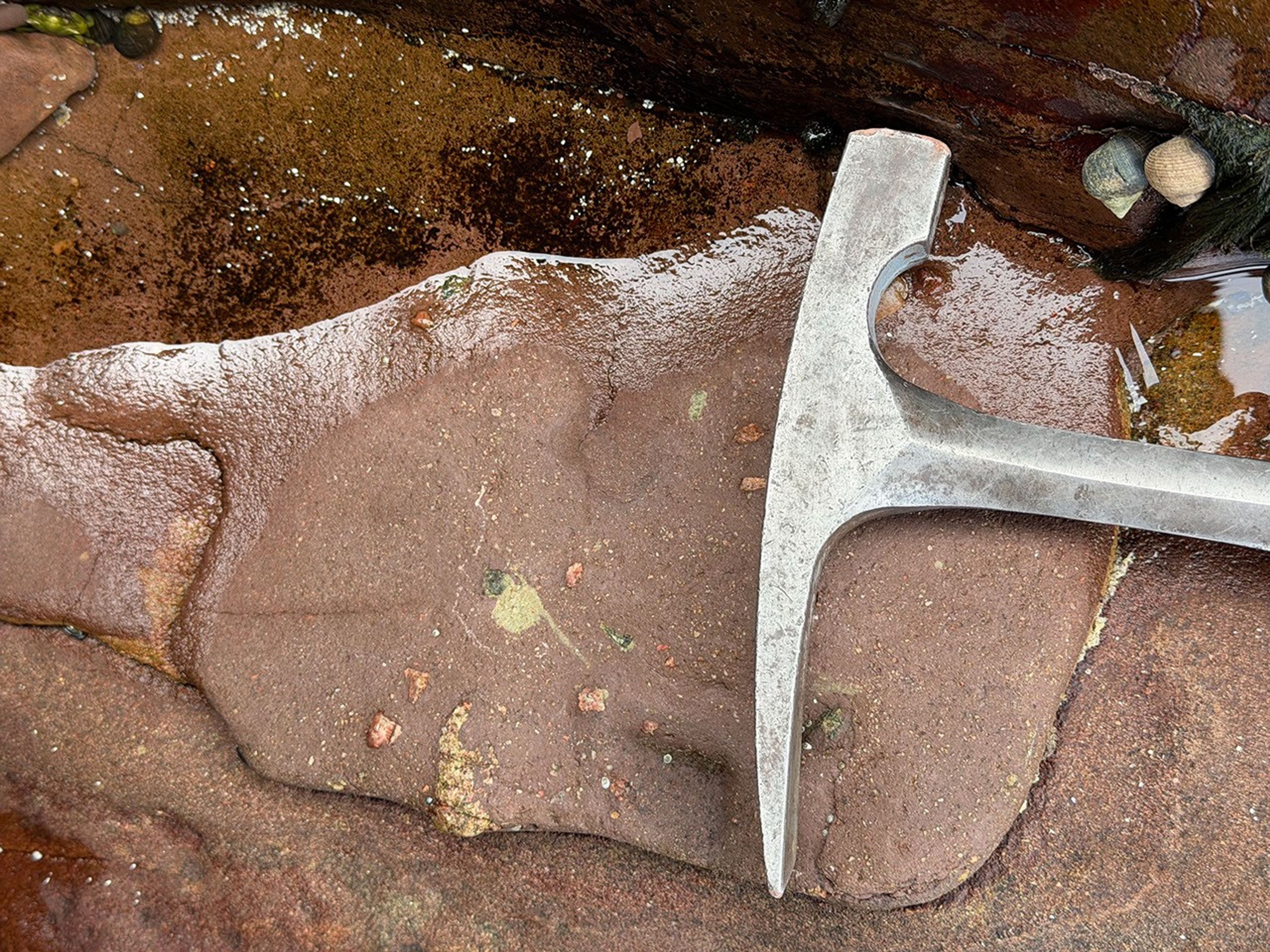
Red sandstone with reduction spots (gray-green) can be seen at the Bay of Stoer in Scotland, and a rock hammer for scale. Reduction spots are sometimes evidence of ancient microbial life interacting with the rock, but they can be formed in other ways, too. Photo from the Goddard Instrument Field Team’s 2026 expedition. NASA/Pedro Cota
Though Mars is dry today, the Martian landscape, like our own planet’s, is shaped by an ancient history of flowing water. Both worlds have layered areas of mudstones and siltstones rich in clay minerals. Learning how signs of ancient life show up in Earth rocks like these Scottish cliffs can help us understand the story of habitability and the potential for biosignatures to be preserved and detected on Mars.
Adrian Broz of Purdue University (left) and Field Lead Mike Thorpe of NASA’s Goddard Space Flight Center (cliff’s far edge) look for reduction spots as Amy McAdam (wearing brimmed hat) and Fuen Cañadas Blasco (right), also of NASA Goddard, prepare to collect samples at the Bay of Stoer in Scotland. The water level at this worksite changes by 11 to 15 feet with the tides; the puddle on the top of the cliff in the foreground is a tidepool. NASA/Pedro Cota
NASA’s Goddard Instrument Field Team , based at the agency’s Goddard Space Flight Center in Greenbelt, Maryland, hiked the coasts and cliffs of the Clachtoll region with science instruments on their backs. Climbs were timed to access investigation sites in between high tides and leave safely while the slopes were dry, not always an easy task in the wet climate of the Scottish Highlands. Scientists used handheld instruments to check mineral and chemical compositions on the spot, searched their surroundings for clues about the environment, and identified and collected samples for further analysis.
Deputy Field Lead Hemani Kalucha of NASA Goddard, Adrian Broz of Purdue University, and Fuen Cañadas Blasco of NASA Goddard hold samples of rock containing reduction spots at Clachtoll Bay in Scotland. NASA/Pedro Cota
With the samples safely home, the story continues to unfold. This research was inspired by questions raised when the Perseverance rover found reduction spots , telltale signs of a chemical reaction that could point to ancient microbial life, in Mars’ Jezero Crater. The team’s work is poised to help fill gaps in our knowledge of Earth’s geologic record, too. In labs across the United States and beyond, with access to cutting-edge tools that can’t be carried into the field, an interdisciplinary coalition of scientists is preparing for deeper analysis of the chemical and mineral traces of ancient life left in Stoer’s rocks. Follow-on work is designed to advance our understanding of data from Mars, help mission teams plan new rover investigations, and prepare the science community for potential Martian sample analysis in the future.
The Goddard Instrument Field Team and collaborators at Split Rock, Scotland. Front row: Pedro Cota, Dina Bower, Amy McAdam, Fuen Cañadas Blasco, Hemani Kalucha, Mike Thorpe, of NASA Goddard and S. J. Ralston of NASA Johnson. Back row: Jessie Wilde of NASA Goddard, Alex Jones, Adrian Broz, William McMahon, David Davis, and Zachary Dickeson. Credit: NASA/Pedro Cota
This expedition was led by the Goddard Instrument Field Team with collaboration from NASA’s Johnson Space Center in Houston, the University of Glasgow, the University of Maryland, Purdue University, Stony Brook University, and the University of Cambridge. The Goddard Instrument Field Team specializes in studying Earth’s extreme environments to understand similar landscapes on other worlds, also called planetary analog research.
By Caela Barry
NASA’s Goddard Space Flight Center, Greenbelt, Md.
Similar Landscapes, Different Worlds About Planetary Analogs Our planet isn’t the only place with volcanoes, ice, impact craters, quakes, and erosion. Studying extreme environments on Earth helps us to understand other worlds better, too.
NASA scientist Mary Beth Wilhelm collects soil samples from Chile’s Atacama Desert. Studying ancient life in the driest places on Earth helps us to understand conditions on Mars. NASA
The post In Scotland, NASA Scientists Search for Clues About Mars’ Past appeared first on NASA Science .