I tested Lenovo's Yoga 9n 2-in-1 against the MacBook Pro for two weeks — impressive OLED and AI smarts cannot make up for poor gaming and weaker raw power
Latest from Tom's Guide ·
null
You've probably heard the term "MacBook killer," especially following the launch of Nvidia's first RTX Spark laptops . Now, Apple has raised the stakes with its latest MacBook Pro models featuring the PROLED XDR Displays, and I wanted to see how these new machines actually stack up.
So, I put my 16-inch MacBook Pro M3 Max away for two weeks and used the Lenovo Yoga 9n 2-in-1 as my only laptop. I wanted to find out whether Nvidia's new platform could replace an older MacBook Pro, how it compares with Apple's latest flagships, and what makes RTX Spark laptops worth considering.
The Yoga makes a strong impression. Its versatile design, vibrant OLED touchscreen, and support for local AI workloads give me plenty to like. But after two weeks, I found that while it's a capable everyday laptop, its high price and performance trade-offs make it a more specialized alternative to a MacBook rather than a true replacement.
Lenovo Yoga 9n 2-in-1 (Starting)
Lenovo Yoga 9n 2-in-1 (as reviewed)
Price
$2,999
$3,999
CPU
Nvidia RTX Spark N1X with 5120-core GPU and 18-core CPU
Nvidia RTX Spark N1X 6144 Core GPU, 20-Core NPU
GPU
Nvidia RTX Spark N1X with 5120-core GPU
Nvidia RTX Spark N1X 6144 Core Blackwell GPU
Display
2880x1800 OLED Touch with Pen Support
2880x1800 OLED Touch with Pen Support
Memory
32GB
64GB
Storage
512GB
1TB
Ports
2x USB-A, 2x USB-C, 1x HDMI 2.1, 1x 3.5mm Headphone jack, 1x SD card slot
2x USB-A, 2x USB-C, 1x HDMI 2.1, 1x 3.5mm Headphone jack, 1x SD card slot
Security Features
Windows Hello IR Camera
Windows Hello IR Camera
Dimensions
14.17 x 9.59 x 0.69 inches
14.17 x 9.59 x 0.69 inches
Weight
4.28 pounds
4.28 pounds
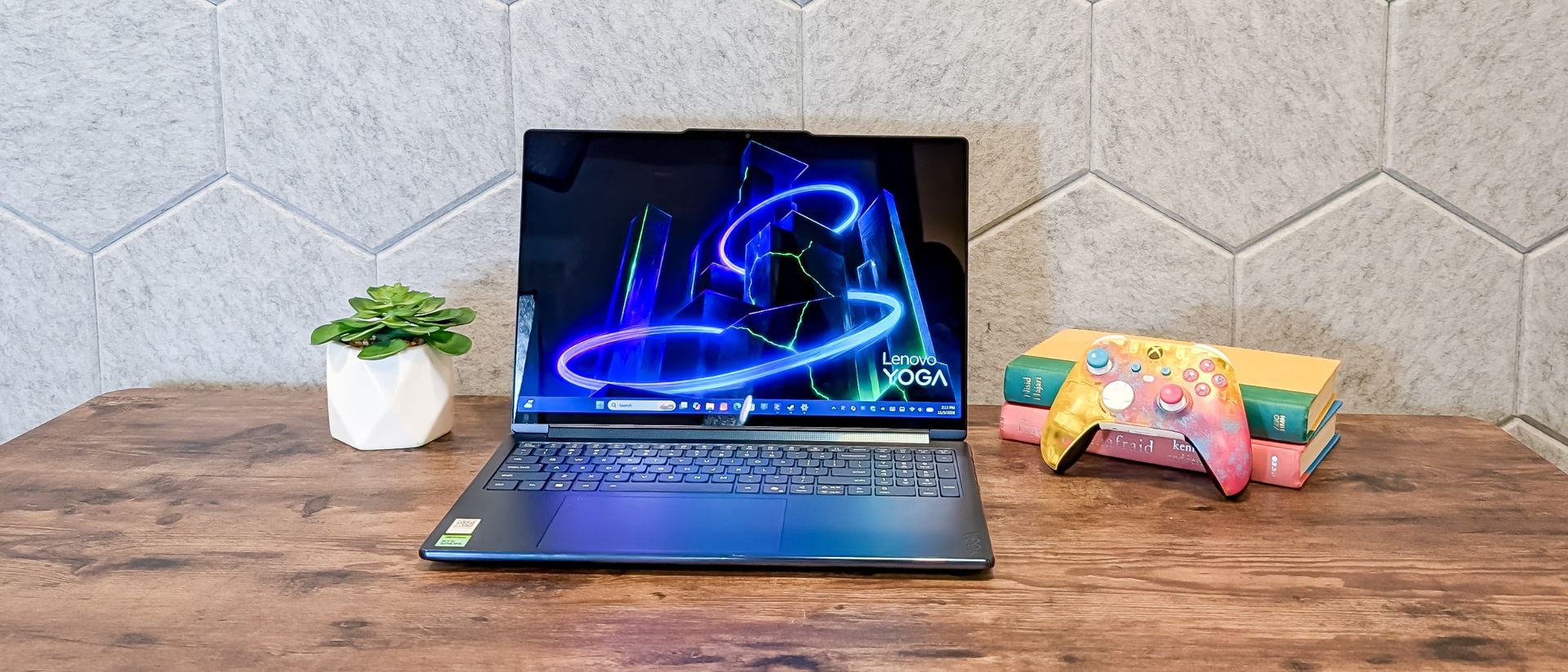
This Lenovo Yoga 9n 2-in-1 is a versatile machine. It features a 360-degree hinge for tablet use, pen support, and a striking design with speaker grilles flanking the screen and keyboard.
Tent mode is perfect for sitting on my sofa and streaming episodes of “ King of the Hill .” Folding the screen flat lets me use the giant 16-inch display as a primary monitor in the lab at work with an external keyboard and mouse.
Of course, holding a 16-inch screen like a tablet can feel a bit unwieldy. However, the ability to use the included pen in photo-editing apps like Photoshop is a nice feature. I also give Lenovo credit for including a pen in the box. There's even a small cradle that magnetically attaches to the top of the laptop, so you don't have to worry about losing the stylus.
The Yoga’s “Ice Blue" finish and polished accents also give this laptop a glamorous look, making it feel like a jewel on my desk. My Space Black MacBook just looks plain and boring compared to this Yoga 9n.
The keyboard and touchpad are also excellent. The dedicated number pad makes spreadsheet work far easier than on my MacBook, while the haptic touchpad matches Apple's gold standard. Clicks feel crisp, and special Windows-specific feedback for actions like closing windows and completing file transfers adds a nice tactile touch that my Mac lacks.
You can even use the pen on the haptic touchpad instead of writing directly on the screen. It can feel a bit strange, but it's another example of the flexibility this design offers. I could never imagine Apple doing that on a Mac.
Connectivity is another area where the Yoga has an advantage over my MacBook. In addition to HDMI and a full-size SD card reader, Lenovo includes two USB-A ports, which you won't find on a modern MacBook Pro.
Given the laptop's relatively thick 0.69-inch chassis and 4.28-pound weight, there's plenty of room for extra connections. During my two weeks with the Yoga, I left my dongles at home, which was a surprisingly refreshing change.
One of the biggest reasons I enjoy using the Yoga 9n 2-in-1 is the 16-inch OLED touchscreen. It's large, colorful, and bright enough to make everything from productivity work to streaming video enjoyable.
However, there's a new challenger in town. Apple's latest MacBook Pro, with its PROLED XDR display, has raised the bar for what we expect from a laptop screen . Although the numbers show that the Yoga 9n 2-in-1 doesn't quite match Apple's latest MacBook, that doesn't make it any less good.
Its 16-inch size gives me plenty of room to multitask with Google Chrome tabs and Slack while working in the lab. Brightness also reaches just over 1,000 nits in HDR, and one of my favorite shows, "King of the Hill," looks incredibly vibrant.
The episode where Bobby dresses up as the local college's mascot to help out Connie was a particularly good showcase. The oranges and other rich colors in the mascot suit practically jumped off the screen, making the animation look wonderfully alive.
Lenovo Yoga 9n 2-in-1
MacBook Pro 16-inch M5 Max PROLED XDR
Samsung Galaxy Book 6 Ultra
HP OmniBook Ultra 16 (RTX Spark)
Nits (brightness) SDR / HDR
449.8 / 1002
549 / 1949
451 / 1042
434 (SDR) | 614 (HDR)
sRGB
193.1
117.8
121.2
120.7
DCI-P3
136.6
83.4
85.8
85.5
Delta-E
0.30
0.19
0.20
0.20
In our lab tests, the Yoga's panel delivered a particularly high and oversaturated color volume, measuring 193.1% sRGB and 136.6% DCI-P3. It also ranked third in SDR brightness among the MacBook Pro 16-inch with M5 Max, Galaxy Book 6 Ultra, and HP Omnibook Ultra 16, reaching 449.8 nits and delivering an impressive 1,002 nits in HDR. Its 0.30 Delta-E result also placed it fourth in color accuracy among the laptops we compared.
However, the MacBook Pro 16-inch M5 Max PROLED XDR still comes out ahead in several important areas. It ranks first in brightness, reaching 549 nits in SDR and an impressive 1,949 nits in HDR. It also delivers the best color accuracy with a near-perfect 0.19 Delta-E.
However, Yoga is a more compelling matchup against my MacBook Pro M3 Max. As shown in the photo above, Lenovo's display produced particularly striking colors in the individual feathers of a parrot. Still, Apple's OLED display delivered more natural-looking detail and contrast, which I ultimately preferred.
Apple has also introduced touchscreen support on its new MacBook Pro and macOS, giving the Yoga serious competition in this category. If you're simply looking for the best touchscreen OLED laptop, Apple's latest MacBook Pro is hard to beat. However, choosing the MacBook means giving up the Yoga's 2-in-1 versatility and included pen.
Considering that the two laptops cost roughly the same in the configurations I tested, your choice will largely come down to pen support and whether you prefer Apple's ecosystem or Lenovo's more flexible design.
RTX Spark-powered laptops like this one aren’t really mainstream. They are more specialized notebooks focused on running local AI and taking advantage of native CUDA cores and the unified memory setup in this new chip from Nvidia. This makes them more of a laptop for developers and those who might want to run local agent platforms.
I tested this myself by downloading LM Studio and loading the Qwen 3.8-27b model. I took the Yoga 9n 2-in-1 offline and asked the model to write a 30-chapter novel about an earthquake in NYC and to describe the government falling apart and the city descending into chaos. The model produced an answer in 6 minutes and 20 seconds.
My final project for a college creative writing class was similar, so I was especially interested in seeing what the local model could produce. The chapters were relatively short and didn't include nearly as much detail as my own writing, yet the model still produced a coherent story. I was impressed by how much it could accomplish entirely on the laptop without an internet connection.
Out of curiosity, I also ran UL Procyon’s Text Gen benchmark. Across all the workloads, it scored 2,635, 2,346, 2,274, and 2,148. This was with the Phi-3.5-mini, Mistral 7B, Llama-3.1-8B, and Llama-2-13B LLM instruct models using CUDA acceleration.
We don’t run these tests on every Windows laptop and Mac, so I have no reference to compare them to, but those numbers look great . According to UL’s own scoring page, scores are in the lower 200s for Intel Core Ultra chips and in the 1,000s for Snapdragon X2 Elite chips. This shows that this first-gen ARM chip from Nvidia is in a great place for AI performance.
For now, the most compelling reason to buy an RTX Spark laptop is its ability to run local AI workloads. That's a much more specialized use case than everyday productivity or gaming, and it's something worth considering before spending this much on a laptop.
The Yoga 9n 2-in-1 isn't designed to be a conventional productivity laptop. Nvidia's RTX Spark platform places a strong emphasis on AI, but that doesn't mean you can't use it for everyday work, creative applications, or even gaming.
For my typical laptop workload, the Yoga is more than capable. I regularly juggle Chrome tabs, Slack, and other applications while working in the lab, and I have no major issues keeping everything running smoothly. Photoshop works well for photo editing, and I have no trouble using Wondershare Filmora on Windows 11.
In other words, for everyday tasks, the Yoga 9n 2-in-1 was a perfectly capable replacement for my MacBook. The raw performance benchmark results, however, tell a different story and are a downside of this laptop.
For raw processing power, the Yoga 9n 2-in-1 struggles to justify its premium price. I give Nvidia credit for delivering competitive performance from its first-generation Arm chip. However, there's still a noticeable gap in demanding creative applications.
The MacBook Pro 16-inch M5 Max PROLED XDR outperformed Lenovo’s laptop across our major productivity and creative benchmarks, with particularly large leads in Geekbench 6 and Premiere Pro.
The Yoga scored 13,437 in Photoshop and 85,779 in Premiere Pro. Apple's MacBook Pro was also considerably faster in both, completing the test in 7,75 minutes in Photoshop and 4,47 minutes in Premiere Pro.
Lenovo Yoga 9n 2-in-1 (RTX Spark, 64GB RAM)
MacBook Pro 16-inch M5 Max PROLED XDR (M5 Max, 128GB RAM)
Samsung Galaxy Book 6 Ultra (
Intel Core Ultra 7 356H, 32GB RAM)
HP OmniBook Ultra 16 (RTX Spark, 32GB RAM)
Geekbench 6 (Single/ Multi)
3076/20084
4359/ 30327
2852/16655
3,165 / 20,056
Photoshop (score/time)
13437
9.03
18431
7.75
Test not run
11,775 / 7.9 mins
Premiere Pro (score/time)
85779
7.40
155248
4.47
Test not run
87,127 / 7.3 mins
Handbrake SSD (mins:secs)
2:00
1:40
3:14
2:03
3DMark Wild Life Extreme (score / fps)
21830
130.21
42998
214.1
Test not run
22,978 / 137
In Geekbench 6, the Yoga scored 3,076 single-core and 20,084 multi-core. That's ahead of the Samsung Galaxy Book 6 Ultra (2,852 and 16,655) and puts it almost neck and neck with the HP OmniBook Ultra 16, which has RTX Spark (3,165 / 20,056). However, the MacBook Pro M5 Max remains considerably ahead at 4,359 single-core and 30,327 multi-core.
The results are particularly interesting when comparing the Yoga against my older 16-inch MacBook Pro M3 Max. Apple's previous-generation high-end chip scored 3,162 in Geekbench 6 single-core and 21,250 in multi-core. While the Yoga comes surprisingly close, it still falls behind. Its HandBrake result of 2:00, however, comfortably beats my older MacBook's 2:37.
The takeaway is that Nvidia's first-generation RTX Spark platform delivers solid everyday performance and competitive results in certain creative workloads. However, the Yoga doesn't consistently outperform newer high-end, near-fully specced-out MacBooks, making it harder to justify spending $3,999 if raw processing power is your priority.
Gaming and Nvidia go hand in hand, and this Yoga can certainly run demanding games. However, RTX Spark isn't a ticket to high-end gaming performance. Developers need to optimize their games for the new Arm-based architecture, or the games won't run at all. That's why I found out that some games from our lab's catalog (like Red Dead Redemption 2 ) won’t run at all. Others, like Far Cry 6 , also misbehaved and didn’t run properly.
I technically can't play Forza Horizon 6 on my MacBook, so the Yoga still has the edge for my gaming needs. I enjoyed playing it with extreme settings and ray tracing enabled, and it averaged 38 frames per second at 1080p. Increasing the resolution dropped it to 23 fps, though. That's playable, but hardly the kind of performance you’d expect from a $3,999 laptop.
Lenovo Yoga 9n 2-in-1
MacBook Pro 16-inch M5 Max PROLED XDR
Samsung Galaxy Book 6 Ultra
HP OmniBook Ultra 16 (RTX Spark)
Assassin’s Creed Shadows (Medium, 1080p, 1880p)
25 / 31
61
34
54
34
26
25
Cyberpunk 2077 (Ray Tracing Ulta, 1080p, 1880p)
34.55
17.29
38.75
13.68
35.81
8.00
33.83
18.14
Forza Horizon 6 (Extreme + RT)
38
23
Benchmark not available
Benchmark was not run
33
23
The results are more mixed in other games. In Cyberpunk 2077 , the Yoga managed 34.55 fps at 1080p with Ray Tracing Ultra enabled, putting it in the same general range as the other laptops we tested. At higher resolution, it actually outperforms the MacBook and Samsung, although the HP was slightly ahead. Assassin's Creed Shadows is less impressive, with the Yoga reaching just 25 fps at 1080p.
Our synthetic benchmarks tell a similar story. In 3DMark Wild Life Extreme, the Yoga scored 21,830, averaging 130.21 fps. That's slightly behind the HP OmniBook Ultra 16, which scored 22,978 and averaged 137 fps.
Compared to a MacBook, the Yoga can game, but these results put it closer to an RTX 5070 gaming laptop. It won’t be a compelling choice if gaming is your main priority. You can get a more capable gaming laptop for this kind of money.
The top reason I love my MacBook Pro is its battery life, since I only have to charge it at most three times a week. When I tried to replace my Mac with the Yoga 9n 2-in-1, I quickly learned that this system can’t match what my MacBook Pro delivers. Even lab results show that this Yoga is behind the competition.
I put the Yoga 9n 2-in-1 through my daily workflow and started the day fully charged. With the screen at a comfortable 33% brightness, I worked through spreadsheets in Google Sheets, talking to my coworkers on Slack, and taking the occasional Google Meet meeting. By the time 3:30 got around, the battery was down to 62%. That was more than enough for when I got home, but after two hours of watching YouTube videos and cartoons on Hulu, I got the recharge warning and had to plug the laptop into power.
Lenovo Yoga 9n 2-in-1
MacBook Pro 16-inch M5 Max PROLED XDR
Samsung Galaxy Book 6 Ultra
HP OmniBook Ultra 16 (RTX Spark)
Battery Test Result (Hours:Minutes)
12:20
21:24:18
15:11:51
10:52:34
In our lab tests, MacBook Pro 16-inch (M5 Max PROLED XDR) claims first place with a marathon runtime of 21:24, followed in second by the Samsung Galaxy Book 6 Ultra at a solid 15:11. The Lenovo Yoga 9i 2-in-1 takes third place with 12:20, leaving the HP OmniBook Ultra 16 (RTX Spark) in fourth at 10:52.
Lenovo’s RTX Spark 2-in-1 is ahead of HP’s, but the numbers don’t lie: the Yoga 9n isn’t the best for battery life.
Lenovo’s Yoga 9n 2-in-1 is an expensive proposition. As configured, our unit costs $3,999 directly from Lenovo. The same configuration is slightly cheaper at Best Buy for $3,749.99. If you want to save money, you can also pick up the entry-level model with the N1X 18-Core Processor, 32GB RAM, and a 512GB SSD for $3,199.99 from Lenovo or $3,099 from Best Buy.
Those prices are pretty wild, but the ongoing RAM crisis and the tough economy are what contribute to them. Apple’s MacBooks are around the same price and, frankly, arguably deliver better performance.
You can get a 16-inch MacBook Pro with the NanoTexture PROLED XDR display, M5 Pro chip, 24GB RAM, and a 1TB SSD for $3,549.99. That’s still cheaper than the Yoga 9n 2-in-1. If you remove the nano-texture display, you can also upgrade to an M5 Max chip with an 18-core CPU, a 32-core GPU, 36GB RAM, and 2TB of storage for $4,799.99. That’s about $800 more than the Yoga, but you’d get more storage and a better screen.
The point is that these RTX Spark machines are not cheap. Most people shouldn’t consider buying them, since their use case is more specialized for AI than anything else. You can take that money and put it toward a brand-new MacBook Pro instead. Or, if you’re really on a budget, invest that $3,999 in a better Windows laptop like the Samsung Galaxy Book 6 Ultra, known for its OLED screen and battery life.
The Lenovo Yoga 9n 2-in-1 is an intriguing, beautifully built hybrid that serves as an impressive canvas for Nvidia’s RTX Spark platform. Thanks to a stunning 16-inch OLED touchscreen, included stylus, versatile 360-degree hinge, and local AI power, there is plenty to like. During my two weeks with it, the Yoga easily replaced my MacBook Pro for everyday productivity tasks like web browsing, Slack, and multimedia consumption.
However, at $3,999 as tested, it doesn't quite earn the title of "MacBook Killer." For heavy creative professionals, it might not be a strong enough MacBook replacement, given its weaker raw processing power in demanding benchmarks and rendering tasks. Likewise, due to its poor battery life, it simply didn't fit into my lifestyle the way my long-lasting Mac does.
If your daily workflow hinges on running local AI models on a flexible 2-in-1 canvas, the Yoga 9n will be for you. But for most power users seeking maximum performance and all-day endurance, a high-end MacBook Pro remains the smarter investment.