Autumn Mornings Bring Valley Fog
NASA Science ·
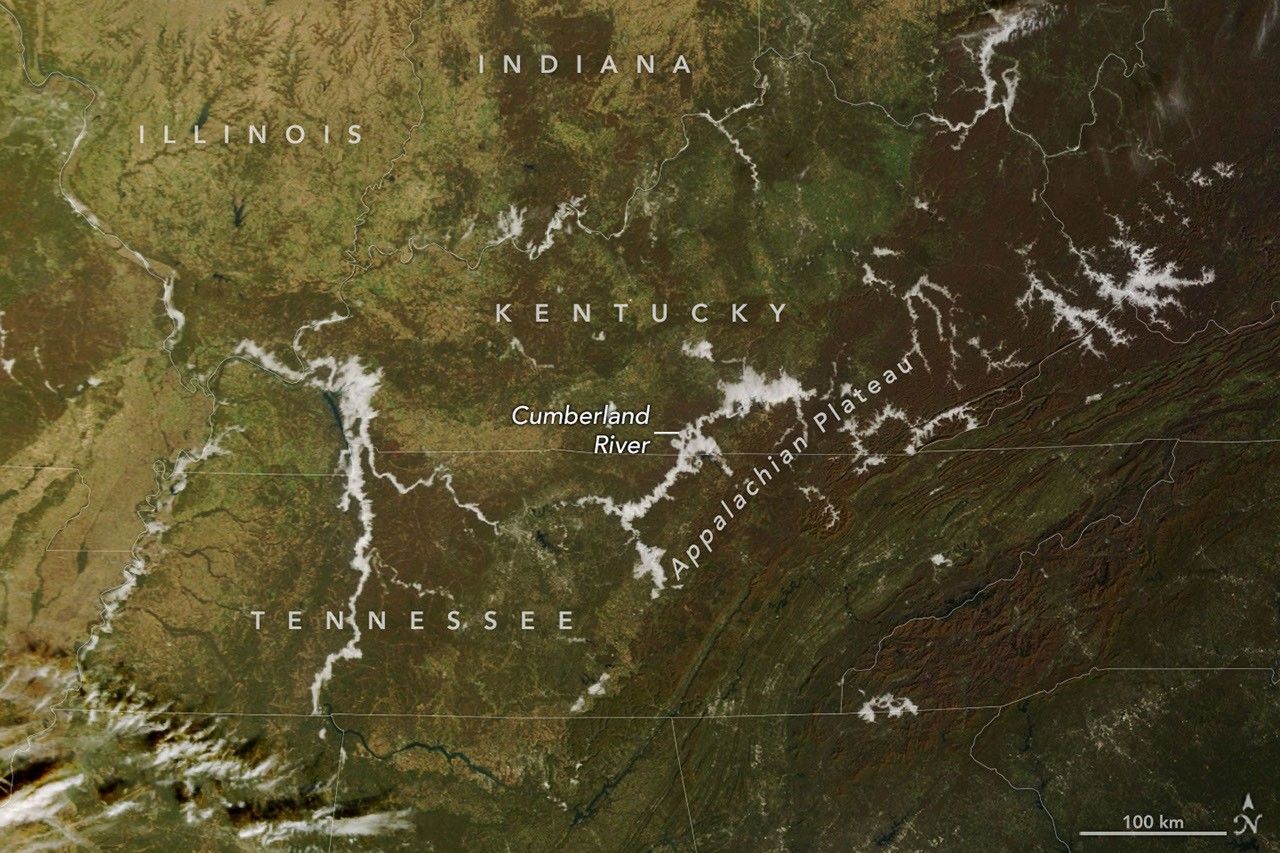
Low clouds trace the branching valleys of the Appalachian Plateau and the Cumberland River, then burn off by afternoon. The post Autumn Mornings Bring Valley Fog appeared first on NASA Science .
Science Earth Observatory Autumn Mornings Bring Valley Fog Earth Earth Observatory Image of the Day EO Explorer Topics All Topics Atmosphere Land Heat & Radiation Life on Earth Human Dimensions Natural Events Oceans Remote Sensing Technology Snow & Ice Water More Content Collections Global Maps World of Change Articles Earth Matters Blog Blue Marble: Next Generation EO Kids Mission: Biomes About About Us Subscribe 🛜 RSS Contact Us Search morning afternoon A natural-color satellite image from the morning shows white fog filling a branching network of river valleys, surrounded by brown and green terrain. NASA Earth Observatory / Lauren Dauphin A false-color satellite image from the afternoon shows the same area clear of fog, with rivers and lakes in dark blue winding through bright green vegetation. NASA Earth Observatory / Lauren Dauphin morning afternoon A natural-color satellite image from the morning shows white fog filling a branching network of river valleys, surrounded by brown and green terrain. NASA Earth Observatory / Lauren Dauphin A false-color satellite image from the afternoon shows the same area clear of fog, with rivers and lakes in dark blue winding through bright green vegetation. NASA Earth Observatory / Lauren Dauphin morning afternoon
On November 8, 2026, low clouds traced the branching valleys of the Appalachian Plateau and the Cumberland River in the morning (left, natural color) then burned off by afternoon (right, false color). The images were acquired with the MODIS (Moderate Resolution Imaging Spectroradiometer) on NASA’s Terra satellite and the VIIRS (Visible Infrared Imaging Radiometer Suite) on NOAA-21 , respectively. NASA Earth Observatory images by Lauren Dauphin. On a cool November morning, low clouds traced the branching valleys of the Appalachian Plateau and the Cumberland River. By afternoon, they had faded, leaving clear skies over the autumn landscape.
The change is visible in this pair of images from November 8, 2026. The MODIS (Moderate Resolution Imaging Spectroradiometer) on NASA’s Terra satellite acquired the left image that morning. In this natural-color view, low clouds appear white as they fill many of the valleys. Autumn vegetation appears in shades of brown and green.
The VIIRS (Visible Infrared Imaging Radiometer Suite) on NOAA-21 acquired the right image that afternoon, after the clouds had dissipated and exposed the rivers and lakes beneath them. This false-color view makes it easier to distinguish water (dark blue) from vegetation (bright green).
The clouds appear to be fog, a type of cloud that forms near the ground . Foggy mornings in the region are common this time of year. As nights lengthen, the ground has more time to radiate away the day’s heat, and the air just above it cools to the dew point —the temperature at which air becomes saturated and water vapor begins condensing into the tiny droplets that make up fog.
Because cold air is denser than warm air, it flows downslope and pools in valleys, so fog tends to form there first. Notice the fog filling the branching valleys across part of the Appalachian Plateau in eastern Kentucky and southwestern West Virginia. Rivers and streams that run along many of the valley floors add to the effect by supplying extra moisture. The same pattern is visible along the Cumberland River and its reservoirs in north-central Tennessee and south-central Kentucky.
According to the National Weather Service, temperatures in many places on the morning of November 8 dipped into the 30s Fahrenheit before giving way to a mild, sunny afternoon. Forecasters reported locally dense valley fog that morning. Dense fog had also blanketed a wider part of the region earlier in the week, prompting advisories for hazardous travel conditions.
NASA Earth Observatory images by Lauren Dauphin, using MODIS data from NASA EOSDIS LANCE and GIBS/Worldview , and VIIRS data from NASA EOSDIS LANCE , GIBS/Worldview and the Joint Polar Satellite System (JPSS). Story by Kathryn Hansen.
JPEG (3.02 MB)
November 8, 2026, NOAA-20 VIIRS
JPEG (3.29 MB)
References & Resources NASA Earth Observatory (2018, October 26) It ‘ s Valley Fog Season . Accessed November 9, 2026. National Park Service (2024, December 10) Appalachian Plateaus Province . Accessed November 9, 2026. National Weather Service (2023) Weather in Action: Valley Fog . Accessed November 9, 2026. NOAA (2025, September 2) What ‘ s the Difference Between Fog and Clouds? Accessed November 9, 2026. You may also be interested in: Stay up-to-date with the latest content from NASA as we explore the universe and discover more about our home planet.
A low-lying cloud layer brought autumn ambience to western Washington and Oregon, while mountainous areas near the coast remained above…
Article Fire Cloud With a Pileus on Top 4 min read Scientists captured rare observations of an ephemeral pileus cloud hovering over a smoke-infused cloud that rose above a wildfire in…
Article Wild, Scenic, and Increasingly Rusty 5 min read Orange streams are now being spotted in hundreds of watersheds in permafrost areas throughout Alaska’s Brooks Range.
Article 1 2 3 4 Next Keep Exploring Discover More from NASA Earth Science Subscribe to Earth Observatory Newsletters Subscribe to the Earth Observatory and get the Earth in your inbox.
NASA's Earth Observatory brings you the Earth, every day, with in-depth stories and stunning imagery.
Explore Earth Science
Open access to NASA’s archive of Earth science data
The post Autumn Mornings Bring Valley Fog appeared first on NASA Science .