3D-Scanning Your Old, Slow BMW Just to Fabricate an Exhaust Is Glorious Overkill
The Drive ·
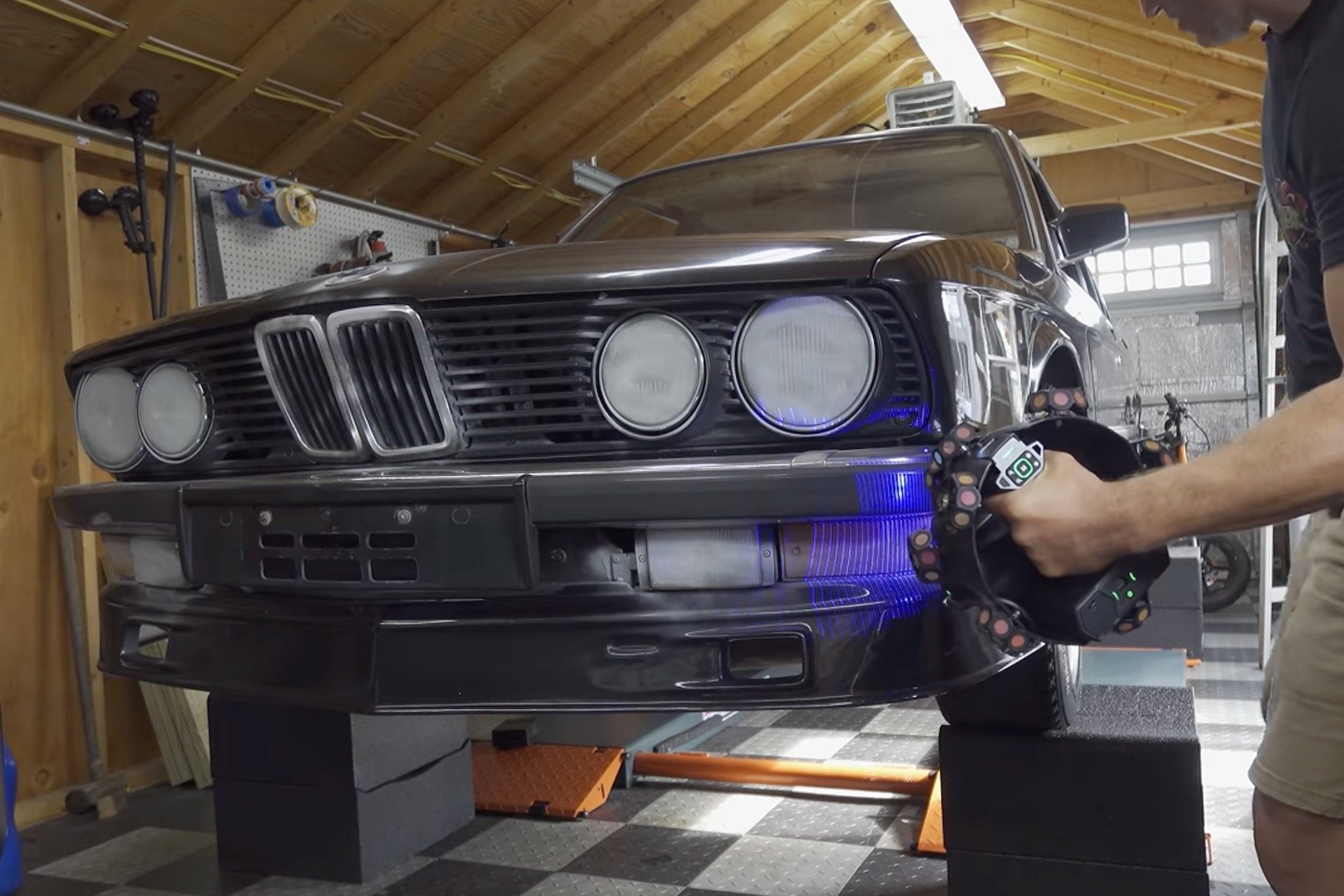
You don't need to scan an entire car to make a new exhaust system, but when you have a hammer, every problem starts to look like a nail. The post 3D-Scanning Your Old, Slow BMW Just to Fabricate an Exhaust Is Glorious Overkill appeared first on The Drive .
Technologies like CAD and 3D printing make it a lot easier to design and fabricate custom car parts, respectively, and having an accurate digital model of the car you’re working on makes things even easier. These days, 3D scanners are readily available to do just that, and this video demonstrates how they work using a very humble test subject.
John Volk is well known in the custom BMW community for making turbo-ready exhaust manifolds , and he’s also built a 13B rotary-powered BMW i8 . These days, you can find him on his YouTube channel Couch Builds , where he puts digital parts engineering and 3D printing into practice. In one of his recent videos, Volk scanned a European-market E28 BMW 518i powered by what he calls a “sub-100-horsepower” 1.8-liter version of the M10 inline-four. This engine wasn’t offered on the E28 in the U.S., which is probably just as well.
The scan was done to aid fabrication of a new stainless steel exhaust system, since the old exhaust had rusted out. Only the underside of the car really needed to be scanned for this, but to demonstrate scanning techniques and test out his Einscan Trak 3D scanner, Volk decided to do the entire car.
Scanner setups vary, but the Trak 3D uses a stationary tracking bar, which communicates via WiFi with a handheld tool that looks a bit like the weapon of a disco-themed supervillain. It’s covered in sensors that capture images when the tool is waved over a surface, with user-adjustable levels of resolution. In this case, those can be adjusted locally to better render more intricate areas. For comparison, he also did a few passes with a simpler Einscan Rigil, a smaller device that looks more like a supermarket scanning tool.
The Trak 3D looks sillier, but it also requires less precision. Simple passes with a spray-paint like motion get the job done. That’s important when freedom of movement is restricted, as in the small garage where the E28 was scanned. Even in that confined space, the job pushed the limits of the scanner’s range, so multiple images needed to be composited with the scanner’s accompanying software.
In the introduction of the video, Volk compares 3D scanners to welders. Even if you can use one, each job is a learning experience, he says. He certainly makes it look easy in this video, but then again, countless reality shows did the same for welding. If I had the skills, I guess I’d be scanning anything I could, too—even an ultra-slow BMW.
The post 3D-Scanning Your Old, Slow BMW Just to Fabricate an Exhaust Is Glorious Overkill appeared first on The Drive .