Testing AI Exactly How It’s Used: MLPerf Endpoints v1.0
MLCommons ·
MLPerf Endpoints v1.0 measures AI systems the way customers actually use them: through live API endpoints under production-like load. This post explains why a full Pareto frontier beats a single peak score, what is in the v1.0 workload suite, and how to submit, step by step. The post Testing AI Exactly How It’s Used: MLPerf Endpoints v1.0 appeared first on MLCommons .
If you are new to the world of AI infrastructure, you might not be familiar with MLCommons , the open-source engineering consortium that acts as the global standard-bearer for AI performance measurement. Historically, their MLPerf benchmarks measured isolated silicon performance. However, the recently launched MLPerf Endpoints v1.0 benchmark aims to measure the larger system by measuring live API endpoints under production-like loads. Rather than benchmarking a tuned accelerator in a vacuum, Endpoints evaluates the entire AI stack—the hardware, model, serving software, batching behavior, and networking together —giving buyers and systems builders an unvarnished look at real-world capabilities.
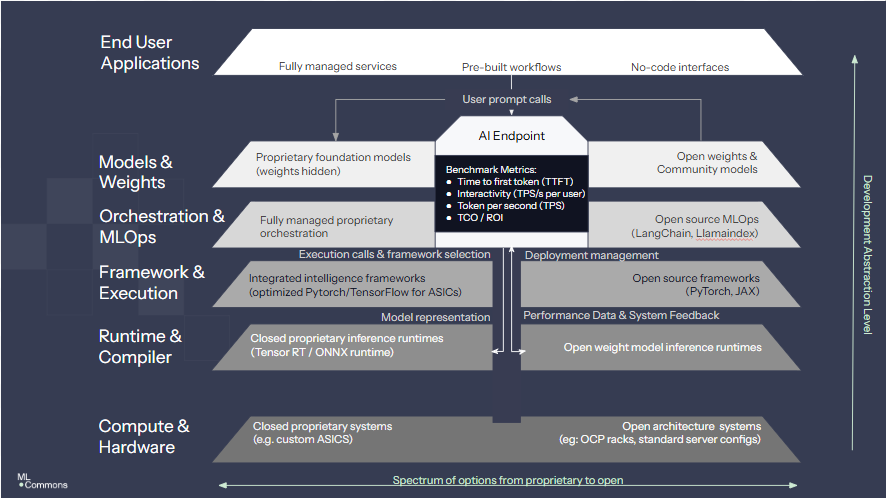
Figure 1: The many layers of a typical AI technology stack: AI benchmarks only test at the lowest compute & hardware layer. Others test using only closed or synthetic tests on highly optimized systems. MLPerf Endpoints v1.0 uses publicly available AI models to perform open, reproducible and peer-reviewed benchmarks for enterprise AI.
Why MLPerf Endpoints v1.0 is Important for Providers and System Builders
For cloud providers, hardware OEMs, managed service models, and “neoclouds,” available AI benchmarks can turn into a tuning arms race that fails to reflect actual business utility. The scores represent how well you perform in that specific test, and nothing more. This is akin to buying a car by looking at the top speed printed on its odometer, without ever test driving it. MLPerf Endpoints v1.0 fixes this by generating a full Pareto frontier of system behavior across varying workloads, rather than a single peak score. No data is estimated or interpolated, so only real-world conditions are shown, including where potential performance cliffs may be experienced by your customers. This is the information their customers need to know in order to select their system.
Figure 2: The MLPerf LoadStair Visual maps strictly measured, discrete operating points to show exactly how an AI endpoint behaves under scaling demands. Unlike traditional performance graphs that use smoothed, interpolated curves to guess a system’s limits, this model uses step functions to expose the real-world operational thresholds and performance cliffs of audited systems.
Enterprise Legitimacy
Submitting your system gives your engineering, sales, and marketing teams an indisputable stamp of validity backed by strict peer review from industry competitors and third-party auditing.
Showcasing Full-Stack Innovation
If you have written a groundbreaking custom scheduler or optimized your networking fabric, traditional benchmarks might ignore it. Endpoints explicitly measures the whole frontier dataset, letting your software and integration engineering shine.
Real-World Workload Profiles
The v1.0 suite does not use artificial or synthetic tests. Instead, it features workloads that customers are actually using today, moving beyond simple single-shot tasks to complex, multi-turn AI agents.
Table 1: AI models used for testing in MLPerf Endpoints v1.0
Submitting to MLPerf Endpoints v1.0
This benchmark drastically lowers engineering overhead that has been associated with previous benchmarks, and features rolling submissions with publication cohorts every few weeks, keeping pace with the rapid market speed. Here is the roadmap to get your system benchmarked and published:
Once submitted, your results will enter the continuous peer-review cycle, ultimately generating an intuitive MLPerf LoadStair Visual that clearly displays your system’s operational thresholds and capacity to global enterprise buyers.
To enable submitters to access their results faster, MLPerf will now allow provisional results to be shared after an automatic check has completed, prior to the peer review process. Final verified results may now also be held under embargo if required to be timed with an event or launch.
Figure 3: The MLPerf Endpoints v1.0 benchmarking process: submissions proceed through checking and peer review by a committee of industry experts to ensure accuracy and credibility. Early provisional results can also be made available to improve turnaround subject to restrictions.
For more detailed instructions on how to prepare and submit to MLPerf Endpoints v1.0, please check out our MLPerf Endpoints v1.0 – First Time Submitters Guide .
To learn more about MLPerf benchmarking, including other test suites, please visit https://mlcommons.org/benchmarks/
The post Testing AI Exactly How It’s Used: MLPerf Endpoints v1.0 appeared first on MLCommons .