I really wanted the Asus ProArt P14 to be my favorite RTX Spark laptop — and it’s painfully close
Latest from Tom's Guide ·
Jason brings a decade of tech and gaming journalism experience to his role as a Managing Editor of Computing at Tom's Guide. He has previously written for Laptop Mag, Tom's Hardware, Kotaku, Stuff and BBC Science Focus. In his spare time, you'll find Jason looking for good dogs to pet or thinking about eating pizza if he isn't already.
Every time I test a new Nvidia RTX Spark laptop, I’m looking for the sweet spot — that magical balance where the local AI horsepower, creator muscle and genuine portability finally shake hands. On paper, the Asus ProArt P14 looks like it cracked the code.
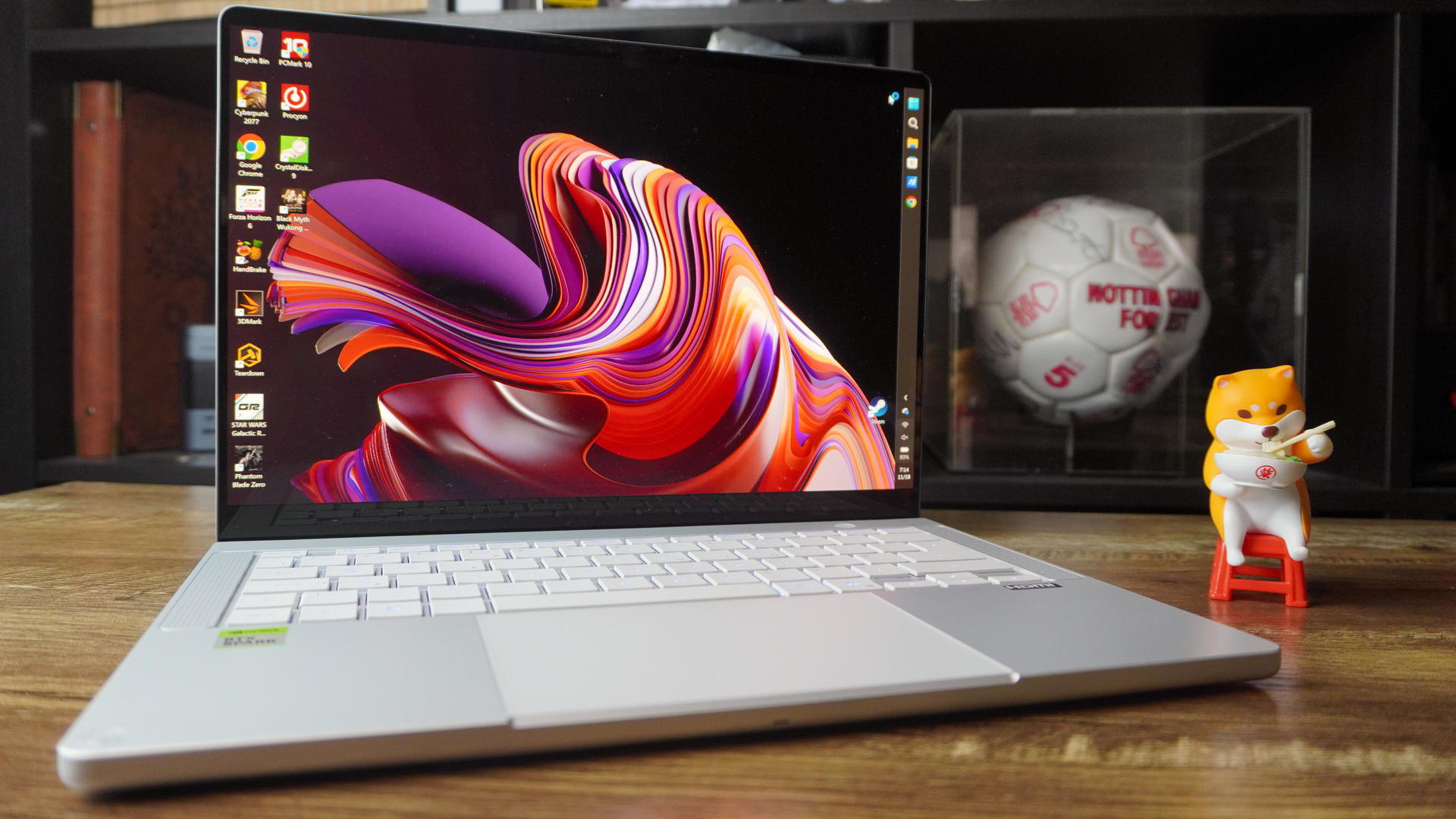
Asus managed to crame Team Green’s monster chip into the lightest 14-inch ProArt chassis it has ever built, measuring just 0.55 inches thin and tipping the scale at 3.26 pounds.
Add in a jaw-dropping 3K Lumina Pro OLED touchscreen, a proper SD card reader (no dongle circus required), surprisingly good speakers and a 12.5-hour battery life, and you have a machine that feels effortlessly refined the second you slip it into a backpack.
I genuinely wanted this to be my favorite RTX Spark laptop. In terms of size, weight, ergonomics, and sheer screen quality, it arguably is.
But physics always collects its debt. To keep a 14-inch chassis this slim and squeeze out 12.5 hours away from an outlet, Asus had to rein in the total wattage. The result is a laptop that can cook your crotch in lap use — especially with its wide, exposed bottom vents — and trails larger RTX Spark machines when you really push the silicon.
And at $3,099 (£3,199), that compromise is a tough pill to swallow unless portability is your absolute number-one priority.
Spec
Asus ProArt P14 (base model)
Microsoft Surface Laptop Ultra (as tested)
CPU
Nvidia RTX Spark N1X (18-core CPU / 5120-core GPU)
Nvidia RTX Spark N1X (20-core CPU / 6144-core GPU)
RAM
24GB unified memory
32GB unified memory
Storage
1TB SSD
1TB SSD
Display
14 in 3K OLED 100% DCI-P3 120Hz Touchscreen
14 in 3K OLED 100% DCI-P3 120Hz Touchscreen
Ports
3x USB4, 1x HDMI 2.1, 1x USB-A 3.2, 1x SD card reader, 3.5mm audio jack
3x USB4, 1x HDMI 2.1, 1x USB-A 3.2, 1x SD card reader, 3.5mm audio jack
Wireless connectivity
Wi-Fi 7 / Bluetooth 5.4
Wi-Fi 7 / Bluetooth 5.4
Battery
90 Wh
90 Wh
Dimensions
12.2 x 8.6 x 0.6 inches
12.2 x 8.6 x 0.6 inches
Weight
3.2 pounds
3.2 pounds
Price
$2,699
$3,699
After dealing with the sheer heft of the Microsoft Surface Laptop Ultra and lugging around various other RTX Spark beasts like the Lenovo Yoga Pro 9n, the backpackability of this system was the first thing that stuck out to me — alongside other key pros.
Asus rarely misses with its OLED panels, and the 14-inch Lumina Pro OLED here is pure eye candy. That 3K resolution and color accuracy are fantastic for any creative work I threw at this on Photoshop or Premiere Pro, with that peak brightness meaning I could see the screen comfortably outdoors (give or take some screen reflections).
And that 120Hz refresh rate meant games like Forza Horizon 6 flew by in a flash flood of color. Whether for work or play this is a delicious panel to feast your eyes upon.
At 0.55 inches thin and 3.26 pounds, the ProArt P14 is super portable, and you feel that the moment you pick it up.
The sandblasted Neo White finish feels premium and thoughtfully built, and unlike a lot of sleek systems that ditch ports, Asus has kept the full creator toolkit intact: 3x USB4, full-side HDMI 2.1, USB-A and SD 4.0 card reader.
Not only that, but there are no compromises across the ergonomics too. The keyboard offers snappy, comfortable travel for long writing or coding sessions, and the Asus HapticPad feels crisp and responsive under the fingers.
Even better, the speakers caught me completely off guard — they get impressively loud without turning muddy or tinny, coming close to matching the 14-inch MacBook Pro!
One of the downsides we’ve been seeing to Spark systems is the longevity of them, but that’s not such a problem here. Part of that may be down to something I’ll talk about in the cons section, but I have to give credit to Asus here.
Chip (laptop)
Web browsing battery life test result (hh:mm)
Asus ProArt P14 (RTX Spark)
12:32
RTX Spark (Microsoft Surface Laptop Ultra)
10:15
M5 Pro (16-inch MacBook Pro)
21:25
Snapdragon X2 Elite (Zenbook A16)
10:26
AMD Ryzen AI Max 395+ (ProArt Go Pro Edition PX13)
11:12
Packing a 90Wh battery into a 14-inch frame is no small feat, and it pays off. This longevity is enough to comfortably get through a full workday or a transatlantic flight without obsessively hunting for a wall outlet — and it edges ahead of several other Spark systems.
But to get this ultra portability, some decisions have to be made. A lot of it comes down to pure physics.
OK I’ll start this by saying that we benchmark every system as is out-the-box. If you go into the power settings and turn it up, you’ll see better numbers, but that sacrifices the 12.5 hour battery life we talked about.
But even at that maxed out speed, the ProArt P14 isn’t giving you the full, unchained RTX Spark experience. Using manual mode, you can crank it to an 80-watt TDP, whereas its bigger brother the P16 can go up to 135 watts.
Chip
Geekbench 7 single-core
Geekbench 7 multi-core
Asus ProArt P14 (RTX Spark)
2672
22027
Microsoft Surface Laptop Ultra (RTX Spark)
2704
23610
MacBook Pro (M5 Pro)
3690
29659
Asus Zenbook A16 (Snapdragon X2 Elite Extreme)
3214
23645
Asus ProArt GoPro Edition (AMD Ryzen AI Max 395+)
2407
20856
Don’t get me wrong, it’s still plenty snappy for creative work and local AI tasks, but if you put it head-to-head against a bigger Spark laptop, the performance ceiling is noticeably lower.
3DMark test
Asus ProArt P14 (RTX Spark)
Microsoft Surface Laptop Ultra (RTX Spark)
MacBook Pro 16-inch (M5 Pro)
Asus ProArt PX13 GoPro Edition (AMD Ryzen AI Max 395+)
Asus Zenbook Duo (Intel Core Ultra X9)
Fire Strike Ultra (x64)
6480
7492
n/a
6050
3555
Time Spy Extreme (x64)
4760
6060
n/a
4689
3226
Steel Nomad
2340
2912
2335
1895
1483
Solar Bay Extreme
8716
10594
9108
6047
4015
Even with the wattage dialed back, cramming this chip into a slim chassis generates serious heat under load.
Kudos to Asus for the thermal system that keeps it running at solid sustained speeds, but to do so, the underside features large, exposed fan vents that do two things: punk warm air out right on your crotch, and they’re way too easy to suffocate on softer surfaces like a duvet.
Despite its ultraportable dimensions, this is a desk-or-table machine when you’re doing anything heavier than web browsing.
There’s no polite way to say it: $3,699 is a massive chunk of change for the better RTX Spark, especially for a 32GB unified memory configuration that doesn’t run its headline silicon at full tilt.
As we’re seeing across all Spark systems, you’re paying a hefty early-adopter fee, but here there’s a miniaturization tax too. If you don’t explicitly need 14-inch portability, that same budget gets you significantly more raw headroom in a larger chassis.
I really wanted the Asus ProArt P14 to be my favorite RTX Spark laptop. And in a lot of ways, it genuinely is. The 14-inch size, lightweight ergonomics, full port selection, loud speakers, battery life and dazzling 3K OLED panel make it one of the most likable portable creator laptops I’ve used all year.
The rub is that it simply isn’t the fullest representation of what Nvidia’s RTX Spark can do. To make this compact footprint work, Asus had to leave some performance on the table.
So this leaves it to one particular kind of person — someone like me: a traveling creative or developer who values a compact 14-inch frame and a gorgeous OLED screen above raw benchmark dominance. If you fit in that camp (and your budget can stomach the price), you’re going to love living with this machine.
If you want every single drop of muscle that Spark promises, skip the shrink ray and buy a bigger system.
Oh and P.S. Asus (hi if you’re reading this), for the next P14, maybe think about making the frame a touch thicker. That additional thermal headroom would be huge.