Election security center reports limited threats as voting glitches fuel fraud claims
Nextgov/FCW - All Content · · g5128581
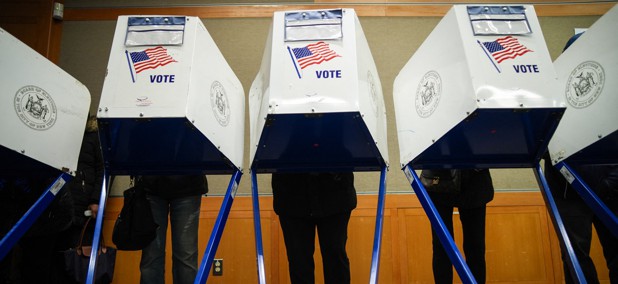
A bomb threat briefly forced voting outdoors at an Ohio polling place. In New York and Florida, equipment problems prompted unfounded claims that Democrats were interfering with the vote.
An organization that tracks election threats for state and local officials said Tuesday afternoon that it had seen limited threat activity during the midterms, though a handful of incidents that briefly disrupted voting and equipment problems in some states have fueled unfounded claims of fraud.
Most cases have been resolved quickly, the Elections Infrastructure Information Sharing and Analysis Center said in a 3 p.m. EST update.
“The midterm elections are a massive undertaking. Each cycle, some jurisdictions experience challenges and rely on layered safeguards to protect the accuracy of results,” said Geoff Hale, an election security visiting fellow at the Center for Democracy and Technology.
“This election cycle, the incidents we’re hearing reports of aren't significantly different than those in previous years. So far, we have not seen evidence of significant cyber incidents,” added Hale, who was also former associate director for election security and resilience at the Cybersecurity and Infrastructure Security Agency.
Physical threats and disruptions
In Toledo, Ohio, a bomb threat at Beverly Elementary School forced voters to leave the building around 10:30 a.m. Election workers brought machines outside so people could vote while police searched the school. Authorities cleared it around 12:15 p.m. At least four other schools in the area received threats, according to the center, though none were being used for voting.
Nextgov/FCW asked the FBI whether investigators had determined who was behind the bomb threats. CISA was also asked for an assessment of the day’s activity so far.
In Georgia’s Fulton County, some voters reported receiving texts saying their polling place had moved. It was unclear who sent the messages or how many people received them. The county said the texts hadn’t come from its office and directed voters to Georgia’s official polling-place lookup to check where to cast their ballots.
Tech issues and false information online
Headline-making ballot issues arose in New York’s Westchester County Tuesday morning. Across much of the county, scanners couldn’t read ballots because they hadn’t been updated after a change to a local race, the New York State Board of Elections said. Some scanners are back online as of this afternoon.
The issues in Westchester are real but “are getting picked up with a false, conspiratorial framing that suggests that the issues — and remedies — are an intentional effort to disenfranchise certain voters,” according to an analysis produced by the Center for an Informed Public.
By mid-afternoon, rumors about the Westchester glitches had circulated widely online and buried the state’s actual explanation, Quinn Raymond, co-founder of VoteShield, told Nextgov/FCW .
In Florida’s Broward County, a feature designed to check that each voter received the correct ballot instead held up voting when polls opened at 7 a.m. The problem was fixed by 7:20 a.m.
As of 1:30 p.m. EST, the ISAC said it had received no reports of foreign influence operations .
The election threat center also flagged unusual traffic at one election office, which reported more than 600 web requests a minute Tuesday. It was unclear what caused the spike or whether voters had trouble reaching the site. In a separate incident last week, an election office reported that a network of automated devices had flooded the webpage voters use to find ballot drop boxes.
So far, the most common false allegation is that Democrats were behind the disruptions, according to Carah Ong Whaley, executive director of Better Choices for Democracy, who shared an assessment with Nextgov/FCW .
Whaley also flagged a fabricated story claiming the FBI had found more than 20,000 fraudulent ballots marked for Democrats in a Houston storage facility. Lead Stories, a fact-checking website, traced the claim to a social media account that regularly posts satire.