Meet The IMD MBA Class of 2026, Srikanth Pilla
Poets&Quants · · g1253102
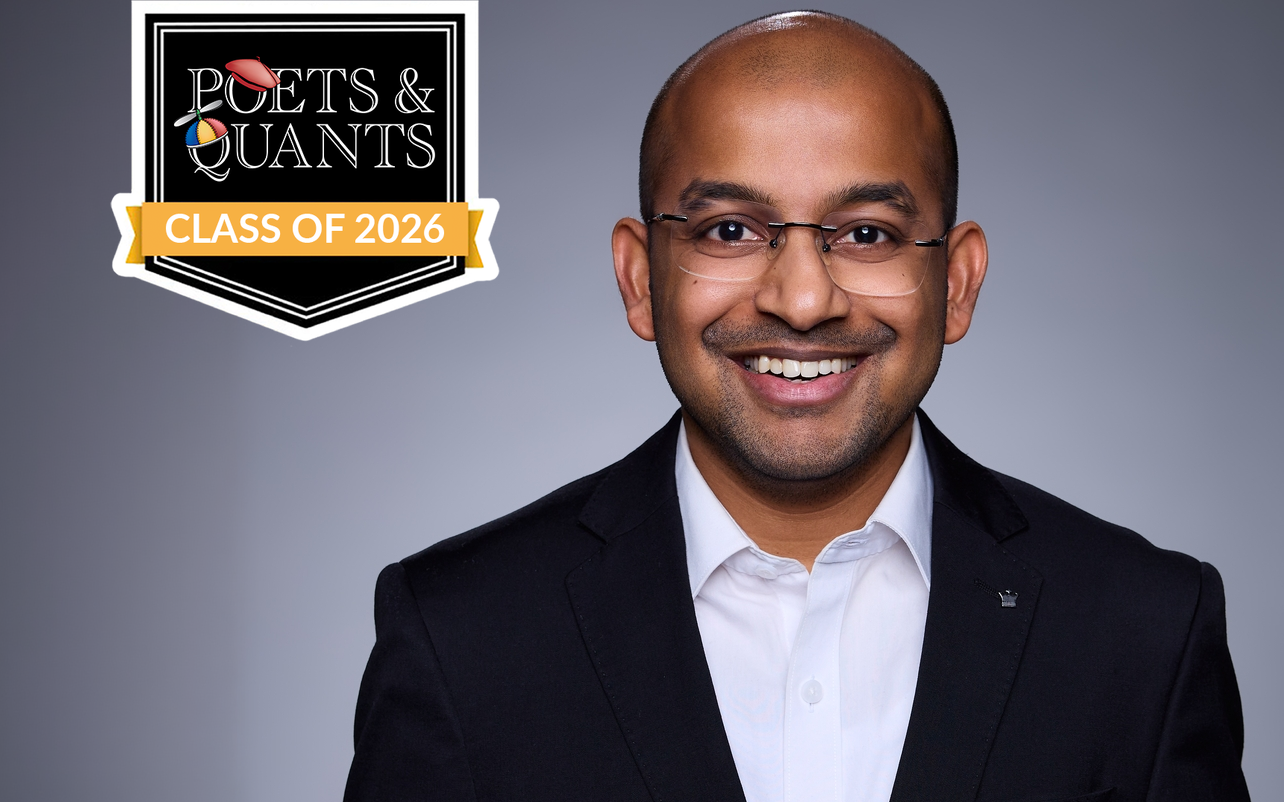
Srikanth Pilla “Taking things apart to dig deeper. Fixing them to help others. Growing along the way” Hometown: Visakhapatnam, India Fun Fact About Yourself: My best friends & I shot a dance video while in university and the ... The post Meet The IMD MBA Class of 2026, Srikanth Pilla appeared first on Poets&Quants .
“Taking things apart to dig deeper. Fixing them to help others. Growing along the way”
Hometown: Visakhapatnam, India
Fun Fact About Yourself: My best friends & I shot a dance video while in university and the video has 1mn+ views on YouTube.
Undergraduate School and Major: Mechanical Engineering, IIT Bombay, India
Most Recent Employer and Job Title: Commercial Excellence Manager, Glenmark Pharmaceuticals, India
What has been the best part of being in a small class with this group of classmates?
When you spend six to eight hours a day together for months, in class and working in different groups, you get to know how people think, what they bring and where you disagree. There is almost always someone in the room who sees a problem differently from me, and I’ve learned a lot from understanding why.
That familiarity also changes the way we give and receive feedback. We are taught how to do both well at IMD, but it becomes much more meaningful when it comes from someone who really knows you. You can be more candid with each other, and when someone challenges you, you know it’s based on months of seeing how you work, not one interaction. That makes it much easier to listen, reflect and do something with it.
The size of the class also makes experiences possible that would be very difficult with a much larger cohort. For our Singapore module, for example, the MBA team arranged for the entire class to travel on the same flight and stay in the same hotel. It sounds like a small logistical detail, but it meant we experienced the month as one cohort. That’s something I’ve noticed repeatedly at IMD: the program is student-centric, not teacher-centric.
Aside from classmates, what part of IMD’s MBA programming led you to choose this business school and why was it so important to you?
As we progress in our careers, people management becomes more important than task management. I’ve worked across multiple functions, and the common thread I’ve encountered is the importance of how I lead, both myself and others. A few of the leaders I’ve worked with inspired me to think more deeply about my own executive presence and approach to problem-solving. We spend at least a third of our day at work, and for me, creating a positive environment for the people around me is paramount. At this stage in my career, I’m making the transition from managing tasks to managing people.
So, I was specifically looking for an MBA that could help me develop my leadership abilities. IMD’s emphasis on leadership development became a deciding factor.
I’ve also interacted closely with the healthcare ecosystem throughout my life, both personally and through my family, many of whom are doctors. After working for a year at Cipla in India, I began to see how the decisions I made could ultimately affect patients’ health, and I decided to build my career in healthcare. Switzerland’s strong healthcare ecosystem, and its access to other key European markets, made IMD the right choice for me.
IMD is known for academic rigor. What is one strategy you used that would help a future IMD MBA better adapt to the workload early on?
Every C-suite leader I worked with has one skill in common: “time management”. Working closely with top executives in India, I became extremely brutal about prioritization. I religiously followed the Eisenhower decision matrix. This not only helped me navigate the academic rigor at IMD but also enabled me to have enough mental space. I was also very sure of what I do not want. I always had fewer options to select from. My only recommendation to future IMD MBA candidates is “less is more”.
Describe your biggest accomplishment in your career so far:
In my recent role as Commercial Excellence manager, I led a patient support program for chronic respiratory patients to guide them through their rehabilitation. I was mandated to improve the efficiency of the program involving 1000+ doctors, 100+ respiratory educators and 10 lung physiotherapists. After extensive fieldwork talking to doctors, I realized I needed to solve diverse problems simultaneously.
Realizing doctors needed customized service, I revamped the doctor engagement strategy. I established a periodic training system for the educators to improve counselling skills. I devised a WhatsApp marketing strategy to reach more patients and ensure rehabilitation adherence, improving patient engagement for online physiotherapy sessions. I also spearheaded multiple awareness webinars and deployed educational material spreading awareness across 200k+ patients.
In 12 months, I increased the number of doctors engaged by 63%, the proportion of productive doctors from 25% to 60% and the monthly patients receiving our lung physiotherapy by 300%. This experience made me realize the power of breaking down a problem and staying focused. The testimonials from doctors and patients on how the program helped them recover were fulfilling. This is my most notable achievement as I was able to create a direct impact on patients’ health and that’s what makes me feel proud.
Describe your biggest accomplishment at IMD so far:
My own leadership transformation is my biggest accomplishment so far. When I started my MBA in January, I keenly looked forward to the leadership module more than anything. I was excited to see that both Dean and Director of the program are very actively involved in the Leadership stream.
Through my PDE (Personal Development Elective) and Leadership Coach, I evaluated how I lead myself and how I lead others. During the first 10 minutes of my first leadership coaching session, I recognized that I don’t always draw boundaries. During one of the PDE sessions, I realized even when I set boundaries, I over analyze if I had crossed boundaries during the process. I translated this realization and practiced it over the next couple of months on real life situations where I stood for myself whilst being respectful and polite. These improvements usually take time, and we also need the right environment for these to come to fruition. Fortunately, IMD MBA has plenty of opportunities to develop how I lead myself.
There are many behavioral patterns that come to surface while working with diverse people. Diversity comes from nationality, yes, but also from professional and personal experiences. My group work so far unearthed a few of my patterns that needed improvement. While I knew conflict is not animosity, it was very difficult for me to engage in conflict. I either agreed quickly or avoided conflict. I came to know through my leadership assignments that this pattern not only hurts my chances to grow but also does not help the team to do better collectively. I am now actively stepping into uncomfortable zones and not avoiding conflict. While improvement is a journey, I’m grateful I’m made aware of these patterns and that is the reason I consider this as my biggest achievement.
Where is your favorite hang-out in Lausanne? Why do you (and your classmates) gravitate there?
Personally, I prefer a more intimate setting, as an introvert. At least once in two weeks, we have a house party in my apartment. We all cook together and have delicious Indian food. And yes, endless talking!
The three cities I have lived in most are all by the sea. Cool breeze from water bodies calms my mind. At times, sitting by Lake Geneva is more relaxing than going to a fancy place. So, sitting by the lake is my favorite hang-out outside.
We all prefer places where we can immerse ourselves in thought-provoking conversations. So, classmates often hang out by the lake. Having said that, we party hard too. In the first one month, I don’t remember a day when someone from our cohort wasn’t partying in White Horse, a go-to place for the cohort. Apart from White Horse, Jetée de la Compagnie and The Lacustre are a few more places to name.
What has been your best memory at IMD thus far?
There is one moment that I cherish the most (and that I can reveal here). “Women’s Football Final – MBAT 2026”.
When we all landed in HEC Paris for MBAT, a sports and cultural competition for European MBAs. Little did I expect that we would have such a memorable end. Over the 3 days of events, we broke barriers to support each other. We all go to MBAT irrespective of our event participation.
We had a cheerleading group too who weren’t competing in anything. I saw the support, cheerleading and bond grow as the days passed at MBAT. Some of us roamed with snacks, some of us moved with a megaphone and some of us were coordinating the events to attend. Just to support our classmates.
Our women’s football team had been quietly dominating every game, and the excitement grew gradually in the cohort over the 3 days for the final, which is one of the last events of the competition. We all gathered before the game to support the team. Imagine the full cohort sitting on the sidelines cheering for your team against the hosts. All due respect to the hosts but we did better at supporting. The banter we had during the game was fun. That 7-1 scoreline wasn’t expected. The cohort running on the pitch and huddling up was joyful. We took a memorable group photo. This experience made me realize that the strongest connections are made when you show up for people even when there is nothing in it for you.
The post Meet The IMD MBA Class of 2026, Srikanth Pilla appeared first on Poets&Quants .