MIT affiliates elected 2026 American Geophysical Union Fellows
MIT News ·
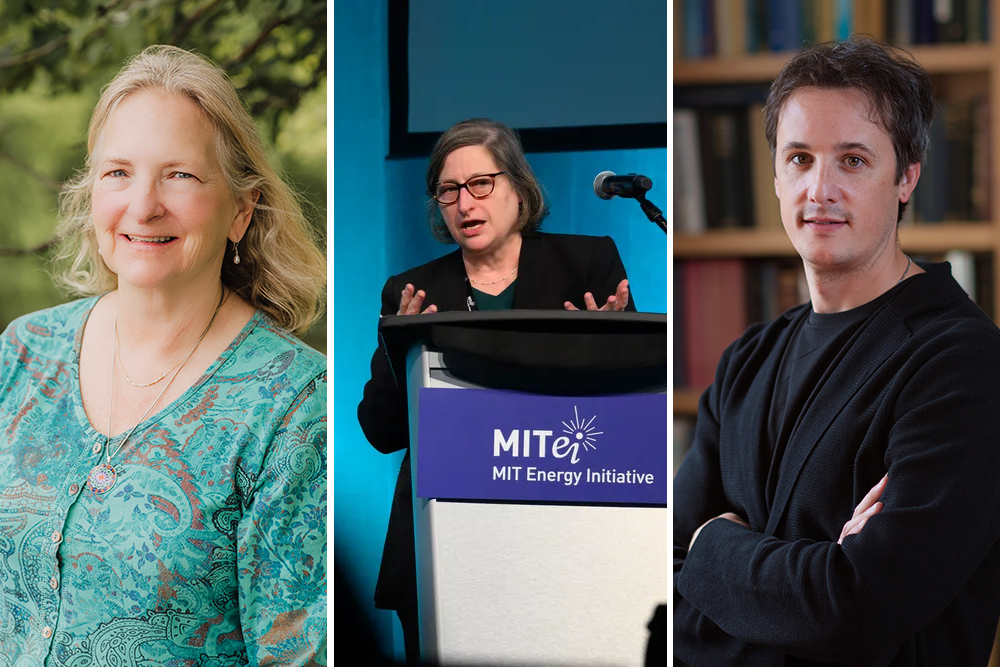
Anthea Coster, Carolyn Ruppel, César Terrer, and eight additional alumni are honored for their work in the geosciences.
Three MIT affiliates — Anthea Coster of MIT Haystack Observatory, Carolyn Ruppel ’86, SM ’86, PhD ’92 of the MIT Energy Initiative, and César Terrer of the Department of Civil and Environmental Engineering — have been elected as fellows of the American Geophysical Union (AGU) for 2026.
The AGU also honored eight additional MIT alumni as new fellows: Claudia Benitez-Nelson PhD ’99; Robert Howarth PhD ’79; Douglas J. Jerolmack PhD ’06; Tamara Shapiro Ledley; Galen A. McKinley PhD ’02; Mark David Schmitz PhD ’02; Frederik J. Simons PhD ’02; and Dawn Y. Sumner PhD ’95.
With some 60,000 members in more than 135 countries, the AGU is the world’s largest professional organization for Earth and space scientists and annually elects less than 0.1% of its membership to fellow status. Fellows are chosen from among AGU members who “have made exceptional contributions to Earth and space science through a breakthrough, discovery, or innovation in their field.” AGU Fellows are recognized for their scientific eminence, demonstrated through breakthroughs, discoveries, or innovations that advance the Earth and space sciences. Fellows also act as external experts, advising government agencies and other organizations outside the sciences.
Anthea Coster
Anthea J. Coster is an MIT principal research scientist and Haystack Observatory assistant director emerita.
Coster joined MIT in 1984, originally at MIT Lincoln Laboratory. At Haystack, her career work focuses on atmospheric physics across the ionosphere, magnetosphere, and thermosphere, along with space weather effects and coupling across these different parts of the complex Earth system. She has been responsible for numerous breakthrough contributions in global navigation satellite signal (GNSS) applications to geospace research, including the first GNSS observations of storm-enhanced density across the heavily populated continental United States. She is a recent winner of the Appleton Prize from the International Radio Science Union.
One of the nomination letters for Coster’s AGU Fellowship states, “recognizing that high-level conferences alone were insufficient to provide the necessary training for researchers in developing nations, she co-founded the annual GNSS workshop series (since 2009) in partnership with Boston College and ICTP [the Abdus Salam International Center for Theoretical Physics], training 40–50 participants yearly from developing countries … Through the U.N.-sponsored International Space Weather Initiative (ISWI) and other programs, she has participated in numerous public outreach initiatives, consistently working to make space science accessible to diverse audiences worldwide.” Her nomination also mentioned “[h]er efforts in bringing space physics to South America, Africa, and tribal Alaska ... as does her work with advocating for opportunities for women and underserved populations,” and highlighted her integrity, work excellence, respect for colleagues, and collaboration efforts, as well as her public outreach activities.
Carolyn Ruppel
Carolyn Ruppel , who earned three degrees from the MIT Department of Earth, Atmospheric and Planetary Sciences, is currently the deputy director of science and technology at the MIT Energy Initiative (MITEI). Ruppel, a life member of the AGU, is an expert on gas hydrates, an icelike combination of water and concentrated methane that sequesters an estimated 15% of Earth’s massive methane budget. Before joining MITEI in 2025, she held positions at Woods Hole Oceanographic Institution (1992-93), Georgia Tech (1994-2006), and the U.S. Geological Survey’s (USGS’s) Woods Hole coastal and marine research center (2006-2025). In her current position, Ruppel supports Director William H. Green in leading MITEI’s strategic and technical activities. She coordinates among member companies, MIT researchers, and MITEI’s internal teams to manage its portfolio of energy research, education, and outreach.
Starting in 2010, Ruppel led the renowned USGS Gas Hydrates Project, focusing on the resource potential of these shallowly buried and widely distributed deposits, as well as possible feedbacks among warming climate, gas hydrate breakdown, and release of methane (a greenhouse gas) to the ocean and atmosphere. In 2011, Ruppel wrote the supplementary paper on gas hydrates for the MITEI study on “The Future of Natural Gas.” Ruppel also led the influential study debunking catastrophic scenarios for massive gas hydrate breakdown due to global warming and co-discovered over 700 seafloor methane seeps on the U.S. Atlantic margin. Ruppel’s other scientific contributions have been in the fields of continental rifting, subsea permafrost distribution, hydrate reservoir dynamics, and marine heat flow and acoustics.
César Terrer
César Terrer is the TianFu Group Career Development Professor and associate professor of civil and environmental engineering at MIT.
Terrer studies the land carbon sink: The roughly 30 percent of annual carbon dioxide emissions that plants and soils absorb each year, and whether that will hold through this century. It is one of the largest uncertainties in climate projection. Earth system models disagree about the fate of the land sink by an amount comparable to decades of emissions, largely because they represent the biology that governs it through assumptions rather than measurements. Terrer’s group replaces those assumptions with data, combining global observations — CO₂ experiments, soil inventories, forest plots and satellites. That work has shown that soil nutrients limit how much extra carbon plants take up as CO₂ rises, about three times less than models had assumed; that plant and soil carbon trade off against one another rather than accumulating together as models assume; and that animals are part of the carbon cycle, with tropical forests that have lost their seed dispersers regrowing less than a quarter as much carbon as intact ones. His group is now testing whether soils, rather than vegetation, account for most of the recent land sink.
All of Terrer’s first-author papers are cited in the Sixth Assessment Report of the Intergovernmental Panel on Climate Change. NASA selected him to co-lead the modeling and data synthesis working group for PANGEA, the scoping study shaping the agency’s next tropical field campaign, and Apple, Cargill, PepsiCo, Inditex, and other organizations have sought his advice on natural climate solutions.
Alumni honored
The eight additional MIT alumni honorees elected AGU Fellows graduated from the following departments: