Meet Seven Scholarship for Service Interns Strengthening NASA’s Digital Infrastructure
NASA OIG ·
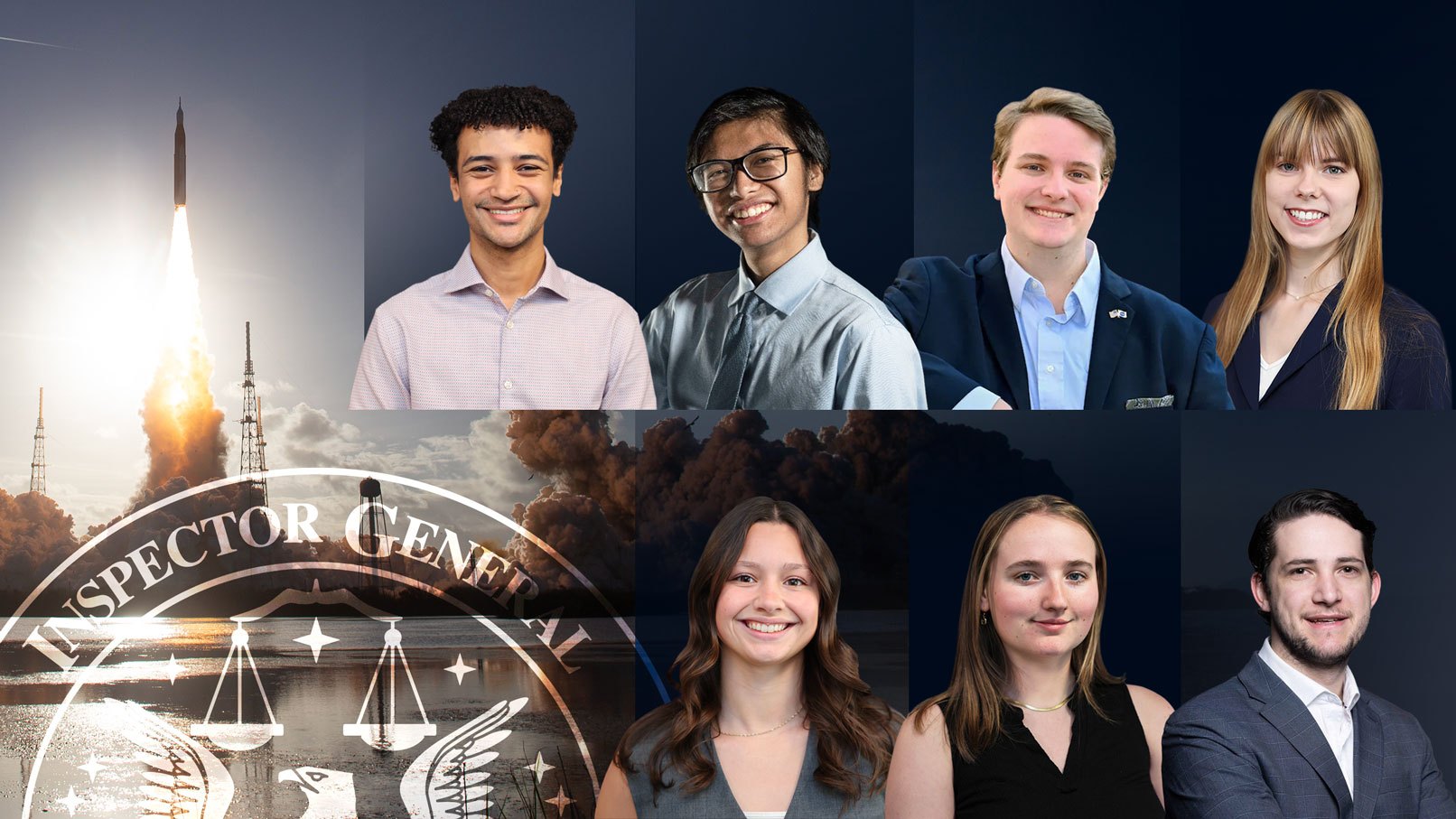
From the launchpad to the laboratory, secure data systems underpin each of NASA’s ambitious missions. Through the CyberCorps® Scholarship for Service (SFS) program, the Office of Inspector General (OIG) recruits exceptional undergraduate and graduate students to help protect the Agency’s critical infrastructure. Managed by the National Science Foundation in partnership with the Office of Personnel […]
From the launchpad to the laboratory, secure data systems underpin each of NASA’s ambitious missions. Through the CyberCorps® Scholarship for Service (SFS) program, the Office of Inspector General (OIG) recruits exceptional undergraduate and graduate students to help protect the Agency’s critical infrastructure. Managed by the National Science Foundation in partnership with the Office of Personnel Management and the Department of Homeland Security, the program provides educational funding in exchange for a post-graduation commitment to government service.
At NASA OIG, SFS interns tackle complex challenges within the Office of Investigations , working directly with experienced intelligence and data analysts. This year, the OIG hosted a standout cohort of interns who strengthened the Agency’s oversight efforts by modernizing anti-fraud tools, investigating allegations of misconduct, solving cases using open-source data, and more. Explore their career paths, projects, and advice for future SFS scholars.
A senior at The George Washington University (GW), Marcell Ambush is earning his bachelor’s degree in computer science. He entered the university ready to explore a broad range of careers, but after attending various information sessions he ultimately homed in on cybersecurity.
After completing a data analytics internship at a private investment firm, Ambush decided to shift his focus to the public sector. Becoming an SFS scholar seemed like an ideal way to make this transition, so he attended an SFS career fair and met NASA OIG representatives from the Office of Data Analytics (ODA).
I discovered that the OIG had a data analytics internship that perfectly matched my background. Being able to contribute to NASA’s oversight really appealed to me. Marcell Ambush
SFS Intern, Office of Data Analytics
As an ODA intern, Ambush developed a tool to help the OIG’s Office of Communications track and evaluate multimedia engagement. These efforts earned him a project-based award and significantly expanded his technical expertise. He collaborated with colleagues across the OIG—and even met the SpaceX Crew-11 astronauts when they visited NASA Headquarters in Washington, DC.
“This internship has helped prepare me for a future in government service by introducing me to different skills and people,” Ambush said. “From the start, everyone has been very welcoming, and I feel very comfortable reaching out if I ever need help.”
After earning his bachelor’s degree next spring, Ambush will remain at GW to pursue his master’s degree. Given the growing need for cybersecurity and artificial intelligence experts in the federal government, he is eager to begin his full-time civil service career.
His advice to fellow SFS interns is to never shy away from asking questions. “It shows you are learning and active in your work,” he said. “Asking questions is also a great way to build connections with your colleagues.”
Christian Culanag’s interest in cybersecurity stemmed from an early knack for problem solving. Initially drawn to software programming, he found himself gravitating toward a career in cybersecurity after participating in summer courses, clubs, and competitions. He attended a Career and Technical Education high school, which allowed him to pursue a dual major in cybersecurity and computer science.
Culanag went on to earn his bachelor’s degree in computer science and engineering from the University of Nevada, Reno (UNR), where his college mentor encouraged him to join the SFS program. When it came time to apply to internships, a fellow SFS scholar and former OIG intern recommended he check out NASA. Chatting with representatives from the OIG’s Criminal & Cyber Targeted Intelligence (CaCTI) Unit at a career fair solidified his interest.
I was drawn to the investigative nature of the job. The prospect of being able to solve problems, while supporting NASA and its missions, was too incredible to pass up. Christian Culanag
Former SFS Intern, Criminal & Cyber Targeted Intelligence Unit
Working with CaCTI open-source intelligence (OSINT) analysts at the Jet Propulsion Laboratory, Culanag used open-source information to advance ongoing investigations, carefully documenting and reporting his findings. One case in particular required him to be highly resourceful and leverage creative methods to track down information. Throughout the process, he was able to collaborate with the lead special agent in real time.
“Every single person I talked to was incredibly passionate about their career,” he said. “I learned so much about report writing and the investigative process, and I am grateful for these opportunities.”
Culanag is currently earning his master’s degree in computer science at UNR and plans to pursue a career in the federal government with a focus on digital forensics. He is grateful for the mentorship and guidance he’s received as an SFS intern and aims to pay it forward.
“I strive every day to be even a fraction as reliable and motivating as those before me,” he said. “My goal is to foster the spark of learning, just as those in the cybersecurity community have done for me.”
He urges current and future SFS scholars to focus on a direction rather than a destination. “Every step forward is a success,” he explained. “Continue walking in the right direction as best you can.”
Noah Dillon first learned about the SFS program as a high school student attending cybersecurity summer camp at Tennessee Tech University. He later enrolled at the University of Tennessee at Chattanooga, where he earned both his bachelor’s and master’s degrees in computer science with a concentration in cybersecurity. In 2024, while he was still an undergraduate, he attended an SFS career fair and met NASA OIG’s ODA team.
“I’ve always been interested in space and exploration, so doing something with NASA was always a dream,” he said. “After the SFS job fair, I remember calling my father and saying, ‘These are my people.’ Looking back over the past two and a half years, I was right.”
As an ODA intern, his primary project involved modernizing an investigative tool to detect fraud in government grants and contracts. The tool is now available to NASA OIG auditors and investigators, as well as the broader federal oversight community.
Everyone I’ve met at NASA OIG has been incredibly kind and wanted to help me achieve my goals. The Agency is extremely dedicated to providing professional development opportunities and making sure that you are the most capable version of yourself. Noah Dillon
Former SFS Intern, Office of Data Analytics
Today, he serves as an information technology (IT) specialist in the OIG’s Office of Audits. As part of his auditor training, he recently visited Kennedy Space Center (KSC) to meet colleagues from other NASA centers and tour the launch facilities.
Reflecting on his experience, he considers his time as an SFS scholar and OIG intern integral to his professional development. “The opportunities to make connections and grow as a professional are well worth the effort,” he said. “It’s exciting to use my technical skills to help secure computer systems and protect NASA’s vital missions.”
Amelia McMahan grew up in Alabama close to Marshall Space Flight Center (MSFC), where NASA and space exploration were a cornerstone of the community. Aspiring to be an astronaut was practically a rite of passage, but those dreams faded for McMahan once she became interested in cybersecurity.
I realized that I could still contribute to NASA’s mission in some way. The idea that I could be part of investigations that strengthen the integrity of the Agency was particularly inspiring. Amelia McMahan
SFS Intern, Criminal & Cyber Targeted Intelligence Unit
While she was still in high school, McMahan enrolled in a workforce development scholarship program at Calhoun Community College. She received a certificate in cybersecurity and went on to earn a bachelor’s degree in that same discipline from Mississippi State University. There, she applied to the SFS program to launch her federal career.
Now, as a NASA OIG intern at MSFC, McMahan supports CaCTI investigations into misconduct and grant fraud, in addition to assisting with data breach reports. Outside of her casework, she’s also attended a panel featuring the Artemis II astronauts and toured KSC.
“The atmosphere at NASA OIG is incredibly inspiring, and I’ve been able to contribute to cases that have a meaningful impact,” she said. “I was surprised by how friendly and supportive everyone is. Even OIG senior management made a point to introduce themselves and personally welcome each intern.”
To those considering participating in the SFS program, her advice is: “Take that first step, even if you feel intimidated! If you’re considering federal service, SFS is an amazing way to build your experience, connections, and resume while supporting your academic career.”
Jacquelyn Sansone attended Oregon State University, where she earned her bachelor’s degree in computer science with a focus in cybersecurity. The university began participating in the SFS program when she was a first-year, and applying seemed like the next natural career step. “I knew I wanted to work for the government, and SFS sounded like a unique opportunity,” she said.
Sansone first learned about NASA OIG internships during a career fair where she met CaCTI’s OSINT analysts. They challenged her to solve a puzzle: track down missing information using only open-source data to complete a series of statements.
“I had so much fun and the people were so friendly,” Sansone said. “After the career fair, I knew working with NASA OIG was something I wanted to pursue.”
Although Sansone is based at Johnson Space Center, she’s traveled to other NASA centers to meet OIG auditors, legal experts, administrative staff, and others in the oversight community. These experiences have helped her develop new technical skills and practice communicating with colleagues in different fields.
NASA OIG has taught me what it takes to be a good OSINT analyst, and I'm excited to continue learning here for as long as I can—and hopefully continuing doing OSINT at my next job. Jacquelyn Sansone
SFS Intern, Criminal & Cyber Targeted Intelligence Unit
For those just starting their careers, Sansone emphasizes the importance of curiosity and persistence. “Everyone’s path is different, and things might not work out the first time,” she explained. “If there’s an opportunity you really want, go after it and don’t give up.”
Meagan Wentworth holds a bachelor’s degree in computer science with a minor in physics from the University of Rhode Island (URI). Most recently, she graduated as an SFS scholar from URI’s cybersecurity master’s program.
“I decided to pursue a career in cybersecurity because I love the problem solving and constant learning required to do the job,” she explained. “SFS is a great way to get government experience in this area, and it also allowed me to get my master’s done in one year.”
Eager to contribute to NASA’s mission, Wentworth applied to an internship working with CaCTI’s OSINT analysts. Now, she supports investigative casework by utilizing publicly available information from websites, social media, public records, geolocation data, and other platforms to root out fraud, waste, and abuse. Although she’s stationed at NASA Headquarters in Washington, DC, Wentworth also traveled to KSC to watch engineers assemble components of Artemis III.
The work at NASA and the OIG is genuinely impressive. Many people are surprised by how broad the OIG’s scope truly is. It’s been rewarding to share that with others and help them understand the impact of what we do. Meagan Wentworth
SFS Intern, Criminal & Cyber Targeted Intelligence Unit
Ultimately, Wentworth hopes to secure a permanent position at NASA OIG. “Being an SFS scholar and working at the OIG had an incredibly positive impact on my life,” she explained. “If you’re still in school and interested in government work, I highly recommend looking into the SFS program and applying. The same goes for any internship with NASA; these experiences can truly open doors.”
Growing up, Matthew Winter was fascinated by puzzles and understanding how intricate systems function. He wanted to find a career where he could put these analytical skills to the test, so he applied to The University of Texas at Dallas and earned a bachelor’s degree in mathematics. After graduating, he worked for several years in the private sector before enrolling at Johns Hopkins University to earn a master’s in security informatics.
“I was just beginning my cybersecurity journey, and I was looking for ways to gain additional cybersecurity expertise,” he explained. “That’s when I started putting myself out there for various cybersecurity scholarships and came across the SFS program.”
As an ODA intern at KSC, Winter has assisted with data cataloging, designing an intuitive webpage, and optimizing a database search tool for investigators. In addition, he also toured KSC’s Vehicle Assembly Building with his fellow interns.
It was truly breathtaking to see the scale of NASA's work, and to see Artemis III getting assembled. It really helped me understand the importance of what we do at NASA OIG. Matthew Winter
SFS Intern, Office of Data Analytics
After he finishes his master’s, Winter is looking forward to pursuing a full-time position in the federal cybersecurity workforce—ideally related to cryptography and threat intelligence.
He encourages future SFS interns to shoot for the Moon. “Learning is a lifetime journey, and the SFS program is an amazing opportunity that allows you time and resources to seriously pursue practical skills in cybersecurity full-time,” he said. “Working with NASA OIG is a joy. They are truly a group of like-minded, intelligent, focused individuals who improve NASA’s mission through their work.”