Audiophiles are eating good this December with new headphones and earbuds from classic American brands
Popular Science ·
If you're wondering what to get the audiophile in your life this Christmas, innovative wired and wireless options from Klipsch, Grado Labs, and Noble Audio just made the choice easier ... or maybe harder, because they're all awesome. The post Audiophiles are eating good this December with new headphones and earbuds from classic American brands appeared first on Popular Science .
If you’re into personal audio , you might not want to spend all your money during Black Friday/Cyber Monday (but feel free to spend a little, and keep coming back here for some great suggestions as to how). Just within the last week, several innovative new headphones and earbuds have been announced, so read on for wired, wireless, and TWS options for every taste.
First up is Klipsch , the Hope, Arkansas-based heritage brand celebrating its 80th anniversary. But that doesn’t mean the acoustic design team is stuck in the past. Originally teased as Atlas at CES 2026 during a behind-closed-doors preview alongside powered standmount speakers and other surprises, the new Stratos Series uses an atypical (for headphones) two-way coaxial array, which aligns a mid/bass driver with a dynamic tweeter on a single axis to deliver low-distortion, high-efficiency, full-range sound.
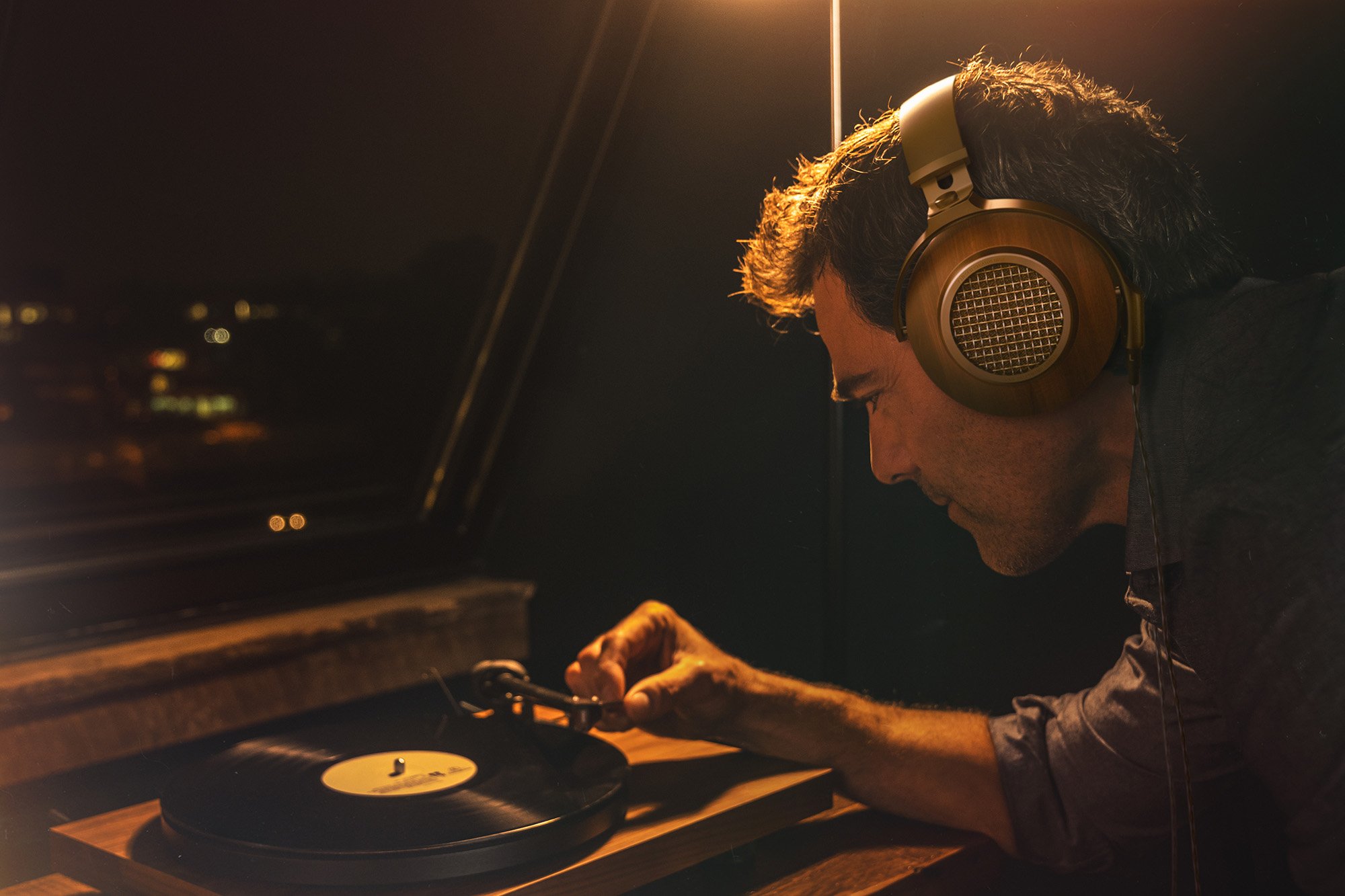
The 380g Klipsch HP-2 (above) is the closed-back option, with a 40mm bio-cellulose woofer and 10mm tweeter achieving a frequency response of 15 Hz-18 kHz (+/-5 dB), plus isolation for more critical monitoring. The 458g HP-3 (below, and the one we’re most excited to audition) is a semi-open-back design that expands the woofer to 50mm to make up for some of the low end typically traded for a more expansive soundstage, and it achieves 16 Hz-22 kHz (+/-5 dB). Both promise “warm, punchy bass and crisp, sparkly highs,” and the pre-production units I heard in January delivered a good bright/bouncy balance, with rich, fun-colored but still composed mids as I recall (though it’s been many months removed).
Both models have an appropriately mid-century modern aesthetic, with auburn-stained sapele wood earcups and copper accents, machined aluminum yokes and contact points, Klipsch Heritage Twitchell grille cloth, replaceable microseude earpads, and protein-leather-wrapped open-cell-foam-filled headbands. Both 4.4mm balanced and 3.5mm unbalanced cables (plus a 1/4-inch adapter) with dual-mono connectors are included.
While both the Stratos HP-2 and HP-3 can be paired with smartphones and dongles of all sorts, they’ll really open up with a more refined signal chain, like the simultaneously announced $649.99 Onkyo HA-70, featuring two premium ESS ES9039Q2M SABRE DACs feeding an amplifier with plentiful inputs and three gain settings versatile enough to drive sensitive IEMs to 600Ω flagship headphones.
Compared to Klipsch, Brooklyn’s Grado Labs is a relatively young’un at the spry age of 73. First (and still) known for decades of producing phono cartridges, the family-owned company expanded into distinctive, hand-built headphones in the late ’80s (and still produces some fabulous flagships). The GW200 carries that tradition into something you can carry. The 235g GW200 takes a 44m S paper-composite diaphragm derived from the drivers in the company’s multi-thousand-dollar Signature line and puts it in an open-back wireless headphone. This helps deliver expressive bass and treble articulation within a frequency response of 16Hz – 34kHz.
Being open-back means a more spacious presentation with more instrument separation than your typical Bluetooth headphone (at the expense of isolation, of course, so don’t expect these to stand in for ANC travel headphones ). Helping ensure this is Bluetooth 5.4 with support for Qualcomm aptX Lossless, aptX Adaptive, aptX HD, aptX, AAC, and SBC, plus 60+ hours of battery life. And there’s a single-sided 3.5mm audio input for passive use in case the battery does run out (or you just prefer an external DAC/amp combo).
As for comfort and tuning, the GW200 comes with the Grado Labs F Cushions but is compatible with Grado’s complete line, so you can change both the physical and sonic feel by swapping them. Another trickle-down from the Signature series is the padded leather headband, which goes nicely with the matte black finish. We’re looking forward to getting a pair to try out.
Over in eastern Texas, Noble Audio has been producing artisan IEMs since the early 2010s (and founder John Moulton was doing custom in-ear monitors for enthusiasts even before that). In recent years, the company has been showing what’s possible when the multiple-driver mentality of IEMs (some costing many thousands of dollars) is turned to portable audio, and the Astrid is the latest example. A tribrid architecture featuring an 8.3mm dynamic driver with a PU diaphragm and an aluminum-magnesium alloy dome, a 6mm planar driver, and one balanced armature in each earpiece, the Astrid brings a wired configuration and sophistication to true wireless earbuds.
The overall tonality of the Astrid is rich, full-bodied, but not boomy … punch but not paunch. While sitting beneath the company’s top TWS model, the 4-driver Prestige Encore, Astrid still delivers a detailed soundstage. What really brings the best out of it is the Audiodo Personal Sound feature, which uses a short tone recognition test to test each ear and saves per-channel adjustments on the earbuds to make up for any frequency range deficiencies. Then Audiodo Equalizer lets you address sensitivities/preferences, overlaying further adjustments on your personalized curve (3-band on iOS, 5-band on Android). There’s also an assessment-independent 10-band EQ if that’s more your vibe.
To ensure the most cohesive playback possible, there’s multipoint Bluetooth 6.0 with high-resolution LDAC/aptX Adaptive support for compatible devices, as well as AAC and SBC. Plus active noise cancellation. Battery life is rated up to 11 hours on a single charge, with the wireless/USB-C case bringing the total carry capacity to 40 hours. All that is wrapped in IPX4 ABS enclosures featuring “divinely beautiful” glass fiber faceplates adorned with a dense lattice of silver filigree, like electro-acoustic etching … a metallic polyphony of colliding chords and intersecting transients.
The post Audiophiles are eating good this December with new headphones and earbuds from classic American brands appeared first on Popular Science .