I reviewed the new M6-powered Mac mini and iMac: Here’s how to pick the right Apple desktop for you
Latest from Tom's Guide ·
Anthony Spadafora is the managing editor for security and home office furniture at Tom’s Guide where he covers everything from data breaches and malware to password managers and the best way to cover your whole home or business with a strong Wi-Fi signal. Before joining the team, he spent three years covering cybersecurity and B2B tech for ITProPortal while living in South Korea. After moving back to the US. Anthony joined the TechRadar Pro team where he covered these topics along with VPNs, web hosting, online collaboration software and video conferencing for four years. Anthony also has his ears to the ground and is on the lookout for the next major cyberattack or data breach. Based in Houston, Texas, Anthony also handles VPN testing for both Tom’s Guide and TechRadar. As someone who has worked from home exclusively since 2018, he has reviewed dozens of standing desks as well as office chairs and has taken a closer look at other essential remote working accessories. As part of these reviews, Anthony frequently builds intricate desk setups which is why he’s such a big advocate for cable management and keeping things organized. When he’s not writing, he can be found tinkering with PCs and game consoles, managing cables and making upgrades to his smart home.
If you’re looking for a new computer and want a Mac, your first instinct might be to pick up one of the best MacBooks . However, opting for Apple’s premium laptops or even the much more affordable MacBook Neo has its drawbacks — especially if you're paying a portability premium for a machine that will rarely leave your desk.
Sure, the new MacBook Pro OLED looks fantastic with that illuminated Apple logo on the lid, and it is the first Mac with a touchscreen. For the majority of people, though, it’s total overkill. Unless you plan on editing 8K video or running demanding local AI models on the go, you’re buying far more computer than you need.
If you just want a reliable, fast Mac to use at home, Apple’s desktops are a much better bet. The powerhouse Mac Studio will be overkill for most, too. That’s why, if you’re setting up a dedicated home office or just need a shared family machine for the living room, the new Mac mini and iMac with Apple’s M6 chips make a whole lot more sense.
While you can configure either with beefier specs, I’ll be focusing on the entry-level models for this comparison: the base Mac mini with M6 and the base iMac with M6 . The latest Mac mini landed in September of 2026, followed shortly by the new iMac in November. Since both sport the latest Apple Silicon, either will easily last you for years to come.
Having reviewed both the Mac mini M6 and the iMac M6, the question is: which one actually deserves a spot on your desk and is worth your hard-earned cash? Here’s a full breakdown of their real-world performance, design, ergonomics, and value to help you decide between one of the best mini PCs and one of the best all-in-one computers you can buy right now.
Mac mini with M6
iMac with M6
Price
$899, £899, AU$1,449
$1,499, £1,499, AU$2,399
CPU
M6 (12-core CPU, 12-core GPU)
M6 (10-core CPU, 10-core GPU)
RAM
16GB (up to 32GB)
16GB (up to 24GB)
Storage
256GB (up to 512GB, 1TB or 2TB)
256GB (up to 512GB or 1TB)
Display
N/A
24-inch 4.5K Retina display
Ports
2 x USB-C, 3.5mm headphone jack (front), 3 x Thunderbolt 4/USB 4, 1 x HDMI, 1 x 2.5 gigabit Ethernet (back)
2 x Thunderbolt 4, 1 x 3.5mm headphone jack
Camera
N/A
12MP Center Stage camera
Connectivity
Wi-Fi 7, Bluetooth 6, Thread, Gigabit Ethernet
Wi-Fi 7, Bluetooth 6, Thread
Accessories
N/A
Magic Keyboard, Magic Mouse
Size
5 x 5 x 2 inches
21.5 x 18.1 x 5.8 inches
Weight
1.5 pounds
9.7 pounds (4.42 kg)
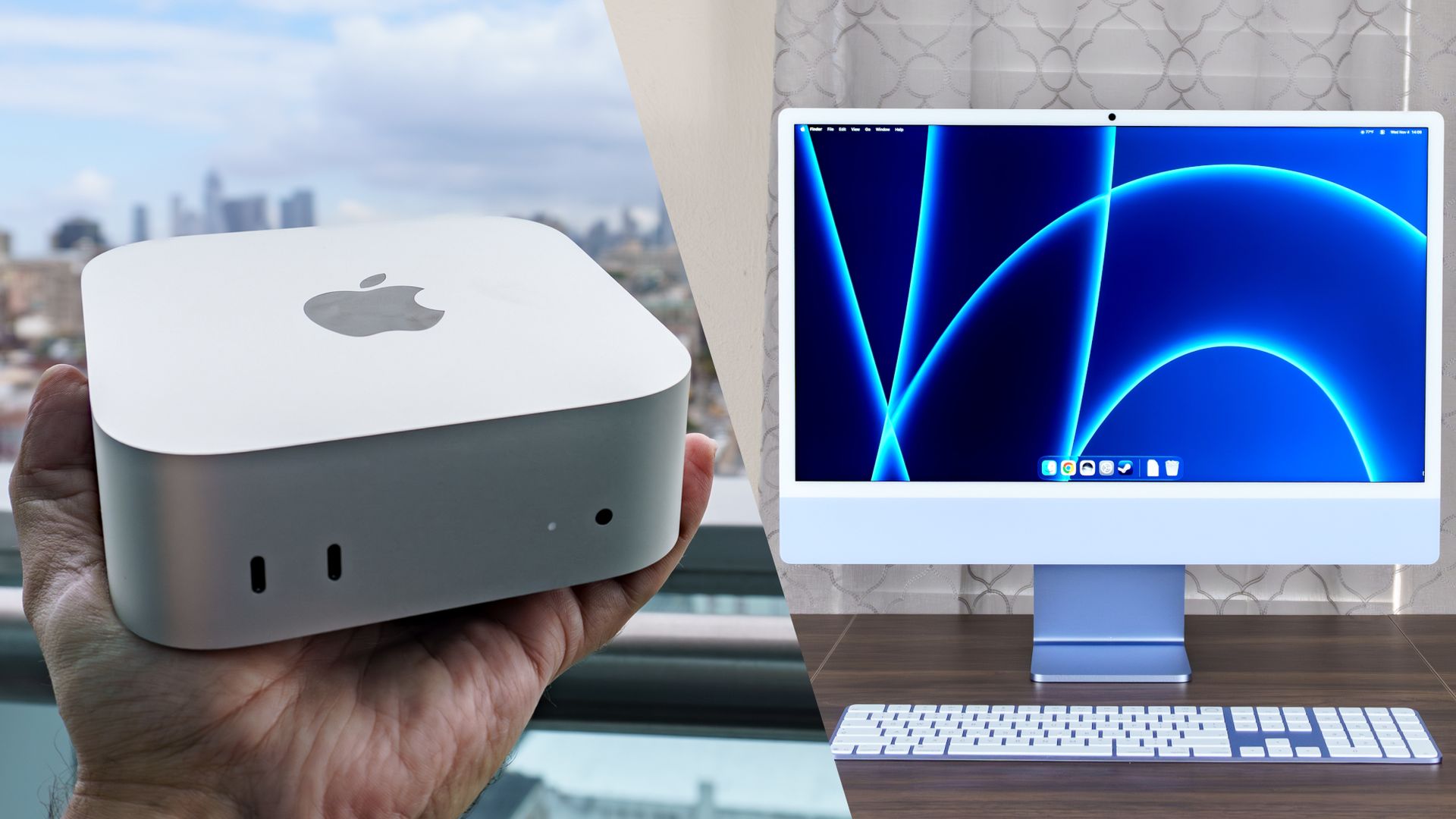
Even though the Mac mini with M6 and iMac with M6 are new Apple desktops, they share one very important thing in common: neither sports a radical redesign. Instead, they feature almost identical designs to their predecessors.
The Mac mini was completely redesigned back in 2024 with the Mac mini M4 . Like that machine, this new model is much more compact at 5 x 5 x 2 inches and retains those front ports — specifically two USB-C ports and a 3.5mm headphone jack. Besides charging, you can use those front ports to quickly connect your iPhone to transfer data, and having a headphone jack on the front means you can use wired headphones without having to plug them in at the back.
Then around back on the Mac mini M6, you get three Thunderbolt 4 ports, an HDMI port, a Gigabit Ethernet port, and a power port. Those Thunderbolt ports are great if you want to use one of Apple’s first-party monitors like the Studio Display or Studio Display XDR , but they also work with most portable monitors. Meanwhile, the Mac mini M6’s HDMI port is ideal for traditional monitors without a USB-C port.
The iMac with M6’s design is even older, though, as Apple first introduced it back in 2021 with the iMac M1. Though it has a much larger footprint than the Mac mini, the iMac M6 is still quite compact for an all-in-one at 21.5 x 18.1 x 5.8 inches.
Given the iMac M6 is an all-in-one, you don’t get nearly as many ports as you do on the Mac mini since you don’t need to hook it up to a separate monitor. While my review unit has four ports, on the base model, you just get two Thunderbolt 4 ports.
Then on the left edge of the device, there’s a 3.5mm headphone jack and that’s it. You can get an Ethernet port on its power adapter, but you’ll have to pay extra for it. The iMac M6 also features a six-speaker system and a built-in 12MP Center Stage camera for video calls.
Overall, you can’t go wrong with either the Mac mini or the iMac when it comes to their respective designs. Both desktops look sleek, but if you want a computer with the smallest footprint and the most ports, the Mac mini is the better choice. You will have to bring your own display, webcam, and other accessories, though.
Although the latest Mac mini and iMac both sport Apple’s new M6 chips, there is a slight difference between them when it comes to the base models.
While the Mac mini has an M6 chip with 12 CPU and 12 GPU cores, the M6 chip in the iMac only has 10 of each. In my testing, both machines feel quite snappy for everyday tasks like opening apps and browsing the web thanks to the improved efficiency that comes with the 2nm process Apple used with its M6 chips. It’s with more demanding tasks where you’ll notice a difference.
For instance, if you’re editing a lot of photos, rendering video, or are a power user with dozens of browser tabs open simultaneously, then the more powerful M6 chip in the Mac mini will certainly make a difference. If you just want a Mac for watching videos, writing emails, and basic daily tasks, the difference between these two M6 chips will be negligible.
One other area where you will definitely see an impact though is with gaming. While neither of these Macs can serve as a replacement for one of the best gaming PCs, they’re surprisingly capable when it comes to gaming and this is especially true with older titles. Here, the two extra GPU cores in the Mac mini help keep frame rates smoother.
For those who plan on pushing their new Apple desktop to the limit or playing games on it, then the more powerful M6 chip in the Mac mini is the better choice. However, if you just need a reliable machine for day-to-day use, the 10-core M6 in the base iMac has plenty of power to get the job done.
If you opt for a Mac mini over an iMac, you’re obviously going to need to get a monitor to go along with it — or you could use one you already have, just like with your mouse and keyboard, to bring your total overall cost down. However, if you want an excellent display with a high pixel count without having to do a ton of research first, there’s no screen quite like the one on the iMac.
The iMac features a 24-inch, 4.5K display with a resolution of 4480 x 2520. Since this panel is manufactured specifically for Apple, you won’t find another standalone monitor on the market with that exact screen size, resolution, and pixel density.
Most monitors that deliver around 218 pixels per inch like the iMac cost as much or more than a Mac mini M6 on their own. Samsung’s 27-inch ViewFinity S9 runs around $800 to $1,000, while LG’s 27-inch UltraFine 5K costs around $1,000 to $1,200. Granted, those panels are slightly larger than 24 inches, but they demand a hefty premium.
If you want something larger and more affordable, 27-inch 4K panels like the Dell UltraSharp or Asus ProArt can be had for around $400 to $500. However, because they aren’t native Apple displays, you do miss out on native features — like using the brightness keys on a Magic Keyboard to dim the screen without third-party software.
Even though 24 inches might sound modest, the high pixel density of the iMac gives you plenty of usable canvas. In my testing with the iMac M6, I was able to comfortably work with two browser windows side by side without feeling cramped.
There is one big catch with the iMac, though: ergonomics. Unlike the Studio Display or Pro Display XDR, there is no height-adjustable stand option. The built-in stand only tilts about 5 degrees forward or 25 degrees back.
To get your iMac to a proper ergonomic height — where your eyes naturally align just below the top third of the panel — you’ll likely need to set it on a monitor riser or desk shelf. Alternatively, you can ditch the stand altogether at checkout and order the factory VESA mount version, though you'll need to budget for one of the best monitor arms alongside your new all-in-one.
If you want a massive display, dual or even triple-monitor flexibility, or full control over your desk layout, the Mac mini is the obvious choice. But if you want a compact, incredibly sharp screen built right into the machine, the iMac’s display is tough to beat.
As the Mac mini doesn’t give you that computer-in-a-box experience that the iMac does, there’s a whole host of optional 3rd-party accessories available for it. From stands and hubs that sit underneath to enclosures that rest on top to add extra ports and even M.2 SSD slots for expanded storage, you can really accessorize Apple’s smallest Mac to your heart’s desire.
You’ll find a few USB hubs and add-ons for the iMac, but nowhere near as many as you will for the Mac mini. One new accessory I’m looking forward to testing with the iMac M6 is BenQ’s iScreenBar, a monitor light bar designed specifically to match the color and aluminum aesthetic of Apple’s all-in-one.
Likewise, Satechi makes a slim dock that sits directly over the iMac’s base to add front-facing ports and an SSD slot — similar to its popular stand and hub for the Mac mini . It’s a clean setup, but overall, the 3rd-party accessory ecosystem for the iMac remains much smaller, and for obvious reasons: there's just less to add to an all-in-one.
When it comes to first-party upgrades from Apple, you can configure both machines with extra unified memory and internal storage. Keep in mind that because everything is soldered down, these upgrades have to be chosen at checkout when ordering through Apple’s website — you can't crack either machine open to upgrade them later.
The most unique upgrade for the iMac M6 is Apple’s nano-texture glass . Just like on high-end MacBooks, instead of standard glossy glass that catches reflections, you can pay an extra $200 at checkout to add a matte finish. The catch? Apple doesn't offer nano-texture on the base 10-core iMac. You have to step up to the higher-tier model first before tacking on that $200 display upgrade, which widens the price gap between it and the Mac mini considerably. Still, there’s no other all-in-one on the market that offers a matte display quite like it.
If you want a vast ecosystem of desk mounts, docks, and external drives to completely personalize your workstation, the Mac mini is the obvious choice. But if you work in a sunlit room with nearby windows and glare constantly drives you crazy, stepping up to an iMac with nano-texture glass might be worth the extra investment.
Although the Mac mini M4 could be had for $599 at launch, thanks to RAMaggedon and the ongoing component crunch, Apple bumped up the starting price of the new Mac mini M6 to $899. As a result, when you factor in the cost of a display, keyboard, mouse, webcam, and speakers, the Mac mini is suddenly playing in the exact same price bracket as the iMac.
The iMac M6 saw a price increase of its own. While the iMac M4 started at $1,299, the new M6-powered version climbs to $1,499. The Mac mini used to be an unbeatable bargain compared to the rest of Apple’s lineup, but if you don’t already have a desk full of peripherals at home, you could easily spend $1,350 to $1,450 just to get a setup comparable to the iMac.
The real value proposition between the two comes down to your existing hardware. If you already have a spare monitor, keyboard, and mouse sitting on your desk, the Mac mini M6 delivers better raw performance for significantly less cash. But if you’re starting completely from scratch, the iMac’s $1,499 sticker price includes a built-in 4.5K display, crisp speakers, a 12MP Center Stage camera, and a color-matched Magic Keyboard and Magic Mouse right in the box.
If this is your first dedicated desktop, the iMac is the easier, better-value buy — unless you prefer an à la carte approach where you handpick every screen, dock, and keyboard yourself. If total customization is the goal, or you already have the accessories to make it work, go with the Mac mini instead.
While you can’t go wrong with either the Mac mini M6 or the iMac M6, the choice between the two ultimately comes down to how complicated you want your desk setup to be.
Let’s say you just moved and need to get to work right away in a new apartment where space is at a premium. One trip to the Apple Store later, you have a complete desktop in a box that you can set up in less than 30 minutes. If you want to heavily personalize your workspace, however — or if you prefer a much larger display or even multiple screens — then the Mac mini makes far more sense.
Regardless of which entry-level Apple desktop you choose, make sure you know what you’ll be using it for and how demanding your workflow will be before hitting checkout. When it comes to their internal components, neither the Mac mini M6 nor the iMac M6 can be upgraded after the fact. It’s essential that you configure the right chip, memory, and storage the first time around.
Although I review mini PCs for a living and have always been a big fan of the Mac mini, setting up and testing the iMac gave me a whole new appreciation for its simplicity. Sometimes, there is undeniable value in not having to overthink your monitor, cables, and peripherals.