A Few Miles From the US Capitol, Dozens Slept in Their Cars, Waiting for Free Care
KFF Health News ·
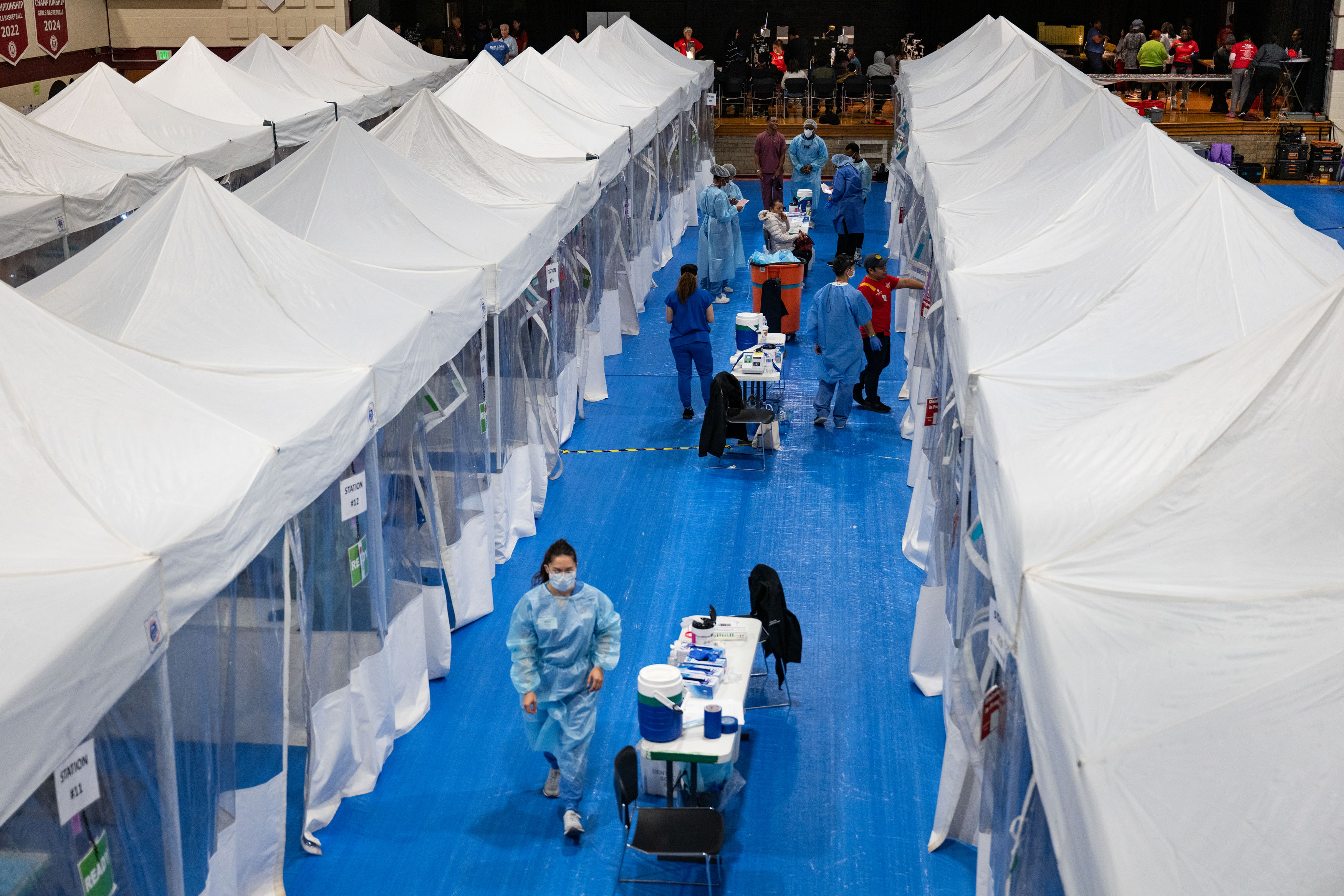
If you’ve heard about how people are struggling with affording healthcare but haven’t been touched by it or seen it, then this pop-up clinic just outside Washington, D.C., put the problem on full display.
TAKOMA PARK, Md. — Friday night lights took on a whole new meaning at a high school here in this suburb of Washington, D.C.
Instead of fans packing stadium bleachers to watch football, on this recent October weekend the gymnasium, hallways, and parking areas were jammed with people desperately seeking healthcare at a free pop-up clinic.
The 2026 election season has been punctuated by affordability issues, with polls showing high healthcare costs are a top concern among likely voters. The staggering toll of people struggling to get care was on full display here just eight miles northeast of the U.S. Capitol — in an area where census data shows the median household income tops $108,000 and about 94% have health insurance.
Dozens of people slept in their cars overnight outside Takoma Academy to secure spots for free health, dental, or vision care, according to clinic coordinators and interviews with patients.
Though clinic doors were scheduled to open at 6 a.m. Oct. 17, the first patients drove up shortly before midnight. By 4 a.m., three hours before sunrise, about 80 cars had arrived. Patients were given numbers representing their place in line when they entered the parking lot, and they had to be on site when they were notified by text message that it was their turn.
Kenys Bautista arrived at the school before midnight after driving 20 minutes from her home in Wheaton, Maryland. She wanted to be sure she got the medical and dental checkups that she had put off for three years because she didn’t have insurance or the money to cover the costs.
“It’s really sad that a lot of people like me had to sleep in their car just to see a doctor or dentist because we do not have health insurance,” Bautista said. She works as a payroll specialist for a small company but does not get any health benefits.
Bautista was one of 467 patients at the weekend clinic. Most received dental and/or medical care. Ninety-nine got vision exams, and many left with new eyeglasses, according to clinic organizers.
While most patients at the clinic were uninsured, 1 in 4 had health coverage, such as through Medicare or their employer. But many said just having coverage was not enough, because it left them with unaffordable out-of-pocket costs .
“I never thought I would need a clinic like this, but it’s gotten so expensive in the world,” Alma Walton said. She has Medicare, but routine dental care is not a standard benefit.
Walton, who lives in Camp Springs, Maryland, was 59th in line for care. She arrived around 1:30 a.m. “I wanted to make sure I could get in,” she said. She went to the clinic in hopes of getting a filling fixed after it cracked over the summer. She had postponed seeing a dentist.
Around 11 a.m., Walton was in one of the 30 dental treatment tents set up in the large gymnasium, having her filling replaced.
“You got here just in time,” John Renzi, a dentist volunteering at the clinic, told her just before he began drilling. “Any longer and this tooth would have been a goner.”
The clinic was organized by Remote Area Medical , a Tennessee-based nonprofit that says it has provided free healthcare to more than a million patients over its 40-year history. The clinics initially targeted rural areas, such as in Appalachia, traditionally home to some of the poorest and least insured communities in the country.
In recent years, the organization has branched out into urban and suburban areas — such as around the nation’s capital, Baltimore, and Philadelphia — where having insurance is more common. The clinics rely on doctors and dentists donating their time.
At the Takoma Park event, more than 300 dental, medical, and vision professionals volunteered along with members of the U.S. Public Health Service.
According to a survey by Remote Area Medical, nearly 40% of patients here said they had not seen a dental provider — other than one provided at a RAM clinic — in at least two years.
And nearly two-thirds said they did not have a usual place for seeking care other than a hospital emergency room.
Dana Bensinger, a nurse specialist working at the medical care clinic, said many patients had high blood pressure or diabetes. They were given prescriptions for a 90-day supply of pills and told to connect with community health centers or free clinics where they can get free or low-cost primary care.
“We have seen a lot of folks who lose insurance or are not able to keep it, and so they can’t get their prescriptions renewed,” he said.
Many patients at the clinic showed up to get a tooth extraction — and with it, relief from dental pain.
“We call it point-and-pull dentistry,” said Tom Ritter, a retired dentist who was triaging dental patients. “You point to the tooth you want out, and we take it out.”
The dilemma, he said, is patients often need multiple teeth extracted and the volunteer dentists have only limited time for each patient. “We have to spread the love around because we have a busy schedule.”
Michel Boudreaux, an associate professor at the University of Maryland Department of Health Policy and Management, said the RAM clinic, about 5 miles from his campus, highlighted the growing difficulty people with and without health insurance face.
“Even in this suburban county there are a lot of uninsured people struggling with affordability and insured people struggling with high deductibles and copays,” he said.
Boudreaux called it “disheartening” that people felt they had to sleep in their cars overnight for care.
Having a government job with benefits was once seen as way of immunizing one’s family from rising health costs.
Cheromie Johnson, who works for the District of Columbia, said that recent dental work left her with a $12,000 bill.
She came to the clinic with her 6-year-old son, Cairo, to get eye exams. She was hoping they would each get a new pair of eyeglasses.
“This is very important, especially for him in school, and I drive, so we both need to see clearly,” Johnson said. She estimated the free vision care would save them more than $1,000.
When asked what this busy free clinic said about the state of U.S. healthcare, she said: “It’s poor, and it needs to be revamped. But we all know that.”
John Osborn, dental director for RAM, was taking a break on a balcony that overlooked the gymnasium, now peppered with treatment tents and mobile equipment that had transformed the space into something from the TV show M*A*S*H from decades ago. He was not surprised to see people showing up on a Saturday morning for care. Over the past 35 years, he’s seen similar scenes at RAM’s clinics across the country.
He only wished that some members of Congress would have come by to bear witness.
“It would have been nice for them to see what people have to do to get healthcare,” he said.
KFF Health News is a national newsroom that produces in-depth journalism about health issues and is one of the core operating programs at KFF—an independent source of health policy research, polling, and journalism. Learn more about KFF .
This article first appeared on KFF Health News and is republished here under a Creative Commons Attribution-NonCommercial-NoDerivatives 4.0 International License .