Making room to explore
MIT News ·
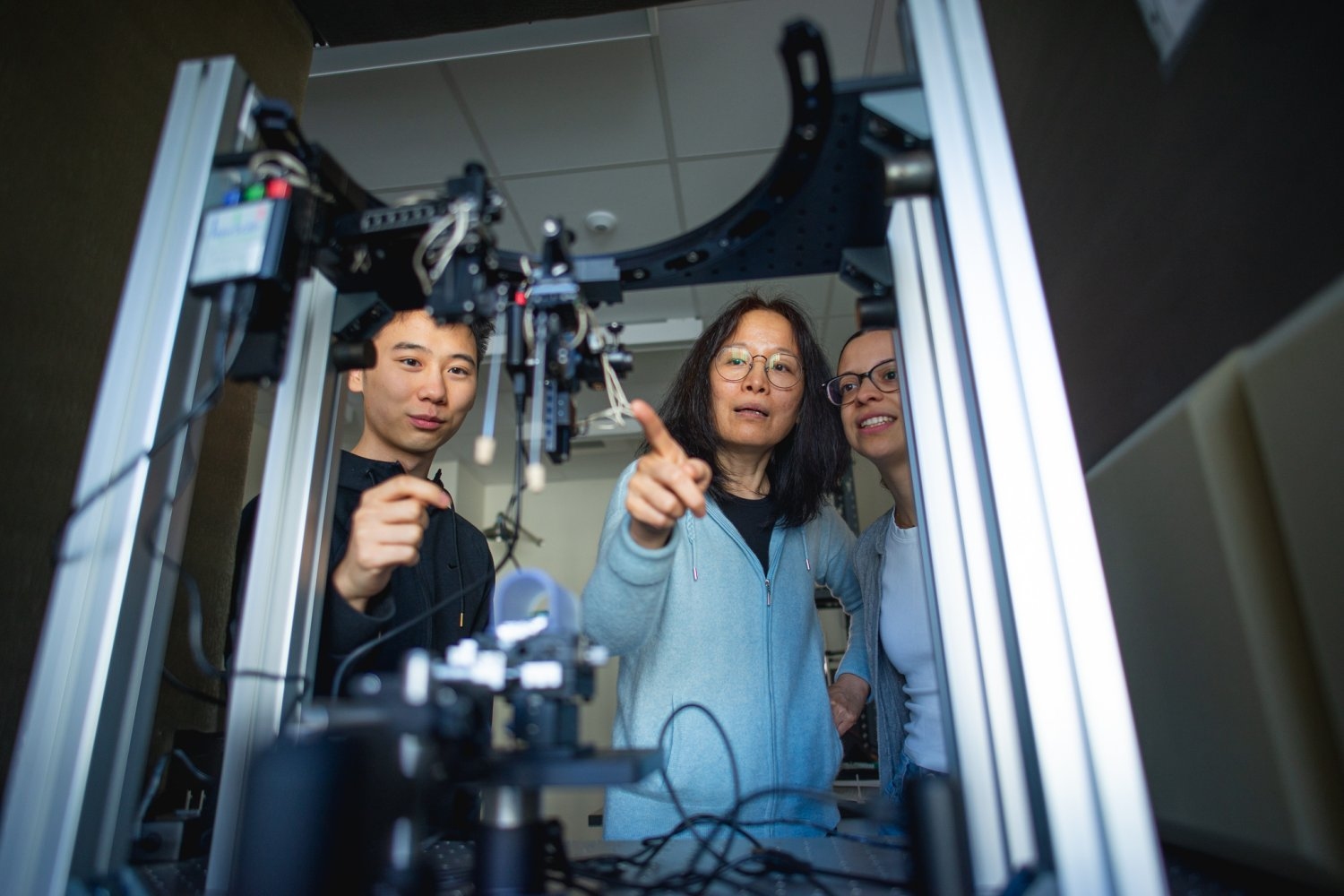
Professor Fan Wang is recognized as “Committed to Caring” for creating a supportive environment for ambitious research and student well-being.
At MIT’s McGovern Institute for Brain Research, Professor Fan Wang tackles innovative research every day. Her work centers on a fundamental question in neuroscience: How does the brain interact with the body to shape our sensations, emotions, and actions? Wang and the students in her lab study the neural circuits underlying experiences such as touch and pain, as well as the sensory and motor systems that allow animals to carry out behaviors like eating, drinking, moving, and vocalizing.
This research is inherently exploratory. Understanding how the brain generates complex sensations and behaviors often requires following unexpected findings and pursuing questions whose answers are not immediately clear.
Wang brings this same openness to her mentorship style, giving those within her lab the freedom to explore while providing the scientific guidance needed to navigate uncertainty.
“Innovative research is often inherently high-risk and requires continuous exploration, and adjustment of direction,” Wang says.
She does her best to share the excitement of promising results alongside her students while also working to alleviate their stress when everything doesn’t go to plan. Ultimately, she aims to create a research process that is “both intellectually stimulating and genuinely enjoyable” for her advisees.
For all these efforts, Wang was honored as “Committed to Caring” through a student-driven nomination and selection process.
Creating space for discovery
Research rarely follows a perfectly predictable path. New results can require revisiting hypotheses, changing direction, or returning to questions that had already been answered. Wang sees this uncertainty as a fundamental part of the research process.
She meets with members of her lab regularly to discuss their work and investigate problems together. These conversations serve to provide both feedback and structure, while also allowing them to work together through the frustrations that can accompany difficult research.
One nominator describes Wang’s “rigorous yet thoughtful scientific training” as tailored to each student’s personality and interests. For this student, weekly or biweekly meetings provide opportunities to review progress and plans, receive detailed guidance, and get critical feedback that supports both academic and professional growth.
Wang strives to create a challenging research environment that is also steeped in encouragement. This is particularly important when students are pursuing questions without obvious answers. When these sorts of questions arise, Wang is quick to work through uncertainty as a team.
For Wang, the goal is not to eliminate the uncertainty that comes with research, but to help students become comfortable navigating it. When results point in an unexpected direction, researchers can return to the questions, discuss what they are seeing, and determine where the evidence should lead them next.
Tailoring support to the student
Wang’s mentorship extends beyond experiments and research questions. She recognizes that each of her advisees is different, with unique interests, relationships, and experiences, and she tries to understand the type of support they need in order to flourish.
Her influence extends beyond the students she directly advises. As a member of the graduate affairs committee for the department, Wang meets with first-year PhDs to offer career advice and help them navigate the challenges of graduate school. Her nominators describe her as “compassionate, approachable, and deeply supportive.”
Wang also recognizes that circumstances outside the laboratory can affect a student’s ability to focus on research. “When something difficult happens in a student’s life, the most important thing I can do is be there to listen with genuine care and without judgment,” she says. “I do my best to support them as a whole person, not just as a researcher, and to be flexible when they need it.”
That flexibility can mean slowing things down, helping a student take a challenge one step at a time, or simply giving them space to talk. At the same time, Wang continues to emphasize the real goals at the heart of graduate education: asking difficult questions and responding thoughtfully to unexpected results.
One nominator describes Wang as bringing “warmth to the lab” — sharing food, engaging in conversations, and showing genuine concern for everyone’s mental well-being. Wang’s gestures create an environment where they feel supported both as researchers and as people.
Fostering trust
Wang describes her position as something of a “mother hen” philosophy. She feels a deep sense of responsibility for every student who joins her lab, and genuinely wants each of them to succeed.
For Wang, mutual trust is what allows mentorship to become an authentic connection. Her advisees can pursue uncertain ideas and navigate difficult moments knowing that their relationship with their mentor does not depend on always getting the right answer.
“When students know that I truly care about them as people, not just as producers of data, it builds trust,” Wang reflects. “They understand that they are not just workers hired to complete a research project, and that I do not value or judge them solely by their output.”