24 hours with the iPhone Duo — here are my 5 immediate takeaways
Latest from Tom's Guide ·
Jeff is U.K. Editor-in-Chief for Tom’s Guide looking after the day-to-day output of the site’s British contingent. Rising early and heading straight for the coffee machine, Jeff loves nothing more than dialling into the zeitgeist of the day’s tech news. A journalist for over a decade, he's travelled around the world testing and reviewing any gadget he can get his hands on. Before joining the team at Tom’s Guide, Jeff covered technology and science for two of the U.K.’s biggest national news sites: Metro.co.uk and the Daily Mirror. Memorable moments include getting lost in Vienna in an electric Audi, touring Lockheed Martin’s mile-long jet factory in Fort Worth and filming a Netflix documentary about Elon Musk in West London. When not plugged into the current news agenda, editing or commissioning a series of articles or debating the merits of Apple vs Android, Jeff can usually be found out for a run trying to shave precious seconds off his PB. Or lifting weights in a vain attempt to offset the ageing process.
You only get one chance to make a first impression, and my first impression with the iPhone Duo happened several weeks ago at a tightly controlled press event at Apple HQ in London . It's fair to say, I was pretty blown away by it. Now though, I’ve spent a full 24 hours with the device in my possession and I’ve come away with a few more follow-up thoughts.
I stand by my initial reaction about this being a game-changer for iPhone owners (and the foldable phone market in general) and, despite that high $2,000 entry price, it’s clear Apple’s first foldable is proving a hit with customers.
But, like my colleague Mark said in his full review , there are some big niggles with this phone that you want to be aware of before parting with your cash. And, in some ways, the delay on fulfilment that’s currently stretching into next year may not be such a bad thing after all.
So after spending a day with the iPhone Duo in the real world, here are my takeaways.
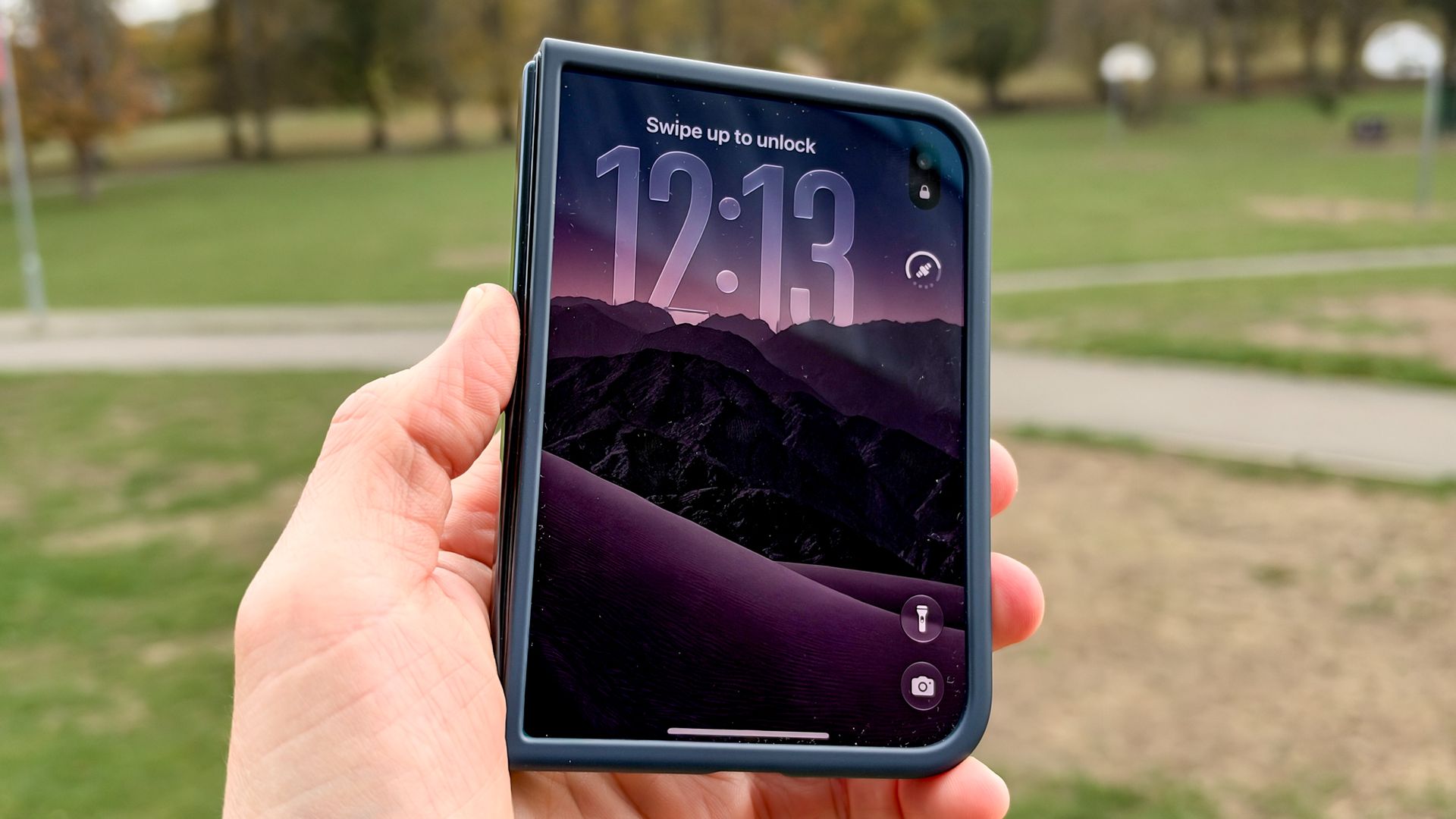
I’m going to level with you; my favorite iPhone of all time is the iPhone 13 mini . For all its battery life faults, I loved the small form factor that meant I could slip it into any pocket and use the device with just one hand.
The iPhone Duo evokes that same sense when folded, and the 5.4-inch outer display is more than capable of doing basic, phone-type stuff on: calling, messaging, checking socials or skimming through pictures. All with one hand. I love it.
You don’t need me to sell the unfolded 7.6-inch nano-texture inner display to you again, but I’m going to nonetheless. I took the Duo to a coffee shop and, when I wanted to spend a bit of time to get started reading a novel, I flipped it open and marveled at the rectangular form factor with the rounded corners.
The 1:4:1 aspect ratio works beautifully for this use case and I much prefer it to the square aspect ratio I’ve experienced on Android foldables.
The iPhone Duo is my first experience with an eSIM iPhone as in the U.K., unlike the U.S., all regular iPhones apart from last year’s iPhone Air still ship with a physical SIM slot.
According to some data released late last year , 40% of my fellow Brits haven’t even heard of eSIM and 41% couldn’t say if their phone supported one or not.
Just like with the removal of the headphone jack all those years ago, Apple’s determined push into eSIM-only territory will, in my opinion, help increase adoption. I’ve kept a physical SIM all these years because I’ve never needed to move across. The iPhone Duo is going to change that.
If you’ve read Mark’s review of the iPhone Duo, you’ll see he marked it down because non-optimized apps look…well, bad. I can certainly attest to this with a number of my go-to apps still displaying the thick black bar on the right hand side. When this happens and you unfold the Duo, it’s like we’re right back in the days of the early iPad and having to simply blow up an app window stuck in iPhone dimensions.
To be fair to Apple, it’s still very much early days. The company has added a “Made for iPhone Duo” badge to compatible apps — we’re cataloging our favorites here — and I expect this to resolve itself over time. I can forgive smaller apps for not yet being optimized but some of the bigger ones, like Wikipedia or literally all of Google’s apps , need to hurry up.
At the moment, it’s a compromised experience that I wouldn’t expect on a $2,000 product and the silver lining of the delay is that most of this should be fixed by the time the Duo is readily available.
Finally, while it's cool to be able to run two apps side-by-side, other Android foldables can manage three. But, y'know, who's counting?
There’s no sugarcoating it; I’ve become used to Face ID and not having it on the Duo is a real bummer. I’ll pause here to say how glad I am the Duo supports MagSafe, but I think a lot of users will resent having to go back to Touch ID. It’s just…slower.
Apple has implemented a process whereby Touch ID pauses just a beat before it unlocks the phone — to make sure you really did mean to unlock it. That’s sensible, but just adds to the jarring feeling of not being able to get into your phone instantaneously.
The way I’ve been getting around it is to swipe up from the lock screen (muscle memory at this point) at the same time as engaging Touch ID. This combination seems to unlock the phone a little bit faster. It’s not an idea solution but I can now do it pretty quickly. If Apple is already drawing up plans for an iPhone Duo 2, I really hope we get a Face ID upgrade.
There’s been…ah, some backlash over screen problems with the iPhone Duo and — so far at least — I haven’t had any sign of screen cracking, hinge failures, or any kind of dust and water ingress. We, and many other reviewers, have praised Apple for its commitment to durability with the iPhone Duo, but looking after this thing has been front of mind ever since I unboxed it.
I want a phone that can take the hits and keep on truckin’ and every time I take the iPhone Duo out to use it, I’m acutely aware it’s a $2k piece of technology.
As a result, I’m treating this thing with kid gloves even though I have full faith in Apple’s durability testing. And just to be sure, I’ve encased it in the standard iPhone Duo MagSafe case to give it a little bit more protection.
If you disregard the hype around a brand-new form-factor device from Apple and look at the Duo critically, there are some definite conclusions on what it is and whether or not you should buy it.
For starters, this is a gadget that genuinely gets you excited about technology again , and I don’t want to underestimate that. Secondly, with the full force of one of the world’s biggest companies behind it, the software kinks will undoubtedly be ironed out soon, third parties will get on board quickly, and customer service should be able to cope with any complaints from early adopters.
But then again, this is very much a first-gen product, and I expect the iPhone Duo 2 will be a far, far better buy. There’ll be Face ID for a start , but also camera improvements and probably a reduction in weight and thickness.
If it seems like I'm being harsh with a few of the points above then that's only because — at $2K, I place a pretty high bar of expectation against it. And to be clear, there are so so many things that are brilliant about this phone. Did I mention the nano-texture display? But also, you can use this with an Apple Pencil and the A20 Pro chipset is just blisteringly powerful. In fact, consider that takeaway number six: the speed and fluidity of iOS 27 on this phone is a wonder to behold!
Where do you sit on the iPhone Duo spectrum? Are you all-in? Interested but hesitant? Or is it a stone-cold “no thank you, Sir”? Let me know in the comments below.