I ran 40 miles in the Brooks Hyperion Max 4 — here’s why I think it misses the mark
Latest from Tom's Guide ·
Nick has been a journalist since 2012 and has spent most of that time writing about health and fitness for a variety of publications. Nick spent nine years working on the Coach magazine and website before moving to the fitness team at Tom’s Guide in 2024. Nick is a keen runner and also the founder of YouTube channel The Run Testers , which specialises in reviewing running shoes, watches, headphones and other gear. Nick has covered all aspects of health and fitness throughout his career, interviewing experts and celebrities, trying fitness classes and running marathons, all in the name of providing readers with the information they need to get the most out of an active lifestyle. Nick ran his first marathon in 2016 after six weeks of training for a magazine feature and subsequently became obsessed with the sport. He now has PBs of 2hr 25min for the marathon and 15min 30sec for 5K, and has run 16 marathons in total, as well as a 50-mile ultramarathon. Nick runs 60-90 miles a week and races regularly with his club, which gives him a lot of opportunity to test out running gear: he has tested and reviewed hundreds of pairs of running shoes, as well as fitness trackers, running watches, sports headphones, treadmills, and all manner of other kit. Nick is also a qualified Run Leader in the UK. Nick is an established expert in the health and fitness area and along with writing for several publications, including Live Science , Expert Reviews , Wareable , Coach and Get Sweat Go , he has been quoted on The Guardian and The Independent . Nick graduated from the University of York in 2010 with a degree in Politics, Philosophy and Economics and worked in the NHS for three years, during which time he completed his NCTJ Diploma in Journalism at News Associates in London. Before starting on Coach and moving into health and fitness, Nick worked as a football journalist and lived in Kathmandu, Nepal for two years.
Brooks has thrown a lot at the Hyperion Max 4, and unfortunately it’s a shoe that ends up being less than the sum of its parts, partly because all those parts make it way too heavy to be an effective speed shoe.
I enjoyed some of my runs in the Hyperion Max 4, which has a bouncy midsole and does perform well as a long-run cruiser, but if you’re in the market for a fast training shoe, I could name many others that I’d buy ahead of it, and almost all of them would cost less too.
It’s also very similar to its predecessor, so even if you were keen to pick it up, you’d be better off finding the Brooks Hyperion Max 3 on sale.
The Brooks Hyperion Max 4 has some good ingredients, most notably the springy DNA Gold foam, but the line needs a rethink to compete with the best running shoes in its category, like the excellent New Balance SC Rebel v1 or Hoka Mach X3 .
The Brooks Hyperion Max 4 launched in summer 2026 and costs $200 in the U.S. and £170 in the U.K., which is the same price as its predecessor.
It’s an expensive shoe, and while the price is around par for a plated super-trainer, the Hyperion Max 4 is undercut by some excellent fast training shoes like the Adidas Adizero Evo SL and Kiprun Kipstorm Tempo .
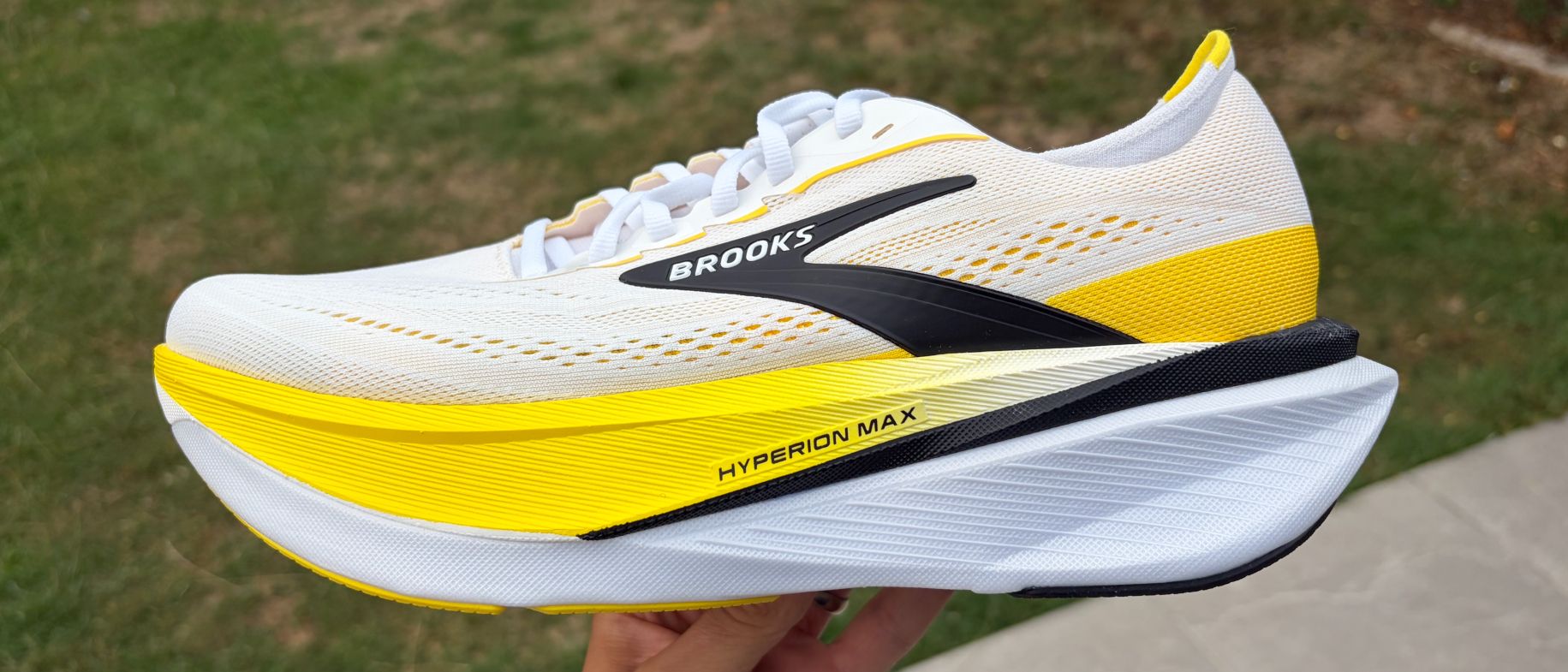
The Brooks Hyperion Max 4 is currently available in four colors, including the white and yellow design I tested, which fit me well in my normal running shoe size.
It’s a very high stack shoe, standing 45mm tall at the heel and 39mm at the forefoot for a 6mm drop.
At 10.8oz in my US men’s size 10, the Hyperion Max 4 is not just heavy for a speed shoe; it’s pretty heavy even compared to most of the cushioned shoes for easy training I tested these days.
The Brooks Hyperion Max 4 has a mesh upper with padding around the collar of the shoe and a large, stiff internal heel counter at the back.
It’s not as thick and padded as the uppers on the brand’s cushioned shoes, like the Brooks Glycerin Max 2 , but it’s still comfortable for long runs, though I think a thinner, more minimal upper would be good for cutting weight and making the shoe feel a bit quicker.
Two foams are used in the midsole of the Hyperion Max 4, with the top layer being made from Brooks’ bouncy PEBA-based DNA Gold foam, and the bottom being a firmer supercritical EVA foam called DNA Flash v2.
In between these two foams runs a nylon plate that helps to stabilize the high stack and add some extra pop to your stride. The plate also creates a stiff feel to the ride, though it’s not as rigid as a carbon plate.
The Hyperion Max 4 has a rocker profile to help roll you from heel to toe smoothly with each step.
A thick layer of rubber is used at the heel and forefoot of the shoe and while this is good for durability, using a thinner material would help reduce the weight of the Hyperion Max 4 for fast running.
One way the shoe has shed some weight is a large cutout on the medial side of the shoe, but the placement of this cutout reduces the stability of the Hyperion Max 4 and might encourage pronation (inward rolling of the foot) when landing.
Midsole cutouts are common on fast shoes to reduce weight, but many brands opt to remove a central section of foam rather than at the sides to limit the instability created.
I used the Hyperion Max 4 for a variety of training runs, including some easy efforts, a progression run, and an 18-mile long run including 15 steady miles at sub-6/min per mile pace.
I’ve tested all four generations of the shoe to date, and it changed a lot in the first three, but the fourth feels similar to the Brooks Hyperion Max 3 to me.
It’s big, it has some bounce and it rolls through smoothly, but the Hyperion Max 4 doesn’t feel great at faster paces. It’s too heavy and doesn’t have the nimble, aggressive feel of most speed shoes.
You can cruise along quite nicely in the shoe and it does have a comfortable and protective ride for long runs at a pace somewhere between easy and steady. However, at really easy paces, it feels a bit firm for me, and it isn’t especially stable because of the high stack and medial cutout.
In general, plated super-trainers like this are often among the most versatile shoes available in terms of the types of runs they work well for, but the Hyperion Max 4 doesn’t have that range — it’s cumbersome at fast paces and too stiff to truly enjoy on easy runs.
I’d skip the Brooks Hyperion Max 4 if you’re in the market for a fast trainer right now, because there are many alternatives that offer a superior ride and/or better value.
The New Balance SC Rebel v1 is my favorite plated training shoe and while it’s also expensive, it delivers a truly fast and fun ride for workouts and can stand in for a full carbon super-shoe for races too.
More affordable speed shoes include the Adidas Evo SL, Skechers Aero Razor , and Kiprun Kipstorm Tempo, which are much lighter than the Brooks and have more energetic rides for workouts.
If you’re looking for more of an all-rounder, then the Asics Megablast is a little pricier than the Brooks, but much lighter and livelier on the run, and more enjoyable to use for easy or fast runs.