Segway E3 Go review: A solid midrange scooter
Latest from Tom's Guide ·
Michael A. Prospero is the U.S. Editor-in-Chief for Tom’s Guide. In his spare time, he also tests out the latest drones, electric scooters, and smart home gadgets, such as video doorbells. Before his tenure at Tom's Guide, he was the Reviews Editor for Laptop Magazine, a reporter at Fast Company, the Times of Trenton, and, many eons back, an intern at George magazine. He received his undergraduate degree from Boston College, where he worked on the campus newspaper The Heights, and then attended the Columbia University school of Journalism. When he’s not testing out the latest running watch, electric scooter, or skiing or training for a marathon, he’s probably using the latest sous vide machine, smoker, or pizza oven, to the delight — or chagrin — of his family.
Sometimes, you don’t need a monster of an electric scooter to get where you need to go. The Segway E3 Go is made for those with more modest demands for their commute; priced at $649 — but often on sale for less — it also places a more modest demand on your wallet.
I rode the Segway E3 Go for a couple of weeks to get a feel for this mid-range commuter scooter, and to see how it compared to some of the best electric scooters I’ve tested over the years.
The Segway E3 Go came out in 2026, and retails for $649, though you can often find it on sale for less than $500. For example, for Black Friday, it's discounted to $449 right now.
Top speed
20 MPH
Max range
25 miles
Motor
400W (800 peak)
Max climbing slope
18%
Battery
276 Wh
Apple FindMy
Yes
Suspension
Front, dual coil
Tires
10-inch tubeless
Charging time
5.5 hours
Weight
46.7 pounds
Max rider weight
220 pounds
Water resistance
IPX5 (IPX7 battery)
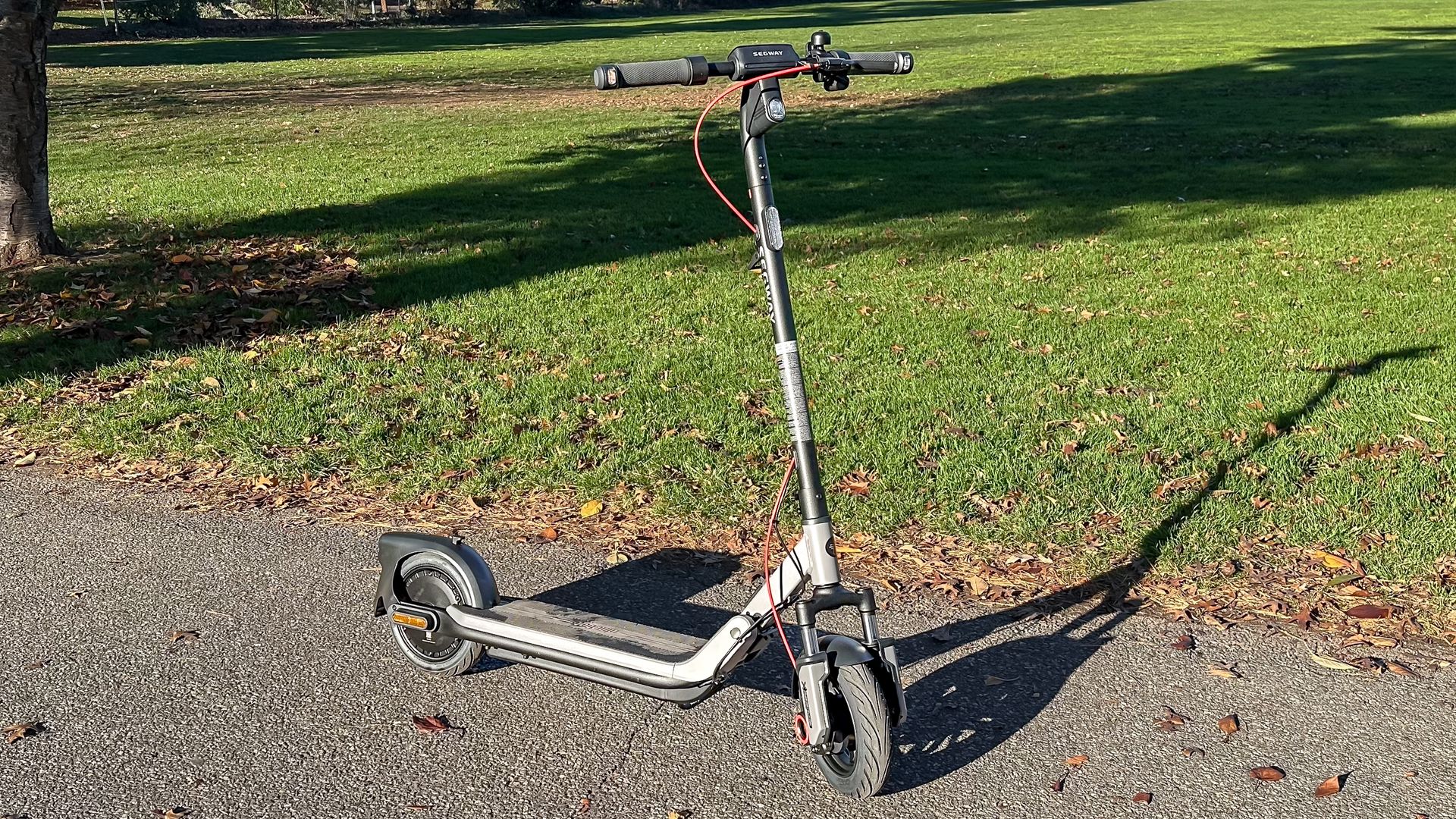
Segway has put a lot of thought into the feel of its scooters; in recent years, it’s started bending its handlebars slightly back, like on a bike, which gave me a bit more control while I was out and about.
The E3 Go’s deck is also fairly spacious; unless you have gigantic feet, you should have no trouble positioning yourself on the scooter.
I’m also a fan of the E3 Go’s folding mechanism; there’s a small tab at the base of the downtube, which you simply press with your foot to unlock the front half of the scooter and fold it down.
However, you’ll still need a bit of strength to carry it around, as the E3 Go weighs a meaty 46 pounds. The E3 Pro, which has dual suspension and a longer range, is actually six pounds lighter.
While it lacks the full suspension of its more expensive siblings like the E3 Max, the Go still has a front suspension. It made for a much smoother ride when going over potholes and other bumps when compared with scooters that lacked such amenities.
Built into the handlebars of the E3 Go are turn signals, which you activate using a thumb switch on the left handlebar; I’ve loved this addition to all electric scooters I’ve tested. I just wish the E3 Go had rear turn signals, like the E3 Max, as it’s hard for cars behind you to see the handlebar signals. I also wish that the E3 Go’s headlight were slightly bigger, and that you could adjust its angle.
Like most of Segway’s scooters, the E3 Go has Apple FindMy, so you can track it if it goes missing. You should always use a lock, but it’s an extra bit of protection.
The 400W motor in the E3 Go proved good, but not great, at climbing hills. On a moderate 5% grade, the scooter slowed to around 10 MPH, which is respectable given its price; however, on a steeper hill with a 6.9% grade — which gets as steep as 10.8% — the E3 Go barely made it to the top, where the similarly-priced Apollo Dash made it up without issue. To be fair, Segway says that the E3 Go is rated to a max grade of 9% (18º slope).
Segway advertises the E3 Go as having a max range of 25 miles; if you set the scooter to its highest performance setting, that estimate drops to just 11.2 miles. I took the E3 Go out for a 5.5-mile ride, and at its conclusion it had 32% battery life remaining, which would mean I would have made it to a little over 8 miles before the battery was completely drained. Of course, your mileage will literally vary based on your weight and the type of riding you do.
The Segway E3 Go is a good, capable scooter for the price. It should be especially useful in flatter urban areas, and will suit commuters well, so long as you don’t have any major hills to climb. If you have steeper terrain, I would recommend the Apollo Dash; while its ergonomics aren’t as good, it has more power than the Segway, and costs about the same, with many other similar features.
If you can spring for the extra $50, the Segway E3 Pro has dual suspension and a longer range than the E3 Go, and is just as comfortable to ride. Either way, if you have to contend with a lot of potholes, the Segway and its suspension is worth a second look.