Voyager 1 Engineers Analyze Data Issue, Ready to Confirm Light-day
NASA Science · · g2172517
On Nov. 14, the Voyager 1 mission team became aware that the spacecraft had stopped sending science and engineering data after a NASA Deep Space Network (DSN) antenna in Canberra, Australia, “locked on” to the spacecraft and received a carrier signal, which is used to carry science and engineering data from the spacecraft to ground […] The post Voyager 1 Engineers Analyze Data Issue, Ready to Confirm Light-day appeared first on NASA Science .
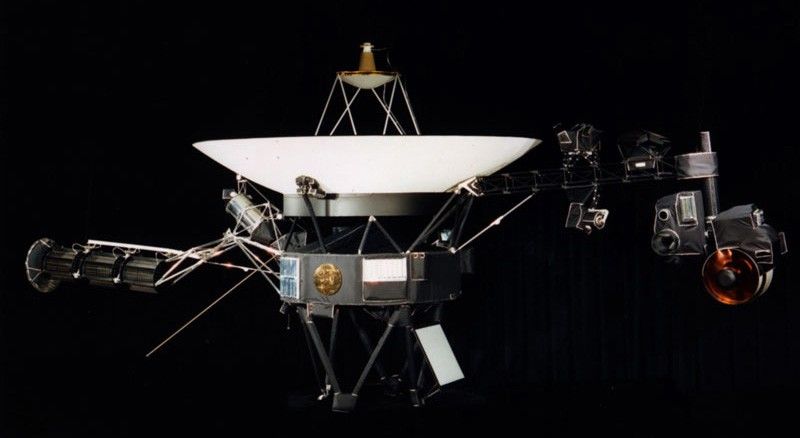
A model of NASA’s Voyager spacecraft. The twin Voyagers have been flying since 1977 and are exploring the outer regions of our solar system. NASA/JPL-Caltech
On Nov. 14, the Voyager 1 mission team became aware that the spacecraft had stopped sending science and engineering data after a NASA Deep Space Network (DSN) antenna in Canberra, Australia, “locked on” to the spacecraft and received a carrier signal, which is used to carry science and engineering data from the spacecraft to ground antennas, but no data.
Engineers are working to determine the cause of the issue and next steps. Although the spacecraft is not currently returning engineering or science data, the team will still be able to confirm it is operating one light-day from Earth, or roughly 16.1 billion miles (25.9 billion kilometers), on Thursday, Nov. 19, using the carrier signal and trajectory calculations.
The presence of a carrier signal means that Voyager 1’s Attitude and Articulation Control computer is doing its job to keep the spacecraft pointed at Earth and that its antenna, as well as its broadcast equipment still work. The lack of data suggests the issue is with the onboard computer responsible for collecting the data from the spacecraft’s various subsystems, including science instruments, and putting it into the right format to be transmitted to Earth.
Analyzing issues with both Voyager spacecraft, even minor ones, is a drawn-out process due to the probes’ distance from Earth . A radio wave, which is a form of invisible light, takes 24 hours to reach the probe, and any signal it sends takes 24 hours to reach Earth. As a result, diagnosing the cause of the issue may take weeks or longer.
In 2023, Voyager 1 experienced a similar scenario in which ground controllers received a carrier signal but no data from the spacecraft. That issue was caused by one of the onboard computers, and the mission’s engineering team experience resolving that past issue is informing their approach to the current one.
The team is currently investigating if there is any connection between the current issue and the brief communications gap Voyager 1 experienced in October, when the mission lost all contact with the spacecraft for about 48 hours. The spacecraft resumed communication by itself and was operating normally until Nov. 14.
Launched in 1977, the Voyagers have already lasted longer and delivered far more science than anyone thought possible. The mission expects to eventually lose both spacecraft to unresolvable engineering issues, but it also plans to do everything it can to keep them operating and delivering science for as long as possible.
NASA and the mission will celebrate the historic light-day milestone on Nov. 19 — a day after the milestone has been reached — once the mission receives the spacecraft’s signal. Mission engineers know the probe’s distance from Earth based on trajectory models based on years of measurements. In addition, the spacecraft is traveling away from Earth at a consistent speed on a known trajectory and has no way to change its speed, so engineering issues cannot influence when it reaches one light-day from Earth.
The post Voyager 1 Engineers Analyze Data Issue, Ready to Confirm Light-day appeared first on NASA Science .