Mashrekur Rahman
NASA Science ·
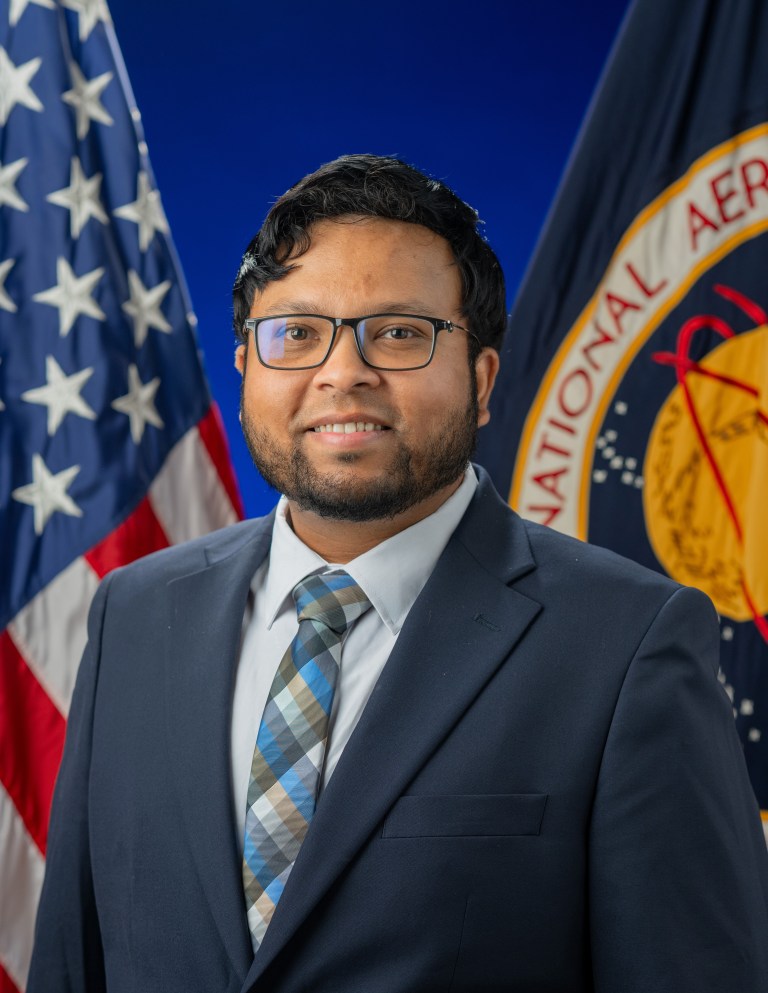
Affiliation: Bay Area Environmental Research Institute, NASA Ames Research Center Division: Earth Science Division (SG), NASA Earth Exchange (NEX) Email: mashrekur.rahman@nasa.gov Google Scholar: https://scholar.google.com/citations?user=pgjbWFUAAAAJ&hl=en Personal Biography Dr. Mashrekur Rahman is an AI research scientist focused on Earth observation and environmental intelligence. His current research spans machine learning for Earth systems, geospatial foundation models, world models, and […] The post Mashrekur Rahman appeared first on NASA Science .
Research Scientist, NASA Earth eXchange (NEX)
Affiliation : Bay Area Environmental Research Institute, NASA Ames Research Center
Division : Earth Science Division (SG), NASA Earth Exchange (NEX)
Email : mashrekur.rahman@nasa.gov
Google Scholar : https://scholar.google.com/citations?user=pgjbWFUAAAAJ&hl=en
Dr. Mashrekur Rahman is an AI research scientist focused on Earth observation and environmental intelligence. His current research spans machine learning for Earth systems, geospatial foundation models, world models, and agentic systems for diverse applications. Examples of recent work include the first systematic physical interpretability analysis of a planetary-scale geospatial embedding model, a Land Surface Intelligence system that operationalizes its embeddings for natural language environmental queries, and a fleet of sensor-specialized world models for hydrologic reasoning.
At NASA Ames Research Center, he is a Research Scientist with the NASA Earth Exchange (NEX) GeoAI team. He develops robust scientific evaluation and benchmarking frameworks for geospatial foundation models. He also supports research teams funded under NASA’s programs on user-centered applications of large Earth foundation models.
Dr. Rahman holds a PhD in Hydrologic Sciences from the University of California, Davis. During his doctoral research, he used natural language processing to study how hydrologic research evolves and computer vision to model human-drought interactions and drought dynamics. As a postdoctoral scholar at the USDA Agricultural Research Service, he then developed continental-scale models of soil moisture dynamics. Before joining NEX, he was an AI Research Data Science Specialist at Dartmouth College, where he led campus-wide cross-disciplinary AI research collaborations spanning the sciences, medicine, engineering, and the humanities.
His work has been funded by NASA, NOAA, USDA, and Google at various stages. In addition to core scientific research, he enjoys communicating AI and data science, building systematic and accessible AI literacy programming for learners from diverse backgrounds.
Ph.D. Hydrologic Sciences, 2024, University of California, Davis. Advisors: Dr. Grey Nearing and Prof. Thomas Harter. Dissertation: From Texts to Pixels: Leveraging Artificial Intelligence to Achieve Novel Insights into Hydrologic Research, Human-Drought Interactions, and Global Drought Prediction
M.Sc. Water Resources Development, 2016, Bangladesh University of Engineering and Technology, Bangladesh.
B.Sc. Civil Engineering, 2014, Ahsanullah University of Science and Technology, Bangladesh.
2026 – Present: Research Scientist, NASA Ames Research Center / Bay Area Environmental Research Institute, Moffett Field, CA, USA
2025 – 2026: AI Research Data Science Specialist, Dartmouth College
2024 – 2025: Postdoctoral Scholar, USDA Agricultural Research Service
2021-2024: Graduate Student Researcher, University of California, Davis
2018-2020: Graduate Research and Teaching Assistant, University of Alabama
2015-2018: Research Assistant, Bangladesh University of Engineering and Technology, Bangladesh.
2026: Arête Glacier Initiative Grant: Leveraging and preserving historical Trapridge Glacier data (Co-I)
2026: Arête Glacier Initiative Grant: Advancing Ocean Forcing for Antarctic Ice Sheet Models Using Historical Observations (Collaborator)
2026: Irving Institute Seed Grant, Dartmouth College (Co-PI)
2026: Scholarly Advancement and Innovation Award, Dartmouth College (Project Advisor)
2024: NCAR Computational Grant for Exploratory ML Research
2022, 2023, 2024: Google Cloud Research Credits Grants
2022, 2023: Henry A. Jastro Graduate Research Award, University of California, Davis
Water Resources Research, Journal of Hydrology, AGU Advances, Hydrogeology Journal, Fundamental Research, Environmental Modelling & Software, Journal of the American Water Resources Association, River, Environmetrics
Rahman, M. (2026). Towards Agentic Geospatial Intelligence: From Planetary-Scale Embeddings to Sensor-Specialized JEPAs, HydroML Symposium 2026, UT Austin, TX
Rahman, M. , Meles, M.B., Bradford, S., & Nearing, G.S. (2025). Drivers of Soil Moisture Dynamics over CONUS, presented at the HydroML Symposium 2025, Lake Arrowhead, CA.
Rahman, M. , Meles, M.B., Bradford, S., & Nearing, G.S. (2024). A Spatially-Aware ViT-LSTM for Understanding Soil Moisture Dynamics over CONUS. Poster H53A-1073 presented at the American Geophysical Union Fall Meeting 2024, Washington, DC.
Rahman, M. , & Nearing, G. (2024). Predicting Global Meteorological Drought using Vision Transformers, HydroML Symposium 2024, Pacific Northwest National Laboratory
Rahman, M. , Sandoval Solis, S., Harter, T., Saeedimoghaddam, M., Efron, N., & Nearing, G. (2023). Understanding Drought Awareness from Web Data, American Geophysical Union (AGU) Fall Meeting 2023, DOI: 10.22541/essoar.170317289.97613363/v1
Rahman, M. , Meles, M., Bradford, S., & Nearing, G. (2024). Drivers of Soil Moisture Dynamics over CONUS, American Geophysical Union (AGU) Fall Meeting 2024
Rahman, M. , & Nearing, G. (2023). DroughtVision – Global Drought Prediction with Computer Vision, American Geophysical Union (AGU) Fall Meeting 2023, DOI: 10.22541/essoar.170317324.47484665/v1
Rahman, M. , & Nearing, G. (2022). The Geography of Hydrology Research Funding, Presentation Number – H32Q-1139, American Geophysical Union (AGU) Fall Meeting 2022
Rahman, M. , & Nearing, G. (2022). Early Signals of Impactful Hydrologic Research, Frontiers in Hydrology Meeting 2022 (FIHM22), San Juan, Puerto Rico.
Rahman, M. , & Nearing, G. (2022). Hydrology Research Articles Are Becoming More Interdisciplinary, European Geosciences Union (EGU) General Assembly 2022, Vienna, Austria, https://doi.org/10.5194/egusphere-egu22-13024
Rahman, M. , Frame, J., & Nearing, G. (2021). Hydrology Research Articles Are Becoming More Interdisciplinary, Presentation Number – H25V-1277, American Geophysical Union (AGU) Fall Meeting 2021
Rahman, M. , Frame, J., & Nearing, G. (2021). A Framework for Predicting Impactful Research in Hydrological Science, Presentation Number – H45W-1472, American Geophysical Union (AGU) Fall Meeting 2021
Rahman, M. , Nearing, G., & Frame, J. (2020). Hidden Stories in Hydrologic Literature: An Interactive Topic-Based Ontology (No. EGU2020-882). Copernicus Meetings.
Rahman, M. , Nearing, G., & Frame, J. (2019). Hidden Stories: Topic Modeling in Hydrology Literature, AGU 2019 Fall Meeting, https://doi.org/10.1002/essoar.10501825.1
M. Rahman & M. M. Rahman (2017), Satellite Remote Sensing of Suspended Sediment Concentration in the Lower Ganges River, Water Security & Climate Change Conference (WSCC 2017), Cologne University of Applied Sciences, Cologne, Germany.
R. Akter, M. Sakib, M. Rahman , Sumaiya, A. Haque, M.M. Rahman & M.R. Islam (2016), Climatic and Cyclone Induced Storm Surge Impact on Salinity Intrusion Along the Bangladesh Coast, Proceedings of the 6th Int’l Conference on the Application of Physical Modeling in Coastal and Port Engineering and Science (Coastlab16), University of Ottawa, Canada.
R. Akter, Sumaiya, M. Rahman , A. Haque & M.M. Rahman (2016), Prediction of Salinity Intrusion Due to Sea Level Rise and Reduced Upstream Flow in the GBM Delta, Proceedings of the 20th Congress of the Asia Pacific Division of the International Association for Hydro Environment Engineering and Research (IAHR APD 2016), Colombo, Sri Lanka.
The post Mashrekur Rahman appeared first on NASA Science .