A rare triple-star system near Earth ‘should not exist’
Popular Science ·
‘We have no clean explanation for how it got there.” The post A rare triple-star system near Earth ‘should not exist’ appeared first on Popular Science .
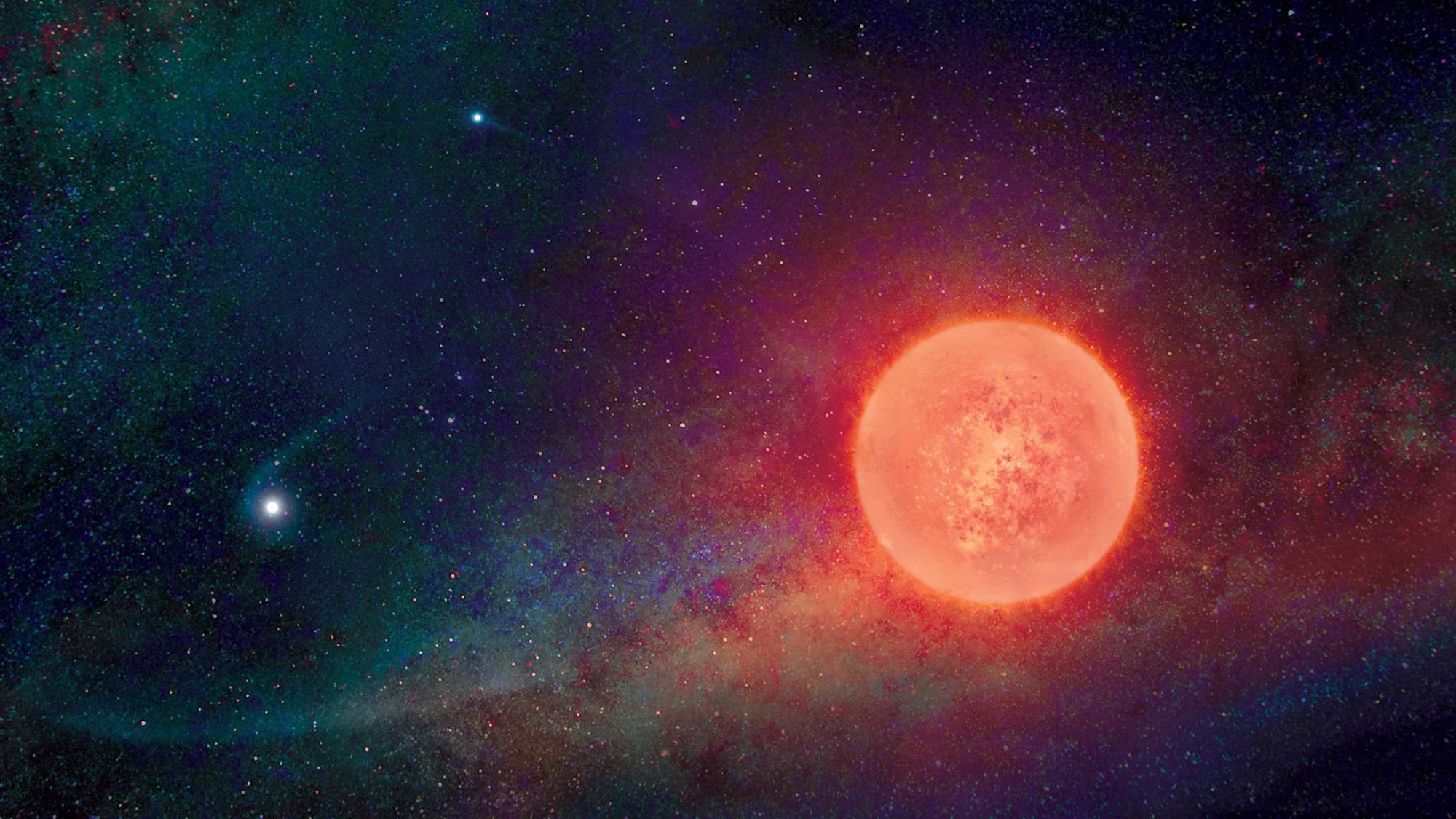
Astronomers searching for new exoplanets recently found something much stranger—a rarely seen triple-star system located only 28 light-years away from Earth. If that weren’t odd enough, two of its three stellar components are dense, depleted white dwarfs . A study recently published in the Astronomy & Astrophysics Journal details an oddball trio that is so perplexing that researchers still aren’t quite sure how it formed in the first place.
“The system should not exist,” Patrick Dufour , a University of Montreal astrophysicist and study co-author, said in a statement . “We have no clean explanation for how it got here.”
Dufour’s team first noticed the perplexing triple-star system while scanning for exoplanets using highly sensitive equipment mounted on the Canada-France-Hawaii Telescope near the dormant volcano of Mauna Kea. Astronomers were specifically looking for subtle discrepancies in the movements of distant stars, which often indicates that there are orbiting planets nearby.
But when it came to one particular red dwarf , the data simply didn’t make sense. Rather than delicate shifts in motion, researchers recorded velocity swings at speeds nearing 10 miles per second. This effect was too much for a single planet to cause, and after years of additional observations, astronomers determined that whatever the unseen subject was, it possessed a mass greater than half the sun.
“The object’s unusual combination of high mass and dim light left only one plausible explanation: it was the remains of a dead star,” explained Charles-Antoine Parent , a University of Montreal astronomer and study co-author.
Possible suspects included a neutron star and even a secret black hole , but some assistance from the Gemini North telescope also on Mauna Kea finally confirmed its identity: a close-orbiting white dwarf. This complicated the situation. Astronomers previously discovered another white dwarf circling the red dwarf at a much greater distance. Taken altogether, that made three stars existing in a single system. The grouping is now known as Welopō‘ai , a Hawaiian phrase that roughly translates to “path of family traits” in reference to the stars’ shared relationships. According to researchers, no other comparable example can be found within 100 light-years of Earth.
However, Welopō‘ai still doesn’t quite add up. The red dwarf’s nearest companion was about 40 percent more massive than our sun prior to transforming into a white dwarf. When it did, it would have expanded hundreds of times its original size. Previously documented systems featuring these dynamics entailed the two stars falling into an even tighter orbit, or even merging. Despite this, Welopō‘ai ’s red dwarf is still there and in a strikingly stable, wide orbit with the closest white dwarf. The team now plans to continue observing their discovery to learn as much as possible about the triple-star system, and possibly figure out how it formed in the first place.
“Discoveries like this remind us that our own cosmic neighborhood still contains remarkable surprises,” added study co-author and astronomer, Étienne Artigau .
The post A rare triple-star system near Earth ‘should not exist’ appeared first on Popular Science .