My feed is full of robots. Someone should check on them.
Nextgov/FCW - All Content ·
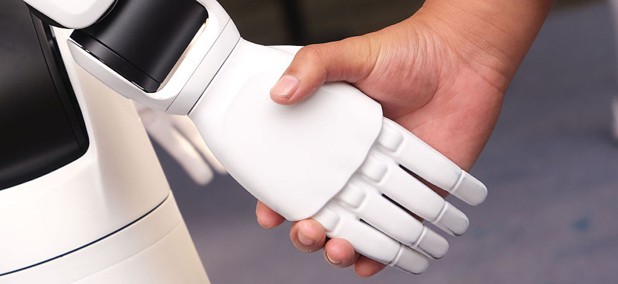
You can barely scroll in peace these days without running into a robot.
In one video, a headless robot sweeps up dust and waters a bonsai tree. It's Voxel, a robot butler from New York startup Tuesday Labs that’s expected to cost about $20,000. You can reserve one with a refundable $200 deposit, though the robot in the video is a prototype.
In another video , a robot front-flips off a car, kicks in another car’s door and elbow-drops its roof. It leaps off a shipping container, rolls and comes up with a roundhouse kick. Then it shields a seated woman from a man with a knife. It’s Chinese robotics company Unitree’s H2-X, the “Kung Fu Legend Guardian.” In a third video, human pilots control humanoid robots as they trade punches and grapple at Singapore’s first robot fighting tournament.
You can barely scroll in peace these days without running into a robot. Sometimes, they're ducks. At Nvidia's recent GTC conference in Berlin, CEO Jensen Huang shared the stage with four Microducks, 10-inch bipeds from Pollen Robotics. He asked them to sit, stand and take a nap. Three toppled over on command, and the fourth needed persuading. The same day as Huang’s keynote, Elon Musk told investors that Tesla’s Optimus humanoid had entered early production , with customer shipments planned for next year.
The videos in my feed come with fine print: Unitree says its video wasn’t sped up, but it hasn’t disclosed how much of the H2-X’s performance was autonomous. Tuesday Labs expects to substantially redesign Voxel's hardware before launching it.
Global humanoid robot shipments topped 22,000 in the first half of 2026, up nearly 300% from a year earlier, according to an August report by Counterpoint Research. Shanghai-based Agibot led with about 9,700 units, followed by Unitree. The five largest vendors accounted for 86% of shipments.
Money is a big reason robots are having their heyday. Investors put $11 billion into humanoid robotics startups through Oct. 6, over twice 2025’s record of $4.8 billion, according to Dealroom, which tracks startup investment. Chinese companies received 63% of the funding. Beijing has set a goal of over 10,000 humanoids in commercial use by the end of 2026 .
Prices are falling, too, and the software is getting better at teaching a body to move. A Forbes analysis of IDC’s revenue and shipment estimates puts the average humanoid price at about $29,600 in the first half, down from roughly $37,000 a year earlier. Nvidia showed how software trained in the cloud and tested on one of its PCs could then run on the ducks.
But most of these robots still aren’t folding anyone’s laundry—some can’t even get through a demo.
In May, a video circulated of a Unitree robot that fell twice during a Michael Jackson routine and had to be dragged offstage. In June, at Computex in Taipei, a Qualcomm-powered humanoid walked onstage with a glass tray and collapsed face-first shortly afterward. Qualcomm said a “brief communication glitch” triggered a controlled shutdown and that the robot’s safety systems “worked as intended,” according to a statement to Creative Bloq . On Aug. 24, during the weightlifting final at the World Humanoid Robot Games in Beijing, a robot picked up its weight, struggled with it, dropped it and stumbled into the judges’ table .
Counterpoint found that over 60% of first-half shipments went to entertainment and performance, data production and research. Some are literally being bought to put on a show, which helps explain my feed. The weightlifter who crashed into the judges’ table has over 580,000 likes on a single Instagram post. We love a good success story, but we love a good faceplant even more.