Humans were never built for tails. Here’s why.
Popular Science ·
And 'Science Friday' host Flora Lichtman on why she (mostly) still wants one. The post Humans were never built for tails. Here’s why. appeared first on Popular Science .
Many of the cutest animals on Earth have one appendage in common. Whether you’re thinking of an adorable raccoon , a kitten , or a puppy , it’s hard to imagine them without their fluffy tail. In fact, the overwhelming majority of animals have tails. Only a select few, like us humans, don’t have an external tail.
But why don’t humans have tails ? To answer that question we have to go way back in our family tree, long before the first hominids ever showed up. We’re talking 25 to 30 million years ago when Megalodon stalked the seas .
Ask Us Anything answers your most outlandish, mind-burning questions—from the everyday things you’ve always wondered to the bizarre things you never thought to ask. So, yes, there’s a best sleep position and no, cremation isn’t good for the Earth . If you have a question for us, send us a note . Nothing is too silly or simple.
This episode is based on the Popular Science article “ Why humans don’t have tails .”
Listen and follow Ask Us Anything on your favorite podcast platform:
Spotify | Apple Podcasts | YouTube | Or wherever you get your podcasts.
Sarah Durn: Think of some of the cutest animals you know, a puppy, a kitten, maybe a little red panda. Now, picture them without their tails.
It’s weird, right?
Tails are such a normal part of the animal world that we barely think about them, and they’re not just adorable accessories.
A kangaroo uses its big muscular tail to help it balance. Opossums can use their tails to grip branches. Fish use theirs to propel them through the water. And your dog can communicate an entire emotional journey with just a few well-timed wags.
Tails can help animals climb, swim, steer, balance, communicate, even swat away an annoying bug.
So what happened to ours? Because humans are part of a huge evolutionary family where tails are basically standard equipment.
We even briefly start developing a tail when we’re embryos. But look behind you now, and unless something has gone very unexpectedly, you probably don’t have one.
And neither do chimpanzees, gorillas, orangutans, or any of our other ape relatives. So somewhere deep in our evolutionary past, our ancestors lost their tails. But why? And what would life be like if we still had them?
Welcome to Ask Us Anything from the editors of Popular Science , where we answer your questions about our weird world from what’s the best sleep position to why do dogs tilt their heads ?
No question is too simple or too out there. I’m Sarah Durn, an editor at Popular Science .
Annie Colbert: And hi, I’m Annie Colbert, editor-in-chief
SD: Here at PopSci , we’re always pondering quirky questions
AC: And this week we’re wondering: Why don’t humans have tails? Because tails are everywhere in the animal kingdom.
SD: And they’re incredibly useful. Beavers use their big flat tails to help maneuver through the water. Some monkeys can basically use their tails like an extra limb, wrapping them around branches as they climb. And rattlesnakes, of course, turn theirs into a built-in warning system
AC: So what happened to ours? Did we just lose them somewhere?
SD: Well, technically, humans never lost them.
AC: Okay.
SD: But that said, we have to go way back in our family tree, tens of millions of years back, to find out why our butts don’t have tails anymore.
AC: I’m guessing the answer isn’t because of pants?
SD: No, you are correct. This goes way beyond pants. We’re talking back to a time when our ancient ape ancestors were still hanging out in trees
AC: So when did tails disappear then? And more importantly, why would you want to give up a perfectly good tail?
SD: That’s the big question because for lots of animals, tails are incredibly useful for balance. But the way our ancient ape ancestors moved through the trees may have actually made a tail kind of pointless.
AC: So evolution really said, “We’re not using this anymore, so just get rid of it.”
SD: Yeah, pretty much. And later we’re going to get into what those ancient apes looked like and why their particular style of tree climbing may have made tails more trouble than they’re worth.
AC: And naturally, we also have to ask the important question: Would life actually be better if humans still had tails?
SD: I have some thoughts.
AC: Same. Many thoughts.
Now, before we swing into our evolutionary past, we want to know what questions are circling in your brain hole. If there’s something you’ve always wanted to know, submit your questions by clicking the “Ask Us” link at popsci.com/ask .
Again, that’s popsci.com/ask and click the “Ask Us” link
SD: We can’t wait to hear your questions
AC: We’ll be back right after this quick break to find out how humans ended up on team no tail.
SD: And stick around to the end because we’ll be joined by Science Friday host Flora Lichtman to discuss what makes a really good tail and whether she’d want one herself.
And we’re back. Okay, Annie, before this episode, how much time have you spent thinking about your tail?
AC: Absolutely none. I can confidently say I have never yearned for a tail.
SD: Yeah. No, I mean, neither have I, but I have spent a lot of time thinking about my tailbone.
AC: Uh-oh, where is this going?
SD: Yeah. Uh, a couple years ago, I was walking my Saint Bernard, Poochie, when he caught a whiff of something and took off. And me, trying to be a responsible dog walker, tried to hold onto the leash.
AC: Oh no.
SD: Yes, yes, yes. Safe to say Poochie, the Saint Bernard, won, and I fell straight onto my butt.
AC: Oh, Sarah. Ouch
SD: Yes, it was un-ideal. I ended up bruising my tailbone pretty bad.
AC: Mm.
SD: And unfortunately for me, this happened about a week before I left for a two-week long trip to Italy.
AC: Oof.
SD: Rome, Pompeii, the Colosseum, the Amalfi Coast, Puglia, all while carrying a little donut butt pillow everywhere I went.
AC: Oh my.
SD: Sometimes I even wore it as a hat.
AC: I mean, obviously.
SD: You know, sun protection is important.
AC: Crucial.
SD: Yeah, so I have actually spent a bit of time thinking about and cursing our teeny-tiny, mostly not there human tail because out we actually do have a tail. Kinda.
AC: Hmm. All right. Tell me more
SD: That tailbone I bruised, the coccyx, is at the bottom of your spine.
It’s basically what’s left of when our ancestors actually had a proper external tail.
AC: But humans had more of a tail at one point, right? Like fetuses have tails in the womb?
SD: Correct. When human embryos are developing, we actually form a little tail that extends beyond the rest of the body. But by around eight weeks, that external tail disappears.
AC: So I briefly had a tail?
SD: You did!
AC: Ugh, RIP. Gone too soon.
SD: We should all have a, like, little tail funeral upon our birth.
AC: Eh, that’s obviously the only normal response here.
SD: I mean, obviously.
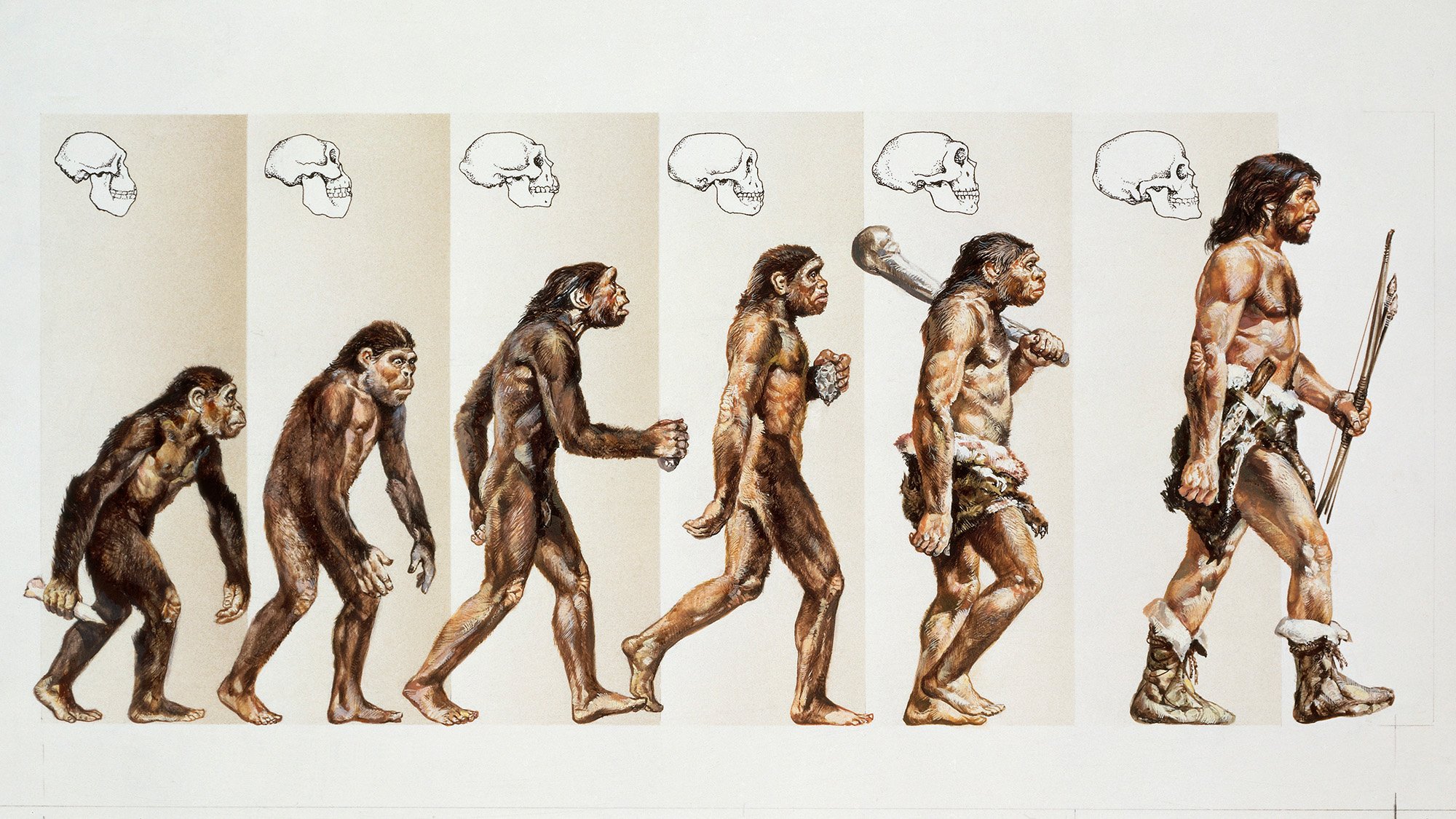
Okay, but here’s the thing. Humans didn’t suddenly decide to ditch our tails. We inherited our tailless bodies from our ape ancestors.
So if we really want to figure out why humans don’t have tails today, we have to first figure out how our furry ancestors lost theirs. And for that, we have to go way back.
AC: How far back are we talking?
SD: Well, first let’s go back about five or six million years.
That’s roughly when scientists estimate the last common ancestor of humans, chimpanzees, and bonobos lived, and that doesn’t really help us with our tail mystery
AC: Because chimps and bonobos don’t have tails either.
SD: Exactly. And neither do gorillas, orangutans, or any other modern ape. So we have to keep going back.
AC: So rewind. Whoop, rewind.
SD: And eventually we get all the way back to around 25 to 30 million years ago. Megalodon is stalking the seas. Daeodon, aka “hell pigs,” were roaming North American forests. And keep in mind, we’re still tens of millions of years before the first saber-toothed cats and mammoths pop up.
And this is where things get interesting because around this time, our ape ancestors branched off from the ancestors of modern monkeys .
AC: And monkeys do have tails.
SD: Right. Most do.
So somewhere around this part of our family tree, around 25 to 30 million years ago, we finally crossed over to the tailless side from our tailed ancestors.
The frustrating thing is the fossil record doesn’t give us a perfect family album. We can’t point to one specific ancient ape and say, “There, that’s our ancestor, that’s the one that lost the tail.” But we can find clues, and one of the best clues comes from an ancient ape called Ekembo .
AC: Tell us your secret, ancient ape
SD: Yes! Tell them. So fossils from this genus have been found in Kenya and date back about 17 to 20 million years. And these animals would’ve looked pretty different from modern apes.
One species, Ekembo heseloni , probably had arms and legs that were roughly the same size. It climbed around on tree branches on all fours, and it had a long, flexible lower back, unlike modern apes. But there’s one thing we know it didn’t have.
AC: A tail?
SD: Exactly. And we can tell because of particular bone, the sacrum.
AC: And where is my sacrum?
SD: It’s right at the base of your lower spine, and it’s actually one of the places scientists can look to to figure out whether an animal could have supported a tail or not.
If you look at the sacrum of a cat or another tailed mammal, it leads into a whole bunch of tail vertebrae.
But in humans and apes, the sacrum just ends in a, you know, little point. And scientists see that little point in Ekembo heseloni . So even though this animal lived up to 20 million years ago, we know they didn’t have a tail.
AC: So by 20 million years ago, the tail was already gone.
SD: At least in Ekembo .
AC: Mm.
SD: And it’s not alone.
Another ancient ape called Nacholapithecus shows up in Kenya around 15 million years ago, and fossils of its sacrum show the same thing. It couldn’t have supported a tail either.
So we don’t know exactly which one of these ancient apes ultimately gave rise to later hominids, aka our ancestors, but we do know that tailless apes were already walking or climbing around millions and millions of years before humans existed.
AC: Okay, so we know the tail disappeared way back in our evolutionary history, but that still leaves the biggest question, which is why? Like, why would you give up a tail? They seem kind of awesome.
SD: And this is where we get into a little bit of scientific speculation because we don’t have one definitive answer.
One possibility is that it has to do with the way these early apes moved. Think about modern animals that really benefit from tails.
If you’re a cheetah sprinting and making incredibly fast turns, a tail can help you balance. Or if you’re a monkey moving quickly through the trees, a tail can be really useful. But these early apes weren’t moving like modern monkeys.
AC: So what were they doing?
SD: Well, millions of years ago, these apes probably had arms and legs that were about the same length, and scientists think they walked on all fours.
They were also climbing through trees looking for fruit. And if you’re trying to get some delicious fruit growing way out on the edge of a branch, you don’t necessarily want to go flying through the canopy.
You want to move slowly and carefully they could support their weight across multiple branches and deliberately work their way towards the good stuff.
AC: So less swinging dramatically through the jungle…
SD: …and more very cautious trip to the fruit bowl.
AC: Got it.
SD: And if you’re moving that slowly and deliberately, a tail might not give you much of an advantage. In fact, it could actually come with costs.
Your body has to spend energy growing this whole extra appendage, and then you’re dragging it around behind you where a predator could potentially grab it.
So as the University of Missouri anatomist Carol Ward told Popular Science , for these slow-moving, careful climbers, the tail just didn’t offer an advantage.
AC: So after all of this, the answer to why don’t humans have tails is basically because our ancestors stopped needing them.
SD: That’s one theory, but the important thing is that we didn’t lose our tails because humans started walking upright or because of something that happened recently in human evolution.
By the time anything resembling a human showed up, tails had already been absent from our branch of the family tree for millions and millions of years
AC: So I never really stood a chance.
SD: Nope. You were born into a long, proud lineage of tailless apes.
AC: Yet after this whole conversation, I’m starting to feel like we kinda got a bad deal.
SD: Yeah, well, before you get too jealous of Team Tail, there is someone I want us to talk to because last year Science Friday host Flora Lichtman went looking for an answer to a very important question. If you are gonna have a tail, what’s the best one to have?
AC: Ooh, yes. Let’s talk upgrades.
SD: Yes, let’s. We’ll talk with Flora about the science of tails, whether there really is a best tail for balance, and whether she’d actually want one herself. That’s after this quick break.
And we’re back with Flora Lichtman. Flora is a podcaster extraordinaire, an Emmy-nominated writer for Bill Nye’s Netflix show, Bill Nye Saves the World , and one of the hosts of Science Friday , a public radio program and podcast about science, nature, technology, and health.
Flora, thank you so much for making the time to come on Popular Science’s Ask Us Anything podcast.
Flora Lichtman: I am delighted to be here. Thank you for the invitation, and I love tails, so glad to talk about them.
SD: So yes, as you know, throughout this episode, we’ve been talking all about why humans don’t have tails when so many animals do, and last year you actually explored an important piece of this puzzle on a Science Friday episode called “ In Search of the Best Tail for Balance ,” which we’ll link in the show notes.
In the episode, you talked with roboticist Dr. Talia Moore and developmental biologist Dr. Ceri Weber about their work into figuring out what’s the best tail, and how a tail could actually help us build better robots.
So obviously I have to ask: Is there actually a best tail for balance?
FL: You know, of course, if you ask scientists, they’ll never give you a best because that’s their, their whole job is to find the nuance and the complicated elements of every story. But what I did learn from them is that there are ways to design tails so that they do their job better.
SD: Hmm.
FL: And the thing that I didn’t know about tails is that they’re an inertial appendage, which is not a term I’d heard.
But the way these researchers described it is that it’s like a tightrope walker’s stick.
SD: Hmm.
FL: That you use to sort of regain your balance. Like that, for animals with tails, that is a primary reason why they have a tail.
SD: Yeah.
FL: The difference, though, between a tightrope walker stick and a tail is that most tails aren’t rigid rods, right? Like, they’re curvy and they’re twisty.
So what these researchers did is this simulation to try to compare, you know, what tails work best as this inertial appendage, and they found that design matters, and, like, you can optimize basically the bones in the tail to make them work better. And they found, it turns out if you have, like, short bones, then long bones, then short bones, that gives you a very good tail.
And it turns out that a lot of mammals in the animal kingdom have tails just like this.
SD: Wow. Amazing. So after spending all of this time thinking about tails: Would you want one?
FL: You know, Sarah, I’ve been thinking about that. Here’s the problem. I already have such a problem finding pants that I like and that fit, so I feel like the tail is just not a challenge I need.
On the other hand, I’m also very clumsy, and I do feel like maybe a tail would’ve helped me in the past.
SD: Yes.
FL: …keep my balance.
SD: Yeah. Yeah, I mean, like theoretically, pants aside, if you did have a tail as a human, what would be different? What would be harder? What would be easier?
FL: I mean, besides my look, I think, the thing that would be easier is walking on a slippery, icy day in the Northeast.
SD: Mm-hmm.
FL: I think they do really help you regain balance. I like the idea of being able to swing from the trees.
SD: Yeah.
FL: I’m at the playground a lot with my kids. I feel like it would be a real flex to get on those monkey bars with a tail.
SD: Oh my God, you’d be the coolest mom.
FL: The something-ist mom for sure.
Would you want a tail?
SD: I think, yeah, I mean, I guess, like, I think I would. I think it’d be fun. I feel like it’s kinda like having wings, you know?
You’d be definitely, like, ostracized a little bit. Like, people would look at you funny, but you could do a lot of cool stuff. I don’t know. I look at squirrels, and they’re basically flying,
FL: That’s true.
SD: Okay, so you also encountered a lot of impressive tales, I’m sure, in your reporting. Do you have a favorite tale from the animal world?
FL: I’m really love seahorse tails.
SD: Oh, yeah.
FL: They’re so iconic and twisty and beautiful and they really need them because they’re these lightweight little animals that are, like, being, you know, battered by ocean waves, and they can use them to hang on.
But I was reading that not only that, which is like, that’s all cool, but actually, while most tails are cylindrical, the seahorse tail actually has a square profile, which I thought was cool, too.
So it’s… I don’t know. I’m into the seahorse tail.
SD: Yeah, no, excellent choice. Excellent, excellent choice. Flora, thank you so much for taking the time to talk tails with us. It was absolutely lovely.
FL: Delighted to be here. I would love to come back anytime.
SD: Oh, we’d love to have you.
AC: Okay, I started this episode having never really thought about having a tail, and now I definitely feel like maybe I’m missing out. Like, when I need help holding things, give me a tail.
SD: Same. Although after my tailbone incident, maybe I shouldn’t be trusted with an additional appendage.
AC: Yeah, that’s maybe for the best.
And that’s it for this episode. But don’t worry, we’ve got more episodes of Ask Us Anything live in our feed right now. Follow or subscribe to Ask Us Anything by Popular Science wherever you enjoy your podcasts.
And if you like our show, please leave a rating and a review
SD: If you could have any animal’s tail, which one would you want? Tell us in the comments.
AC: Yes, we want to know.
SD: We wanna know. Our producer is Alan Haburchak. This week’s episode was based on an article written for Popular Science by Sarah Kiley Watson, and a big thank you to Flora Lichtman for joining us.
AC: Thank you team, thank you tails, and thank you everyone for listening
SD: And one more time, if you want something you’ve always wondered about explained on a future episode, go to popsci.com/ask and click the “Ask Us” link. Until next time, be careful with your tailbone and keep the questions coming.
AC: Wait, if we had tails, what would chairs look like? And pants, and car seats.
SD: Planes? It’d be kind of cute to see all the tails lined up.
AC: I feel like we need tails. It’s time to change up humans.
SD: Let’s do it. I’m ready.
AC: Yeah. We had a good run.
The post Humans were never built for tails. Here’s why. appeared first on Popular Science .