I’ve tested the Garmin Fenix 9 Pro and the Garmin Enduro 4 to compare their design, accuracy and battery life — here’s which I think is the better buy
Latest from Tom's Guide ·
Nick has been a journalist since 2012 and has spent most of that time writing about health and fitness for a variety of publications. Nick spent nine years working on the Coach magazine and website before moving to the fitness team at Tom’s Guide in 2024. Nick is a keen runner and also the founder of YouTube channel The Run Testers , which specialises in reviewing running shoes, watches, headphones and other gear. Nick has covered all aspects of health and fitness throughout his career, interviewing experts and celebrities, trying fitness classes and running marathons, all in the name of providing readers with the information they need to get the most out of an active lifestyle. Nick ran his first marathon in 2016 after six weeks of training for a magazine feature and subsequently became obsessed with the sport. He now has PBs of 2hr 25min for the marathon and 15min 30sec for 5K, and has run 16 marathons in total, as well as a 50-mile ultramarathon. Nick runs 60-90 miles a week and races regularly with his club, which gives him a lot of opportunity to test out running gear: he has tested and reviewed hundreds of pairs of running shoes, as well as fitness trackers, running watches, sports headphones, treadmills, and all manner of other kit. Nick is also a qualified Run Leader in the UK. Nick is an established expert in the health and fitness area and along with writing for several publications, including Live Science , Expert Reviews , Wareable , Coach and Get Sweat Go , he has been quoted on The Guardian and The Independent . Nick graduated from the University of York in 2010 with a degree in Politics, Philosophy and Economics and worked in the NHS for three years, during which time he completed his NCTJ Diploma in Journalism at News Associates in London. Before starting on Coach and moving into health and fitness, Nick worked as a football journalist and lived in Kathmandu, Nepal for two years.
The Fenix 9 Pro is Garmin's flagship watch and offers a more attractive design than the Enduro 4, along with extra features and more choice in the size and display you get.
The Garmin Enduro 4 is cheaper and lighter than the Fenix 9 Pro, and offers better battery life too.
Buying one of the best Garmin watches brings with it some guarantees with regard to the features you can expect, especially at the higher end of the brand’s line-up, where the Garmin Fenix 9 Pro and Garmin Enduro 4 both sit.
These watches offer stellar sports tracking and training analysis, along with the best navigation tools you’ll find on a smartwatch thanks to their offline routable maps. They are also equally accurate with GPS and heart rate, in my experience, and run the same software.
However, after testing the Garmin Fenix 9 Pro and Enduro 4 extensively, there are certainly some key differences between the two in other areas, most notably design and battery life.
If you want more details on either watch, check out my Garmin Fenix 9 Pro review or Garmin Enduro 4 review , but read on for a summary of the differences between them I noticed when testing them individually and at the same time.
The biggest difference between the two watches is price, since the Garmin Enduro 4 costs much less than the Fenix 9 Pro.
You’ll pay $899 for the Enduro 4 right now, while the cheapest Fenix 9 Pro model is $1,099, whether you choose the AMOLED version or the Fenix 9 Pro Solar with a memory-in-pixel (MIP) display like the Enduro.
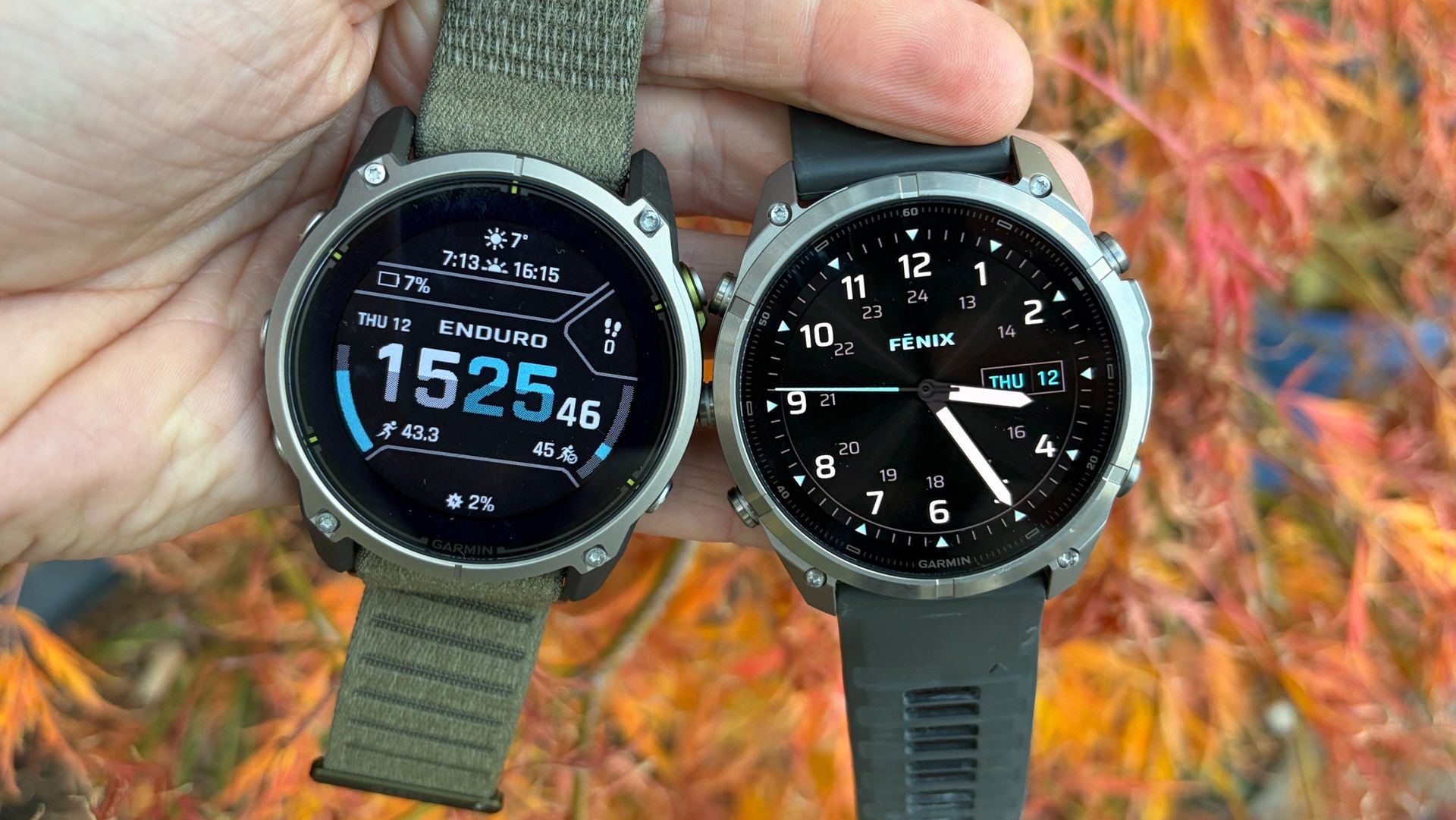
The key thing that the Fenix 9 Pro offers with its design is choice. It comes in three sizes — 43mm, 47mm and 51mm — and you can pick between an AMOLED or MIP display, and even choose between colors for the bezel and sensor guard.
In contrast, the Enduro 4 comes in one style and size. It’s a 51mm watch with a MIP display, and it only uses titanium for its bezel, with a mostly plastic case, whereas the Fenix 9 Pro has a full titanium case.
This gives the Fenix 9 Pro a more elegant look, but it also makes it considerably heavier than the Enduro 4. I tested a 51mm Fenix 9 Pro AMOLED, and both it and the Enduro 4 are large watches, but the Enduro 4 counters that a little by being so light.
When it comes to the display, picking between AMOLED and MIP will come down to personal preferences.
I find AMOLED brighter and clearer in almost all conditions, and just as good as MIP in bright sunlight these days, and I prefer using an AMOLED watch in general, but MIP uses less power and is less obvious on the wrist, and the Enduro 4’s display was still clear enough to see at all times.
Both watches have sapphire crystal screens and built-in flashlights, but you get an extra green mode on the Fenix 9 Pro’s flashlight.
You also get a diveproof watch with the Fenix 9 Pro, which can be used to depths of 40m. The Enduro 4 has a high waterproof rating of 10ATM and is fine for swimming, but isn’t a diving watch.
Another addition on the Fenix line is a mic and speaker, which can be used to take voice notes and give voice commands to the watch.
One advantage of the Enduro 4 is that it ships with Garmin's fabric ComfortFit band as standard, which I much prefer to the silicone band on the Fenix 9 Pro. You can buy the ComfortFit band separately, but it will cost $59.
The design differences speak to the approach behind the two watches. The Enduro 4 is built to be simpler and lighter, which helps it to be more affordable, but the Fenix 9 Pro is the all-singing, all-dancing option with a variety of models to pick between.
The two watches share very similar sports tracking and training analysis features, and both have proved to be similarly accurate throughout my testing.
There’s only one difference worth flagging in this area, which is that the Fenix 9 Pro is a diveproof watch and has Garmin’s scuba, apnea and snorkel sports modes.
One of the biggest features you get on the Fenix 9 Pro (InReach model) that isn’t available on the Enduro 4 is LTE and satellite connectivity.
This feature requires a subscription but allows you to stay in contact with the world when you’re off the grid or phone-free, through messaging and the ability to send SOS alerts.
Otherwise, both watches share the usual Garmin smart features. They can store music and link to streaming services, make NFC payments through Garmin Pay, and have access to the Connect IQ app store.
Along with being cheaper and lighter, the main advantage of the Enduro 4 is its incredible battery life.
Whatever Fenix 9 Pro you opt for, including the Solar MIP watch, the Enduro 4 will outlast it in both watch and GPS modes, partly because it has a bigger solar ring than the Fenix 9 Pro Solar.
I've compared the 51mm models of the Fenix 9 Pro to the Enduro 4 below. Note that to get the full solar battery life listed, you need to be out and about in sunny conditions for three hours a day on average.
Garmin Enduro 4
Garmin Fenix 9 Pro Solar 51mm
Garmin Fenix 9 Pro AMOLED 51mm
Watch mode
36 days/90 days solar
30 days/57 days solar
Up to 31 days (raise to wake)
Normal Activity Mode
80 hours/144 hours solar
75 hours/124 hours solar
56 hours
Max Accuracy Activity Mode
60 hours/90 hours solar
54 hours/75 hours
45 hours
In my use, the Enduro 4 lasted me 16 days on its first charge and is tracking for 17-18 on its second charge, whereas the 51mm Fenix 9 Pro AMOLED lasts me 10-11 days with the screen set to always-on.
This was during the British winter too, when I gave the Enduro 4 almost nothing in terms of a solar charging boost, so you can expect the gap to be wider in sunnier climates.
Garmin Enduro 4
Garmin Fenix 9 Pro Solar
Garmin Fenix 9 Pro
Price
$899
$1,099-$1,299
$1,099-$1,399
Size
51mm
47mm or 51mm
43mm, 47mm or 51mm
Thickness
15.7mm
15.8mm (47mm), 16.6mm (51mm)
13.3mm (43mm), 13.8mm (47mm), 15.8mm (51mm)
Case weight
66g
84g (47mm), 102g (51mm)
62g (43mm), 78g (47mm), 99g (51mm)
Display
1.4in MIP
1.3in or 1.4in MIP
1.3in, 1.4in or 1.5in AMOLED
Case
Plastic with titanium bezel
Titanium
Titanium
Screen
Sapphire crystal
Sapphire crystal
Sapphire crystal
Connectivity
None
LTE & satellite (InReach model)
LTE & satellite (InReach model)
Smartwatch battery life
36 days/90 days solar
30 days/57 days solar
10 days (43 mm), 18 days (47mm), 31 days (51mm) (raise to wake)
GPS battery life (max accuracy)
60 hours/90 hours solar
54 hours/75 hours
18 hours (43mm), 32 hours (47mm), 56 hours (51mm)
The Garmin Fenix 9 Pro line-up offers more features and choice than the Enduro 4, and I prefer the all-titanium design of the Fenix and its brighter AMOLED display.
However, the Enduro 4’s relative simplicity will appeal to many people, as will its lower price, longer battery life, and lighter design.
If you’ve been eyeing the Fenix 9 Pro Solar in particular and don’t really need the connectivity features on the watch, then I think the Enduro 4 is a better value buy. Or even the Garmin Enduro 3, for that matter, since it has a similar design and feature set to the latest model.