I walked 12,000 steps with the Fitbit Edge and the Garmin Forerunner 70, and I wasn’t expecting this result
Latest from Tom's Guide ·
Jane McGuire is Tom's Guide's Fitness Managing Editor, which means she looks after everything fitness-related — from running gear and fitness trackers to yoga mats and sports bras. An avid runner, Jane has tested and reviewed fitness products for the past five years, so she knows what to look for when finding a good running watch or a pair of shorts with pockets big enough for your smartphone, running gels, and house keys. Jane has run six marathons — the London Marathon five times, and the Berlin Marathon once -and is still on a quest to tick off all of the marathon majors. Her marathon PR is 3:30, which she ran in the New Balance Supercomp Elite V5's, but she also spends a lot of time talking about her ‘joy plan’, where she runs for happiness, not for PR’s. Previous to Tom’s Guide, Jane worked for Runner’s World, where she co-hosted the Runner’s World podcast. She also presents on a YouTube channel called the Run Testers, alongside other running-mad journalists, where they review the latest shoes, kit, and tech. Her work has also appeared in Coach, Get Sweat Go, and Women’s Health. When she's not pounding the pavements, you'll find Jane striding round the Surrey Hills, taking far too many photos of her spaniel, Toby.
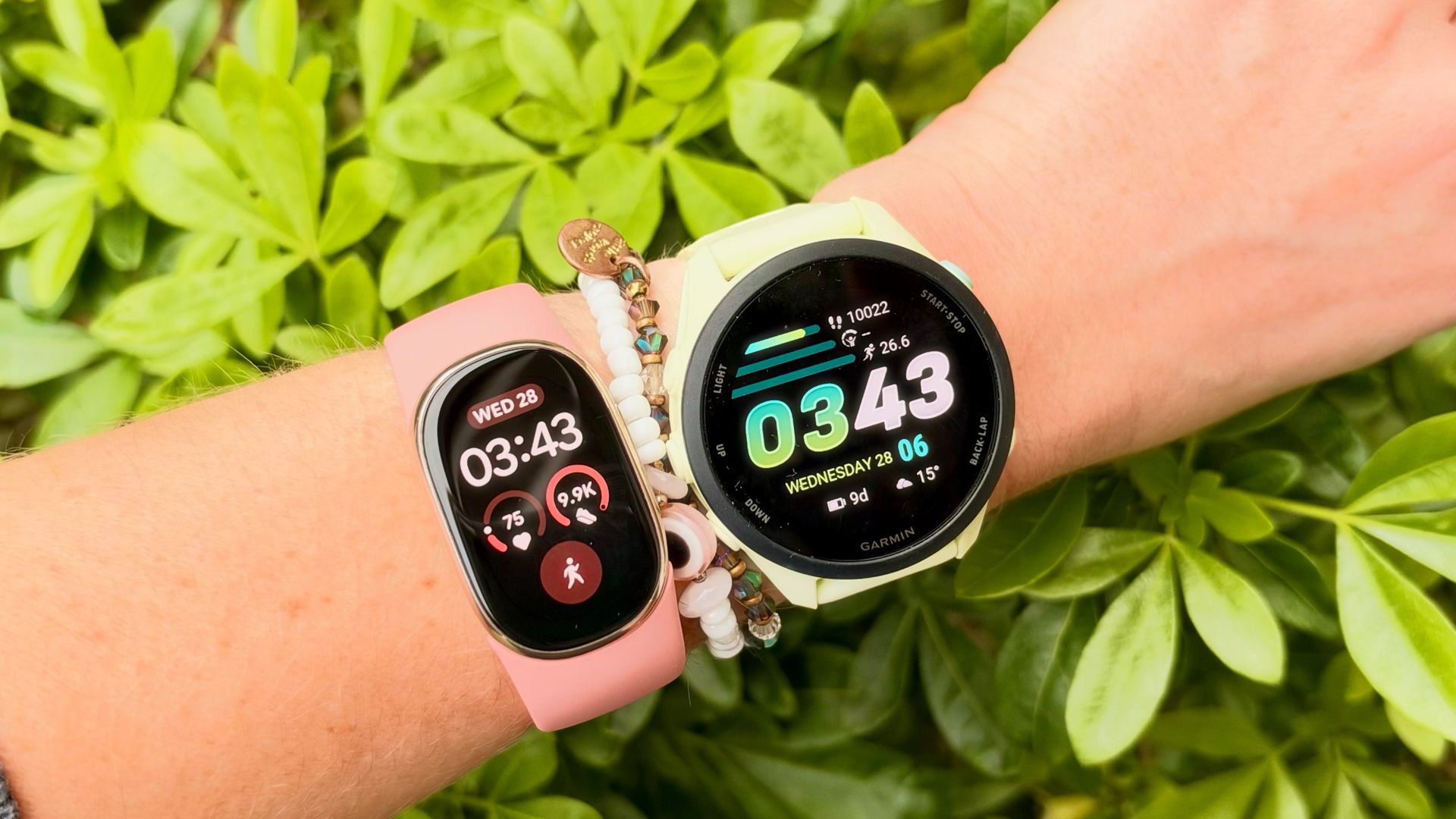
Another day, another walk test on the Tom’s Guide fitness desk, and this time it’s the new Fitbit Edge on test against the Garmin Forerunner 70 — Garmin’s most affordable Forerunner running watch. If you’ve been around here long enough, you’ll know one of the first things we do when a new device is released is look at how well it does the basics, and in this case, that’s counting steps.
Sure, both of these trackers will do a lot more than just count your steps. The Fitbit Edge seems to toe the line between the $99 screenless Fitbit Air and the Google Pixel Watch 5 — a bright screen, built-in GPS, and continuous heart rate monitor. The Garmin Forerunner 70 is Garmin’s $249 beginner-level running watch, with plenty of training tools on board and a bright AMOLED screen.
But which came out on top? Read on to find out more, and check out our Fitbit Edge review and Garmin Forerunner 70 review here on Tom’s Guide.
As with all these tests, I wore one device on each wrist and used an Amazon clicker to count every step I took manually. Both trackers count your steps using an internal accelerometer, which measures the swing of your arms.
Each swing counts for two steps, and it doesn’t matter whether you wear your watch on your dominant or non-dominant hand. It doesn’t matter if you walk with your hands in your pockets or holding a cup of coffee; the accelerometer should still measure your body’s movement.
I split the steps over four different walks, and when I got home, I downloaded all the data. Here are my results:
Manual:
2,900 steps
Fitbit Edge:
2,864 steps
Garmin FR 70:
2,912 steps
Manual:
2,990 steps
Fitbit Edge:
2,964 steps
Garmin FR 70:
3,004 steps
Manual:
2,380 steps
Fitbit Edge:
2,371 steps
Garmin FR 70:
2,388 steps
Manual:
4,261 steps
Fitbit Edge:
4,388 steps
Garmin FR 70:
4,316 steps
Manual:
12,531 steps
Fitbit Edge:
12,587 steps
Garmin FR 70:
12,620 steps
As you can see from the results, the Fitbit Edge beat the Garmin Forerunner 70 during this walk test, only overcounting by 56 steps. That’s not to say the Garmin was inaccurate; however, it only overcounted 89 steps over the 12,500 I actually took.
It’s worth noting that 50-90 steps is pretty much spot on. The average person takes 2,000 steps a mile, so an extra 56-89 steps is nothing.
To really compare these two watches head-to-head, you’d need to look at more than just how well they count steps. Both are designed to be worn 24/7 and help you track more than just walking workouts.
The Fitbit Edge is largely designed to be worn as an overall fitness tracker, with a slim design, an ECG monitor and skin temperature reader, and basic built-in GPS. The Forerunner 70, on the other hand, is largely designed for runners, with more buttons to make it easier to navigate around the watch with sweaty fingers, a heart rate sensor and advanced metrics like running cadence, and highly consistent built-in GPS.
There are no ECG or skin temperature sensors on the budget Garmin; however, it’ll last 13 days between charges compared to the seven-day battery life of the Fitbit Edge.
Both are at a similar price point: $179 for the Fitbit Edge and $249 for the Garmin Forerunner. Which you choose largely depends on what you’re planning on using it for. If you’re looking for a tracker to wear 24/7 and give you a better understanding of your overall health, you’ll get a lot from the Fitbit Edge. If you’re training for your first 10k or half marathon, the Garmin Forerunner 70 is the better choice.
But which would you pick? Let us know in the poll below.