6 stellar images of the early universe
Popular Science ·
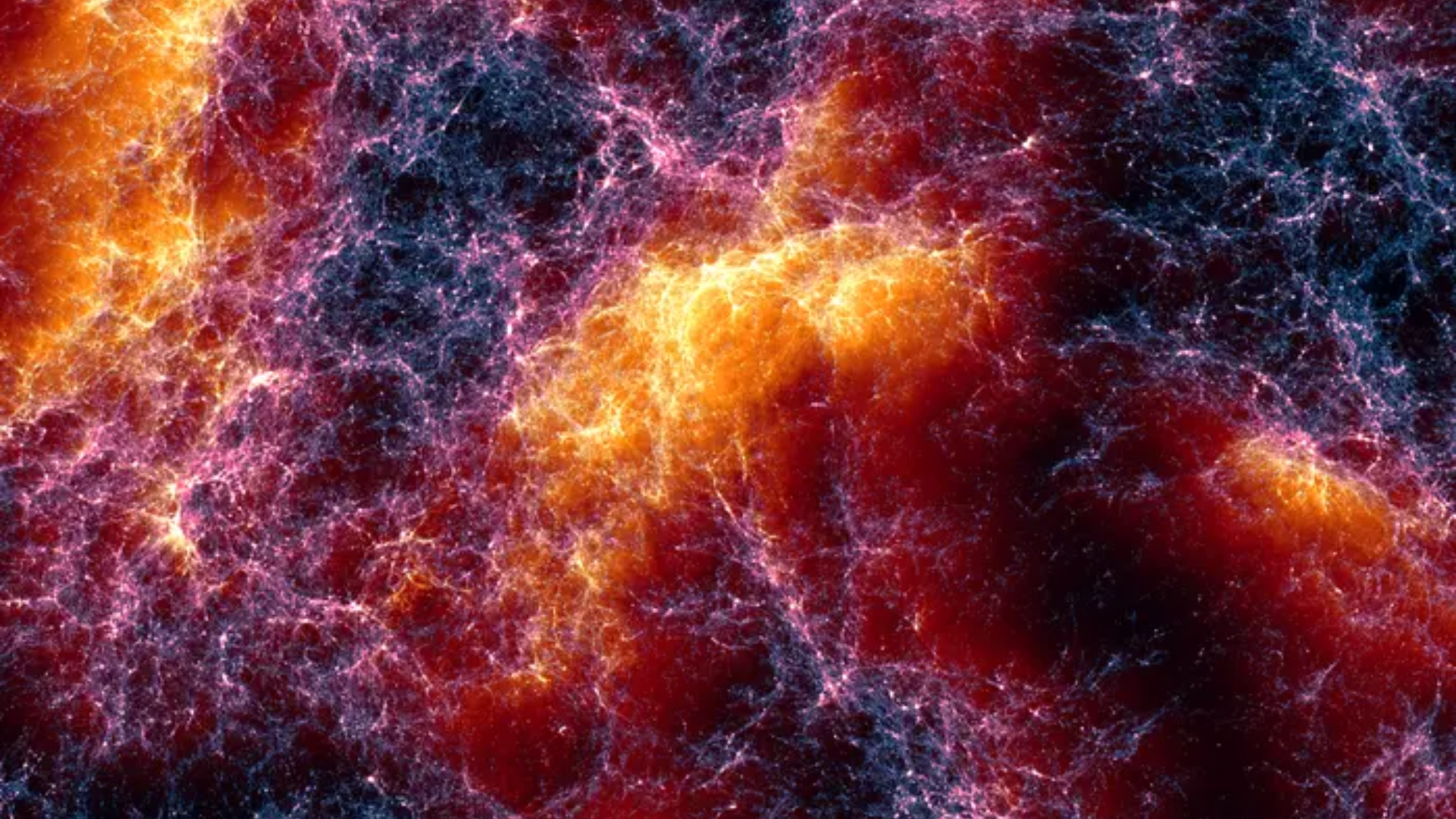
The most detailed simulation of our universe’s first 2 billion years to date. The post 6 stellar images of the early universe appeared first on Popular Science .
Millions of miles away from Earth, the James Webb Space Telescope (JWST) and Nancy Roman Space Telescope are revealing the early days of our vast universe in extraordinary detail. A team at the Center for Astrophysics | Harvard & Smithsonian have developed Lumina , one of the largest and most detailed simulations ever created of the early universe .
The new model is detailed in a study published today in the journal Monthly Notices of the Royal Astronomical Society . It recreates how ordinary matter, dark matter, and radiation all interacted during the universe’s first 2 billion years. This gives scientists a new tool to test out their theories about how the cosmos evolved after the big bang . Comparing observations from JWST, Roman, and other telescopes with Lumina’s predictions, also can help astronomers determine whether their understanding of the laws governing our universe remain accurate or if new discoveries require them to reconsider existing theories.
Creating Lumina required more than 15,000 graphics processing units. Take a peak at some of Lumina’s stellar images and videos in the gallery below. (Click to expand images to full screen.)
“With JWST, the early universe has become an exciting new frontier in astrophysics,” study lead author Oliver Zier , a computation astronomer and ITC Fellow at the Center for Astrophysics | Harvard & Smithsonian, said in a statement . “To understand what we are seeing with this telescope, we need to translate our theories into detailed predictions. After several years of work, with plenty of ups and downs, it is incredibly rewarding to see the simulation results and watch our predictions come to life in video.”
Lumina is the largest cosmological radiation-hydrodynamics simulation ever created. This kind of simulation models how the universe’s fundamental ingredients interact to form stars and galaxies. These ingredients include dark matter, light, and gas. Lumina is tracing how the earliest galaxies emerged and transformed the vast regions of gas between them over the universe’s first 2 billion years.
“We feel incredibly fortunate to be building simulations like Lumina,” added Aaron Smith, an assistant professor of physics at the University of Texas at Dallas and study co-author. “For the first time, we can follow along as both hydrogen and helium changed into their modern form across such an enormous volume of the universe, while still resolving the galaxies and other luminous objects driving that transformation.”
To view the entire project, visit the Lumina Project.
The post 6 stellar images of the early universe appeared first on Popular Science .