Welcome to our ‘RAMageddon Reset’: For Black Friday, I’m stripping away fake AI inflation to find the true MSRP discounts on laptops, desktops and more
Latest from Tom's Guide ·
Jason brings a decade of tech and gaming journalism experience to his role as a Managing Editor of Computing at Tom's Guide. He has previously written for Laptop Mag, Tom's Hardware, Kotaku, Stuff and BBC Science Focus. In his spare time, you'll find Jason looking for good dogs to pet or thinking about eating pizza if he isn't already.
Black Friday is usually the time to get a new computer. Nowadays, it’s a minefield of fake MSRPs and deceptive percentage signs. For the last six months, the tech industry has been jacking up prices because of “RAMageddon” — a massive silicon shortage driven by hyperscalers hoarding memory for data centers.
And after half a year of this, we’re sick of this. So we’re going to do something about it.
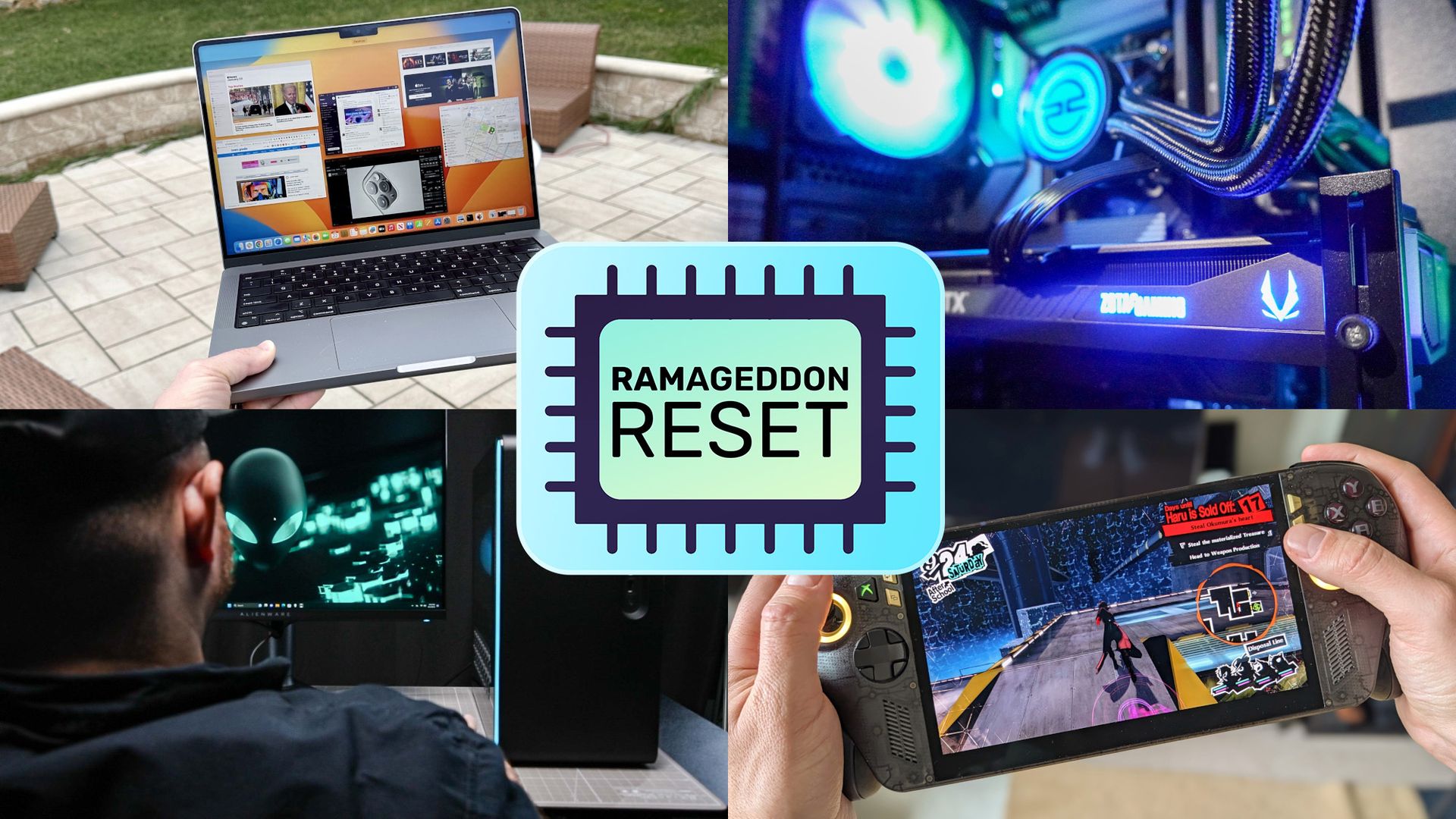
Welcome to The RAMageddon Reset.
For our Black Friday coverage this year, Tom’s Guide is activating a string, BS-free filter. And it all starts with one key rule: we are exclusively hunting for RAMageddon busters — deals that completely erase the memory crisis inflation and bring hardware back to pre-crisis reality.
If a computer or component wants to make it onto our RAMageddon Reset hitlist, it has to pass two brutal economic tests to prove it isn’t just a fake discount on an inflated price tag.
If the system launched before the memory shortage peaked (Q1 2026 or earlier), we ignore the current crossed-out “list price” on the retailer’s website.
We pull the original launch MSRP from our archives, and the current price must either match that cost or drop strictly below that original price.
For computers that launched during the memory crisis (like Googlebooks or Apple’s M6), their starting MSRPs are already massively inflated.
Instead, we’re looking at the pre-crisis equivalent — an equivalently-specced Windows laptop in place of the Googlebook for example. If it’s not below that historical predecessor, it doesn’t make the list.
We will show our working through every element of this, to help train your keen eye to spot what is actually a deal and what is a bluff.
Now, I must tear the bandaid off with some brutal news. If you are building a PC from scratch this Black Friday, you’re going to pay a serious RAM tax.
While laptop manufacturers and desktop makers have enough scale to occasionally eat the cost of inflated memory, the standalone component market is currently a barren wasteland.
Of course, I could be wrong. And if a stick of RAM or a graphics card is ever genuinely cheaper than it was in December 2025, we’ll be sharing it with you expeditiously! But I just want to temper expectations here. There are cracks in the AI bubble, but it’s not bursting yet.
Black Friday seems to start earlier and earlier, and the starting pistol was fired on Friday with Best Buy and more. I’ve looked at the early deals hitting the market, and can show how I’m applying my BS-free rules to them.
The math: Amazon has chopped 8% off the M5 Pro MacBook Pro , and its Alexa for shopping AI says it’s “matching the lowest price we’ve recently seen at other stores.”
The result: Pass
The reset: This passes Rule 1. Apple recently raised the price floor to a staggering $2,899 for their new PROLED XDR models, burying them under an exorbitant AI-era tax.
However, Amazon seems to be quietly offering “pre-hike” clearance pricing on this 14-inch configuration. For example, the M4 Pro 14-inch MacBook Pro with 24GB of unified memory and a 1TB SSD sold for $2,299.
So at $10 beneath that, this passes rule 2 too. If you need macOS for creative workflows, you can bypass the $600 OLED tax entirely and exploit this loophole.
The math: Best Buy is slashing $580 off the Ryzen AI Max+ 395 configuration (64GB RAM, 1TB SSD), dropping it from its bloated $2,999 down to $2,419.
The result: Pass
The reset: This isn’t a fake AI bubble discount; it’s a genuine anomaly. Before the memory crisis hit, a top tier ROG Flow Z13 of this spec would routinely run you around $2,500.
Best Buy is driving this Strix Halo generation below that historical pre-crisis threshold while doubling the memory pool to a massive 64GB.
Plus with FSR 4 support here now, the gaming chops of this system have improved immensely.
The fake math: I’ve seen a lot of places write headlines like “RTX Spark has just come out, and you can already save $400 on it.” Best Buy has dropped the Lenovo Pro 9n down to $4,499.
The result: Fail
The reset: This is a catastrophic failure of rule 2. The RTX Spark SoC launched right in the middle of the silicon drought, and this is being priced like it belongs in an enterprise server rack.
Yes, it has the power to be your own local data center (and compared to the PROLED MacBook Pros, it can be seen as a bit of a bargain).
But before the memory crisis, a flagship Lenovo maxed out with a top-tier RTX 4090 and 64GB of RAM would generally cap around $3,500-$3,800. That’s a massive $1,000+ baked in AI tax on the baseline MSRP — making a $400 discount irrelevant. Hard pass.
The math: Newegg is slashing the price of its ABS Flux II Aqua Prebuilt (Core i7-14700F, RTX 5060, 32GB RAM, 1TB SSD) from a highly inflated $1,799 down to $1,299.
The result: Pass
The reset: There’s a loophole here: using DDR4 memory over DDR5. Hyperscalers and AI data centers do not want the older RAM — they’re focused on hoarding DDR5 and HBM.
By pairing the new RTX 5060 with a capable 14th Gen Core i7 and 32GB of older DDR4 memory, this is a capable machine that bypasses that silicon bottleneck. And it passes Rule 2 too, as an average machine of this calibre before the memory crisis would routine sell for around $1,300.
This year of all years, Black Friday is shaping up to be one of the most treacherous shopping seasons in modern tech history. Retailers are actively relying on the chaos of the holiday rush to slip the invisible AI tax past your wallet.
They’re hoping you’re too hypnotized by a bright red “20% OFF” badge to realize they jacked up the baseline MSRP months ago to cover those enterprise silicon costs.
But you don’t have to play their game. This is just the beginning of a different kind of Black Friday coverage for Tom’s Guide.
Over the next few weeks, me, Tony, Anthony and more will be taking the RAMageddon Reset across the entire computing landscape. We are going category by category — tearing into portable gaming handhelds, monitors, peripherals and whatever scraps of storage we can find. We are going to apply these exact same brutal economic tests to every single product.
If a deal doesn’t completely erase the 2026 memory crisis inflation, we will name and shame it. If it genuinely beats the pre-crisis benchmark, we will verify it and tell you to buy it.
We will continue to show our working on every single item, so you can train yourself to spot the difference between a retail bluff and a legitimate bargain.
Keep your wallets closed, your BS detector armed, and bookmark our RAMageddon Reset hub. The industry wants you to pay for their data center problems, but if you stick to the rules of engagement, we can navigate this minefield together.