Polaris RZR Pro R Boost First Drive Review: A $50,000 Performance Bargain
The Drive ·
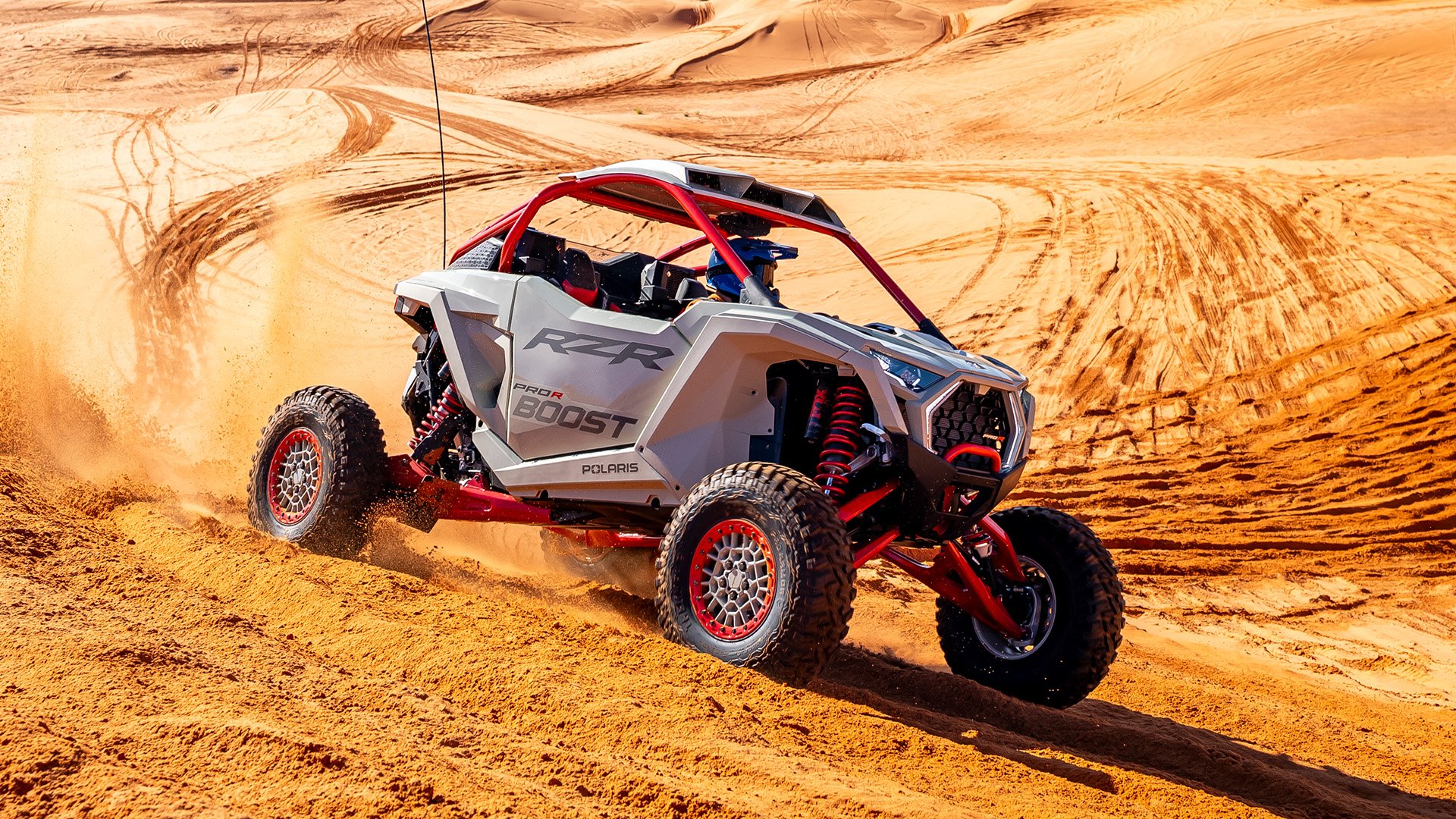
You might flinch at the price of a new RZR Pro R Boost, but just wait until you fling it around a corner. The post Polaris RZR Pro R Boost First Drive Review: A $50,000 Performance Bargain appeared first on The Drive .
The Polaris RZR Pro R Boost costs more than $50,000, yet it’s still a performance bargain. No car you can buy for the same money comes close to this turbocharged off-roader’s agility and outright ability. It’s so fast that I can almost guarantee you will be the limiting factor—not the rig. Want to know how I know? Stick around, and you’ll see me make an example of myself as I blast through the Southern Utah sand.
A group of goofball reviewers, including myself, turned up to Sand Hollow State Park for a day-long romp in Polaris’ newest flagship. I ‘d already tested the naturally aspirated RZR Pro R , so I thought I knew what to expect from this forced-induction variant. In some ways, I was right. But in others… not so much.
In my short time behind the wheel, I learned it’s a bad Mama Jama, ripping and ready to pounce with no hint of lag. It conquers the wide-open with more displacement and more boost than the competition, and it doesn’t need a fancy dual-clutch transmission to haul the mail. What it does need is a pilot who won’t put it on its roof. Sadly, I didn’t get that in me.
But during my stint in the passenger seat—especially while the RZR Pro R Boost’s lead architect took the wheel—I learned it can handle far more than I could have done if I’d kept it shiny-side up. This is one wicked wheeler.
Normally, I’d rattle off the specs and stats here. I’ll still do that, but I’ll do it in a way that doesn’t keep you waiting for the payoff.
I had been digging up the dunes for a couple of hours with the buggy’s 32-inch BF Goodriches. The 2.0-liter four-cylinder, which cranks out 275 horsepower thanks to a 60-millimeter Garrett turbo, makes that pretty easy. Sliding had become the natural way to take corners, but when the aforementioned all-terrains began to grip on wet sand instead of breaking loose, I panicked and stabbed the brake. All my momentum transferred from rolling forward to rolling sideways, and the next thing I knew, I was tipping over. Dangit .
It was a slow maneuver. Almost frustratingly slow. We’d been blasting through sand whoops at highway speeds—no kidding—just minutes before. But my lack of skill and experience on sand is what did me in on a long, wide, 35-mile-per-hour right-hander. For what it’s worth, I wasn’t hurt at all, and the RZR’s rollover protection system kept me safe. I had no scratches except for one on my elbow from crawling out. The only part of me that broke was my pride.
With that short ordeal now done and dusted, I can tell you about the rest of my day with the RZR Pro R Boost.
As soon as you pass through the tunnel to enter Sand Hollow State Park’s OHV area, you’re greeted by mighty steep ascents on both sides. In other words, no Corolla will end up here by mistake. The Polaris didn’t mind these mild obstacles, and before you knew it, our pack of pretty side-by-sides was passing lines of Jeeps in town for the annual Trail Hero event.
A big wall of sand was the first proper test for these machines and their drivers. Polaris hired a pro photographer to hit the trails with us, and he stood at the tippy-top of this dune to get some action shots. We made it our goal to get as close to him as we could without sending the machines over the edge, and that’s when I noticed: We are the limiting factor in this equation. So many in our group backed out before getting near the shooter, and while I felt pretty good about my run, there was still plenty more to give. Dakar winner Brock Heger quickly showed us all how to do it, perfectly executing the side-by-side equivalent of a skateboard tailslide along the wall’s highest point.
The section that followed was maybe the most fun of the entire day. We were let loose to find our limits on a fast, flowing section of trail that let slower riders fall out while faster ones could pass on the high side of berms. I stayed close to Cole Shirley, the man behind MadRam11 Productions —an off-road channel with more than four million Facebook followers and a million YouTube subscribers. He’s a seasoned wheelman from Alabama with lots of experience in RZRs and rock bouncers.
Simply watching Shirley’s rig react to the terrain taught me a lot about the Pro R Boost. It’s almost alien-like in its articulation, as it utilizes 29 inches of rear travel to do its thing. What you can’t see is the Dynamix DV semi-active suspension adjusting up to 200 times a second—though you can feel it. Pucker moments, like barreling down a single-track into a rock ledge, become non-events. And every Pro R, with or without boost, comes pre-wired to accept Polaris’ even more advanced Dynamix DVS system with 12-channel adjustment and active sway bar links .
Hearing all this in the pre-ride briefing was intriguing, but it felt vital when I hopped into the shotgun seat for a ride with Zach Blackford, vehicle architect for the Pro R Boost. He isn’t a pro race driver like Heger, but he engineers the car Heger races at Dakar, the Mint 400, and more. To do that, he has to know how the vehicle performs in all conditions, including when it’s going fast as crap.
We blazed through a wide-open section before diving into a more technical course that would have taken me at least twice as long, and I’m not kidding. I grew up riding four-wheelers on gravel, sliding from one corner to the next, and what Blackford did with the Pro R Boost was far beyond anything I’d ever tried. At no point during that run did I think, “Huh, I wonder when the boost will kick in.” It was always just there.
That’s a big part of this machine’s magic. With such a big turbo, you expect it to take a while to pin your noggin to the headrest. It doesn’t. Likewise, you expect low-speed driving to be sort of a chore. It’s not. With the throttle set to Rock mode, it’ll climb any slickrock you want without drama, and you can kick it into Race mode as soon as things open up. It’s a genuinely versatile machine.
In my experience, it beats the Can-Am Maverick R at its own game. Even though that rig is also turbocharged and makes a healthy 240 hp, it simply doesn’t feel as good as the Pro R Boost. While grabbing gears with the Can-Am’s paddle shifters is fun, the Polaris’ CVT can adjust lickety-split to accelerate straight away. I’d like to test them back to back, but I can’t say I missed the Maverick R’s funky front suspension either; the Pro R Boost is just as capable of blasting through nasty washouts. Oh, and if we’re talking about infotainment and user interface—seemingly minor but actually major parts of ownership—the RZR is much better.
My joyride with the Pro R Boost proved this rig offers no better out-of-the-box performance experience for the money. I don’t have $50,000—or, in the case of a four-door Ultra model, $56,999—to spend on a toy. But if I did, and fun-per-dollar was my sole concern, this is what I would end up with.
I’m not sure how they’d make one of these faster. That said, I bet they will.
Polaris provided The Drive with travel, hotel accommodations, and a day-long loan of this vehicle for the purpose of writing this review.
Strap in and hold on, because this boosted bad boy is probably faster than you.
Got a tip or question for the author? Contact them directly: caleb@thedrive.com
The post Polaris RZR Pro R Boost First Drive Review: A $50,000 Performance Bargain appeared first on The Drive .