Star Wars Galactic Racer Review: Come for the Podracing, Stay for the Punishment
The Drive ·
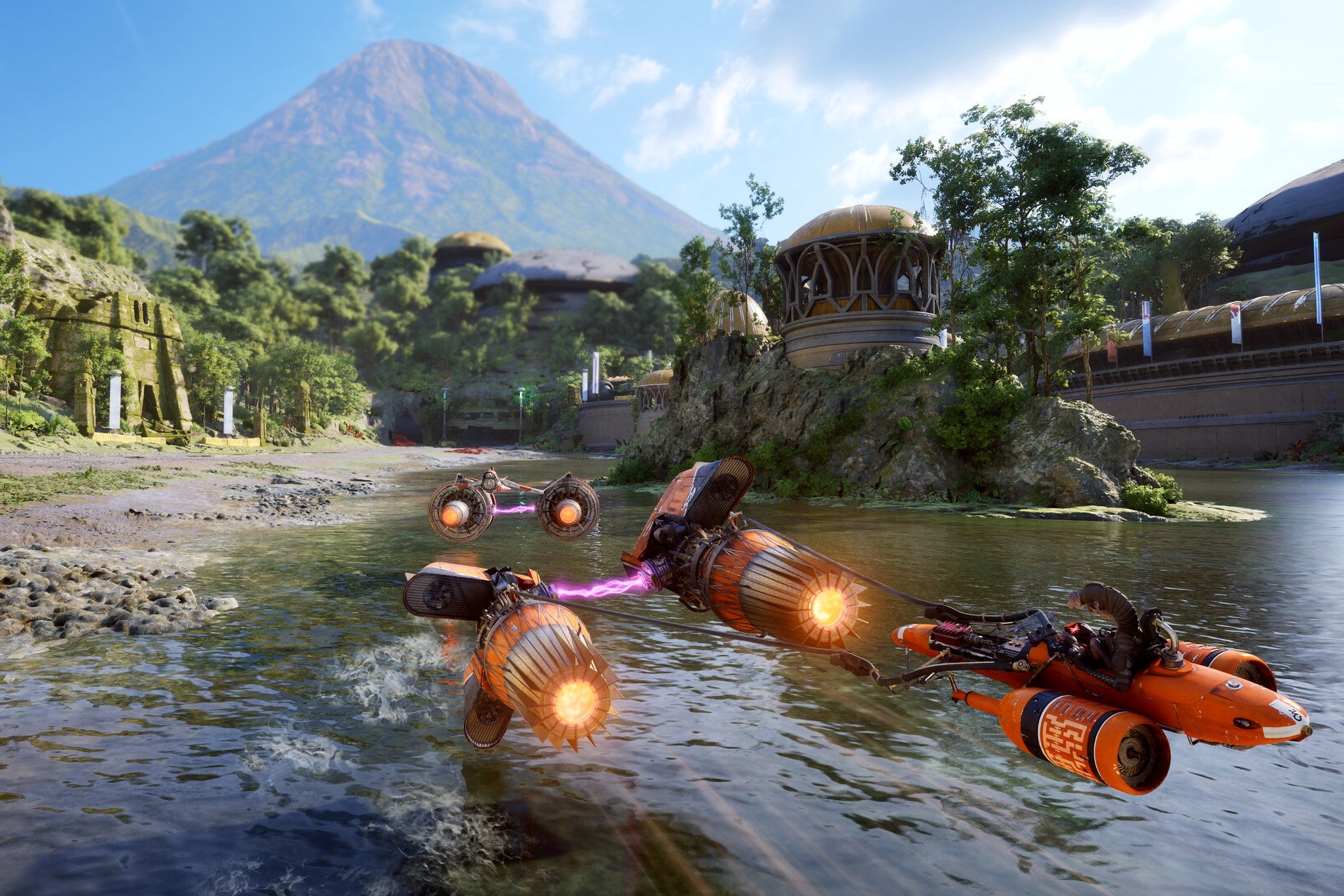
Breakneck arcade racing meets a demanding campaign in this thrill ride through a galaxy far, far away, from the makers of Burnout. The post Star Wars Galactic Racer Review: Come for the Podracing, Stay for the Punishment appeared first on The Drive .
Full disclosure: I know nothing about Star Wars. I’ve seen maybe three of the movies in my life and retained zero plot information from any of them. My nickname for every character is “Glorp Casino.” Still, I was excited when I heard about Star Wars Galactic Racer , because it looked to combine the franchise’s distant-universe steampunk vibes I actually find appealing with tried-and-true arcade racing fundamentals, courtesy of Fuse Games, a new British studio formed by Criterion alumni.
These are the folks behind Need for Speed’s early 2010s renaissance and, more importantly, Burnout . At their finest moments, both games ran a masterclass in conveying the pandemonium of racing; that contradictory feeling where you’re at the absolute edge of control, but also have complete confidence that you’ll be able to hang on and pull out the win. Burnout could make you feel like a hero; Star Wars Galactic Racer does, too.
But of course Galactic Racer achieves this in the Star Wars universe, which will carry more weight for the people playing it. And it’s backed by a bona fide story mode with characters and a thoughtfully-crafted progression system that, while not perfect, imbues every race and interaction with purpose. I think you’ll arrive at Galactic Racer for the raw arcade thrill, but you’ll keep coming back because it actually makes you feel like there’s something to race for.
The core of the single-player loop is a tour around the galaxy, visiting seven planets, which each have a few circuit and point-to-point courses. Most racing games would have you progress through these events naturally, aiming to win enough points to top the championship table as you upgrade your craft with your winnings from each round. But Galactic Racer doesn’t work like that.
Fuse calls its gameplay design “runs-based.” Seasoned gamers who play more than just racers would call it “roguelike.” Whatever you call it, it means that before embarking on your campaign for total glory, you build your craft precisely how you like it with the resources you have, investing stat points to improve the specific areas you deem need attention. And then, you’re pretty much on your own.
When you land on a new planet in the tour, you can buy some upgrades, and depending on your finishing position, you might win some useful parts. But your machine is what it is—there’s no swapping to a different speeder, and no retries. And if you crash too many times in a race, it’s back all the way to square one.
I’m sure someone will read this review and dismiss this next paragraph as me exposing a skill issue, but, frankly, you’re not supposed to make it through your first tour. You’re supposed to lose—whether by crashing out or finishing runner-up in a duel against a rival whose name shall not be spoiled. When you return to home base to start anew, you’ll be able to expend what winnings you might’ve had on a better machine than you started with last time. And that’s the loop: Start, fail, and improve, until you don’t fail anymore. That’s what roguelikes are all about.
I will admit this frustrated me considerably in my first play session. There’s that unavoidable initial feeling that you just threw away the last hour of your life because you got your ass handed to you in a race that lasted three minutes. The whole point of Galactic Racer, of course, is that nothing’s ever wasted, even in defeat. And, over time, the dejection of coming up short is replaced with the eagerness to get back out there, only stronger.
Part of the rather steep difficulty curve is that, being a modern racing game, there are always at least three levers to pull that have nothing to do with actually steering your craft. There are two forms of boost: Afterburner, which is a modest speed bump that merely depletes and refills, and the much more powerful Ramjet, which is sort of like the boost system in Excitebike or MotorStorm , except when you overheat, you explode. Despite its name, it has nothing to do with executing takedowns, an element Galactic Racer smartly borrowed from Burnout that I wish it did a little more with.
In addition to those two facets, which are influenced by passive perks that might change the rate at which you accumulate or discharge boost, there are also abilities—like a shield or temporary autopilot—which are triggered by pressing a certain direction on the D-pad, followed by the left shoulder button. There’s also another designated button that drifts or leans, depending on the type of craft you’re flying. And before you know it, your thumbs and fingers are bopping around the controller to prime and fire every gizmo as you’re speeding out of a very narrow cave like a bullet leaving the barrel of a gun. It’s a little annoying to have to be on it all the time, but a bit like I felt with Screamer , there’s a good, mechanical sense of satisfaction when you get it right.
The courses play into all this too, because each planet has disparate effects owing to their extreme biomes. I love this idea in theory, but the execution is mixed. For example, the water on Lantaana (one of my favorite planets in the game by far) cools your Ramjet to stop it from overheating too quickly, while the lava predictably has the opposite effect. Meanwhile, the ice on Ando Prime can literally freeze and partially immobilize your craft, making it slower and harder to steer. I assumed that burning my Ramjet could counter this frigid effect, but it doesn’t. Rather, Ando Prime has what I can only describe as toaster oven tunnels on its courses, that will get your speeder all nice and warm for maybe a second, before the ice freezes up the works again.
Ultimately, between the many buttons to press and the unforgiving nature of the progression system, I was hoping the Ramjet would counter the ice because I was looking for a break. I found myself looking for many breaks in Galactic Racer—it can feel downright unfair at times. Take the Ramjet trials, for example, where you’re tasked with boosting for as long as possible around a given track. Even on middle-of-the-road Pilot difficulty, I found this really hard to do, using nowhere near the required amount of thrust to pass the test. It’s very easy to go full-throttle on wide open Jakku, but when you get to later planets, with their tighter level design and sharp corners, daring to tap into Ramjet for an extended length of time is literally playing with fire.
Of course, the sheer beauty of these worlds endears them to you anyway. If you ever caught one of DICE’s Star Wars Battlefront shooters—some of the most beautiful games of the last generation—Galactic Racer is that, but for racing. Stunning wide-open spaces interspersed with claustrophobic corridors, lush flora mingling with space junk—the track design in this game is impeccable but, more impressively, tremendously varied. There are times when Galactic Racer feels like MotorStorm , with 20 rivals on vehicles of every size jockeying for position across a the width of a football field. And then there are times where it feels technical and intimate, like Wipeout . Most racing games are terrified to demand both from their players.
It doesn’t take all the horsepower in the world to make these worlds look their best, either. I sampled the game on PlayStation 5, where it runs at a locked 60 frames per second, as well as PC, with a 9850X3D CPU and RX 9070 GPU. That’s considerably more potent than what a base PS5 provides, and despite the fact this game is built on Unreal Engine 5, which can be demanding even for mediocre looking titles, Galactic Racer consistently hovered in the high 70 fps range at a mixture of High and Epic settings at 1440p resolution on my system.
I have zero notes on the visual presentation of this game—it looks thoroughly stunning, and Fuse’s stellar art direction is brought to life by sensational motion blur and global illumination that really lends a filmic quality to the racing action. The only wonky thing about this game is the way the protagonist walks in the pre-race camp segments, but I reckon Fuse could patch that.
My only regret with this review is that I didn’t have time to sample Galactic Racer’s multiplayer, which operates on the same basis as the solitary campaign: building for the best run through the tour against a field of fierce rivals. If anything, though, the loop of that single-player experience has made me not merely curious, but excited to try it out.
There are times when Galactic Racer feels a bit too stifling, a bit too busy for its own good. But its unmistakable beauty, mastery of arcade racing fundamentals, and the conviction of that campaign mode is too infectious to let the frustration linger for long. In fact, it might just drive me to check out another Star Wars movie without someone dragging me to a theater.
Secret Mode provided The Drive with software before release for the purpose of writing this review.
Whether you’re a Star Wars fan or not, Galactic Racer is a thrilling and gorgeous anti-gravity arcade racer with a polished, if unforgiving career mode that feels totally refreshing for the genre.
Email the author at adam.ismail@thedrive.com
The post Star Wars Galactic Racer Review: Come for the Podracing, Stay for the Punishment appeared first on The Drive .