Sonos Beam Ultra review: The compact Dolby Atmos powerhouse we’ve been waiting for
Latest from Tom's Guide ·
Kate Kozuch is the head of video at Tom’s Guide, where she has spearheaded multimedia storytelling and consumer tech coverage since joining the team in 2019. In her role, Kate leads video strategy across platforms while serving as one of the publication’s primary product testing authorities. Her beat spans wearables, home entertainment, premium audio, culinary appliances and an ongoing personal quest to build the ultimate DIY smart home. With well over 100 hands-on reviews under her belt, her deep-dive evaluations frequently anchor the site's most popular buying guides, product face-offs and seasonal gift roundups. Beyond written reviews, Kate is an experienced broadcast contributor and digital host. She regularly breaks down fast-moving tech trends, consumer advice and major industry events on television networks. Online, she anchors coverage across the Tom’s Guide YouTube channel and runs the brand’s TikTok presence, building an audience of over 400,000 followers with dynamic, bite-sized product explainers and show-floor dispatches. She also documents real-world gear testing for an active community on Instagram. When she’s off-camera and away from the studio, Kate is usually tackling a new sport, solving the daily NYT Crossword, or experimenting in the kitchen as an aspiring celebrity chef. Ask her about her trade-show adventures and she’ll gladly share the story of Guy Fieri mixing her a margarita at CES, or the time her clip of Martha Stewart sipping a margarita became a viral sensation, proving that great tech reporting pairs exceptionally well with culinary royalty and tequila.
Price: 3.5/5 Sound quality: 4.5/5 Design: 5/5 Features: 5/5 Overall score: 4.5 Best for: Dolby Atmos in mid-size spaces
I’ve spent years championing the original Sonos Beam and Beam Gen 2 as the best soundbars for anyone living in the “real world,” a.k.a. living arrangements where cavernous ceilings and elaborate home theaters aren’t the norm.
But as much as I loved the Beam Gen 2, the lack of physical height channels was noticeable despite impressive software-simulated Dolby Atmos for a soundbar of its size. The newer Sonos Beam Ultra ($699) addresses that shortcoming with 7.2.1 Atmos powered by dedicated upward-firing drivers and a completely redesigned acoustic system. It also arrives alongside Sonos 27, the company's next-generation OS, which introduces smarter controls, AI-powered features and new ways to connect speakers throughout the home.
And somehow, Sonos has squeezed all of that audio hardware into a soundbar barely wider than its predecessor. On paper, it's the upgrade I've been waiting for. But what surprised me most, as you’ll read in this Sonos Beam Ultra review, was just how much bigger it sounds.
Price
$699 / £699
Weight
6.35 lbs
Speakers
9 drivers (5 tweeters, 4 woofers)
Ports
HDMI eARC, USB-C (line-in/Ethernet via adapter)
Audio formats
Dolby Atmos
Colors
Black, White
Voice assistants
Sonos Voice Control, Amazon Alexa
Connectivity
Wi-Fi 6, Bluetooth 5.3, Apple AirPlay 2, Spotify Connect
The Beam Ultra brings some meaningful improvements over its predecessor, but it's the combination of immersive sound, effortless setup and Sonos' increasingly versatile ecosystem that makes it such a compelling upgrade.
The acoustic jump between the Sonos Beam Ultra vs. Sonos Beam (Gen 2) is night and day. Where the Beam Gen 2 relied on a single center tweeter, four mid-woofers and three passive radiators, the Beam Ultra packs nine Class-D amplifiers powering five tweeters (including two angled upward into directional horns) and four woofers.
Cueing up the low-altitude trench run in Top Gun: Maverick showed off the new architecture immediately. Where jet passes used to feel broad but horizontally constrained, they now climb the bedroom walls and sweep across the ceiling. It’s an authentic three-dimensional sound field rather than an algorithmic trick.
Dialogue clarity is equally top-tier. Sonos introduced an AI-assisted Speech Enhancement algorithm here that rivals Sony’s best dialogue processing. Even against dense orchestral scores or combat sound effects, spoken lines remain isolated, centered and effortless to understand without skewing unnatural or sharp.
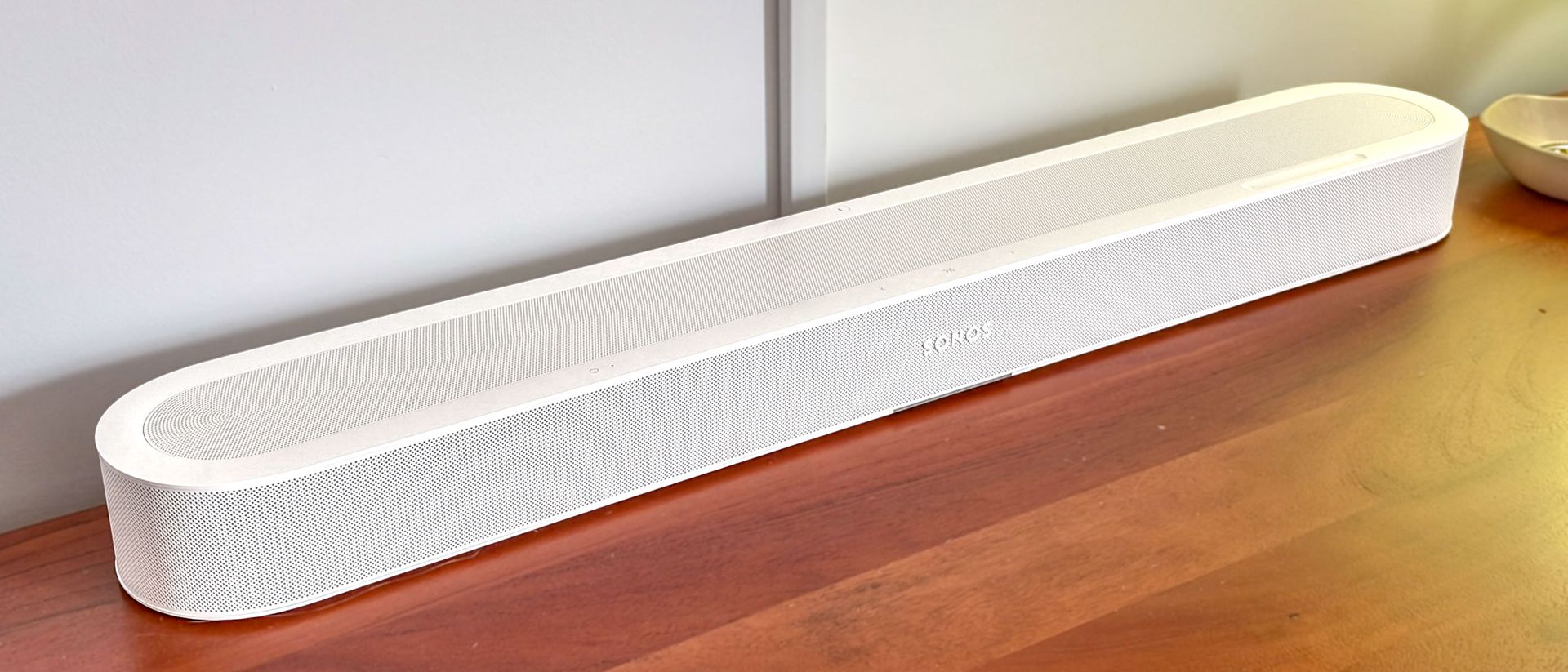
I installed the Beam Ultra beneath a wall-mounted Samsung Frame TV in my bedroom, and visually, it looks exceptional. The matte finish and uniform micro-perforated grille adhere faithfully to Sonos's minimalist ethos. At just 2.5 inches tall, it keeps a slender profile that sits well below screen bezels, while its slightly wider footprint makes it look right at home anchored beneath 55- and 65-inch sets.
The physical setup was ridiculously simple. Because the Frame routes through a One Connect box, swapping out my Beam Gen 2 literally required plugging in two cords: the power cable and the included HDMI eARC lead.
From there, the Sonos app recognized the bar had been powered on automatically. More importantly, Sonos finally added a fast Trueplay routine. Instead of pacing around the room waving your phone in the air for minutes wondering if you look foolish, the Beam Ultra’s built-in far-field microphones handle room calibration autonomously in roughly 30 seconds. You could still dance around your room for refined calibration, but for most spaces, the fast-track version should work just fine.
While the Beam Ultra easily holds its own standalone, its ability to pair dynamically with portable speakers is a standout highlight. I keep a pair of battery-powered Sonos Play speakers around my apartment—one stationed in the kitchen, the other in my home office. On Sunday mornings, I bring both onto my nightstands and assign them as temporary rears inside the Sonos app.
They lock into surround duty instantly over Wi-Fi with no lag or sync stutter. Having an impromptu, cord-free cinema surround rig right from bed elevates movie marathons completely. Once the credits roll, they head right back to their respective rooms for podcast duty.
It's impossible to discuss the Sonos ecosystem without acknowledging the elephant in the room: the company's disastrous 2024 app overhaul. After two years of rebuilding trust, Sonos 27 feels like a meaningful step forward, with more intuitive navigation, improved controls and smarter ways to connect devices throughout the home.
I have a Sonos Era 100 connected to my turntable in the living room, and being able to stream that analog audio to the Beam Ultra in my bedroom is exactly the kind of seamless multiroom experience that made me love Sonos in the first place.
Sonos 27 also introduces new AI integrations and expanded headphone connectivity. With the Sonos Ace Ultra, I seamlessly hand off TV audio for private listening without fumbling through Bluetooth menus.
While Sonos still has work to do to fully restore its reputation, the Beam Ultra paired with Sonos 27 is a compelling reminder of what makes this ecosystem special.
For all the Beam Ultra gets right, there are a few compromises worth considering, particularly when it comes to music playback, connectivity and whether the upgrade justifies its $699 price tag.
For all the improvements to spatial audio and Dolby Atmos, the Beam Ultra doesn't make quite the same leap forward with traditional stereo music. Streaming non-Atmos tracks through Spotify Connect or Sonos Radio sounds pleasant and well-balanced, but I didn't notice a dramatic improvement over the Beam Gen 2.
It also lacks the midrange punch and stereo separation I've come to expect from a dedicated pair of Sonos Era 100s. For casual listening in my bedroom, it's more than capable. But if music is your priority, a dedicated stereo setup is still the better investment.
Sonos continues to favor minimalist connectivity, but that approach comes with compromises. The Beam Ultra offers a single HDMI eARC connection, with no additional HDMI inputs for plugging devices directly into the soundbar.
That means everything needs to run through your TV. If you're working with limited HDMI 2.1 ports and regularly switch between gaming consoles, streaming devices and other accessories, the lack of HDMI passthrough could be frustrating.
Compared to the Beam Gen 2, which is still available to purchase, the addition of dedicated upward-firing tweeters and four additional amplification channels gives the Beam Ultra vertical separation and directional cues that virtual sound processing simply cannot replicate.
Against the flagship Arc Ultra, the Beam Ultra is far more sensible for small-to-midsize living spaces. The Arc Ultra offers deeper sub-bass extension thanks to its Sound Motion architecture, but its volume and acoustic projection easily overpower standard-sized bedrooms and apartments. The Beam Ultra hits the sweet spot of cinematic Atmos scale without annoying your neighbors or rattling your doors.
Model
Price
Acoustic Configuration
Primary Use Case
Sonos Beam Ultra
$699
7.1.2 (5 tweeters, 4 woofers, 9 amps)
Apartments, bedrooms, 55"–65" displays
Sonos Beam (Gen 2)
$499
5.0 (Virtual Atmos, 1 tweeter, 4 woofers)
Smaller TVs (<55"), tighter budgets
Sonos Arc Ultra
$1,099
9.1.4 (Sound Motion woofer, 14 drivers)
Dedicated home theaters, big living rooms
Bose Smart Soundbar 600
$499
5.0.2 (Physical up-firing drivers)
Standalone compact Atmos outside the Sonos ecosystem
Sony Bravia Theater Bar 7
$869
5.0.2 Side-firing speakers, Up-firing speakers)
Gamers and Sony TV owners needing 4K/120Hz HDMI 2.1 passthrough
Outside of Sonos, Bose and Sony both offer compelling alternatives. The Bose Smart Soundbar 600 gets you physical Dolby Atmos height channels for less money, while the Sony BRAVIA Theater Bar 7 is an attractive option for gamers and Sony TV owners thanks to its HDMI passthrough and compatible-TV dialogue enhancement features.
That said, I'd choose the Beam Ultra if you're already invested in Sonos or interested in building a connected whole-home audio system. The ability to expand your setup over time gives it an advantage that goes beyond sound quality alone.
The Sonos Beam Ultra is the best compact soundbar I've tested, and a worthy successor to one of my longtime favorites. By finally bringing genuine upward-firing Dolby Atmos drivers to the Beam lineup, Sonos has delivered the immersive sound I've always wanted from a soundbar this size.
Add exceptional dialogue clarity, effortless setup and a sleek design and it's an easy recommendation for anyone looking to upgrade their home entertainment without building an elaborate home theater in one go.
It's also an especially compelling buy for anyone already invested in Sonos. The flexibility of wireless surround speakers and the improvements introduced with Sonos 27 make the Beam Ultra feel like more than just another soundbar.
Don’t get me wrong, there are still reasons to look elsewhere. The Arc Ultra is better suited to larger rooms, the Beam Gen 2 remains a smart budget alternative, and dedicated stereo speakers still have the edge for music.
If you already own a Beam Gen 2, the upgrade makes the most sense if immersive movie sound is a priority. But for anyone buying a compact soundbar today and is comfortable with the asking price, the Beam Ultra is the clear choice. It's the best soundbar I've tested for a bedroom, apartment or mid-sized living room, and the one I'd recommend without hesitation.