A tiny superconducting sandwich could help computers use less energy
MIT News ·
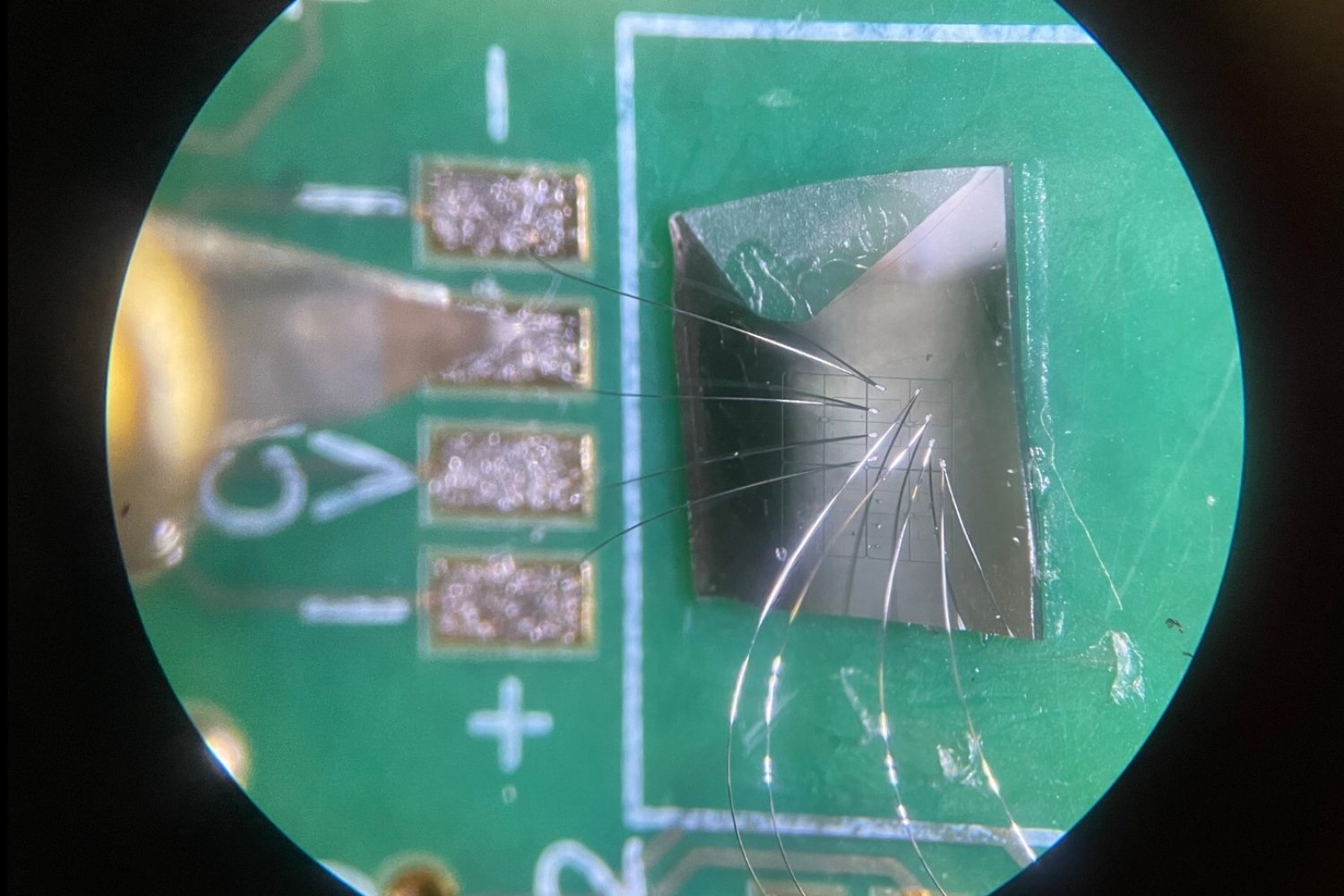
MIT researchers combined superconducting and magnetic layers in a tiny device offering persistent memory and signal control for more energy-efficient computing.
Scientists at the MIT Plasma Science and Fusion Center (PSFC) have created a tiny superconducting device that could help future computers store and process information using far less energy.
Today’s computers, supercomputers, and data centers need more of everything to keep up with demand: more energy, more capacity, and more speed to perform increasingly complex tasks. Feeding those computers’ processors with information — fast — is part of the challenge.
That’s where random access memory, or RAM, comes in. It’s a computer’s working space, keeping the information needed for current tasks close at hand. Without enough RAM, a computer slows down as it repeatedly retrieves information from hard drives or other longer-term storage.
Most familiar RAM is volatile: Turn off the power, and its contents disappear. There’s also nonvolatile memory, like the kind in a flash drive, which retains information without power. But there are trade-offs. Flash memory, for example, is slower to write than conventional RAM, and repeated writing and erasing eventually wear it out. Other forms of nonvolatile memory have different strengths and limitations.
In an effort to create faster, more energy-efficient computers, researchers have been developing superconducting computers, which rely on superconductors — a material that, when cold enough, exhibits no electrical resistance — instead of the traditional semiconductors to write information. In theory, the switch to superconductors allows for much quicker information processing with less heat emitted. But, processing is only as good as the memory that can supply those processors. It’s been a challenge to develop fast, high-capacity memory that also works at the extremely cold temperatures needed to operate superconducting computers.
Researchers at the PSFC have made a device that could help. In their recently published Physics Review Letters paper, titled “ Magnetic Exchange-Coupled Superconducting Devices with Broken Symmetry for Cryogenic Memory ,” senior research scientist Jagadeesh Moodera and his colleagues, including first author and postdoc Josep Ingla-Aynés , describe the device, which is a tiny sandwich made of an ultrathin superconducting film between two magnetic layers that can act as a memory cell. The magnets determine whether the film’s superconductivity is switched on or off.
"Integrating these devices can lead to processors operating at high speed and low energy,” says Moodera. “This development addresses the current lack of suitable cryogenic memory and control components, allowing for the advancement of cryogenic electronics technologies, including quantum computing and networking."
At the memory cell’s operating temperature, depending on whether a current can pass through or not, a computer can distinguish between two states and read them as a 0 or a 1, which is a bit, the smallest unit of data in a computer.
Writing a bit means, in this case, changing the magnetic alignment in the memory cell’s film: If the magnetization is pointing in opposite directions, the current can pass through; if it’s the same direction, the film becomes resistive. The researchers change the magnetic alignment by applying a small magnetic field and an electrical pulse that briefly heats the selected cell, making its magnetization easier to switch. Once set, the magnetic alignment stays in place without a continuing pulse or applied field. Each cell remembers. Moreover, it takes less energy to change that magnetic alignment in these cells and encode the bit than it does in traditional semiconductor cells.
The device still needs to stay extremely cold to operate, but each bit does not need a continuous electrical supply to preserve its state — it’s nonvolatile memory.
The researchers demonstrated that they could switch one cell without changing a neighboring cell, which is key when building memory in which individual bits can be selected and rewritten. The thought is that smaller cells could allow more information to fit into a compact space and could reduce the time and energy needed to write it.
According to Ingla-Aynés, “Any useful memory must have the ability to change one bit without disturbing all the information around it. Showing that we could switch a single cell without losing the neighbor's memory state was an important step toward bringing this superconducting layered device closer to a practical memory technology.”
The sandwich has another useful trick: It can also control where electrical signals go.
At a lower temperature, the device acts as a superconducting diode, which is like an on/off switch for delivering electricity in a certain direction. Within a particular range of currents, the device lets current flow without resistance in one direction while presenting resistance in the other. Changing the magnetic alignment can reverse that preferred direction, or create a resistive “off” state. Those settings could be used to direct or block the electrical pulses that carry information through superconducting circuits.
Having both capabilities in the same layered structure opens possibilities for combining memory and signal control on a superconducting chip. With that technology, superconducting computers could become a practical, energy-efficient alternative to the traditional computers currently relied upon for energy-intensive applications like AI. Moreover, while the devices store regular bits rather than quantum computers’ qubits, both quantum and traditional computers need reliable ways to hold information and move signals; the devices could potentially provide memory and signal control for quantum computers’ supporting electronics. Placing these devices near the cryogenic systems needed for superconducting operation could help reduce heat and electromagnetic interference that can disrupt the qubits’ fragile quantum state.
The researchers have demonstrated that their device can be used as an individually switchable, nonvolatile memory cell that could potentially serve as a building block for a new generation of highly efficient computers. The next challenge is to make these devices smaller and combine them into arrays capable of storing large amounts of information, while also quantifying just how much energy savings is possible in a system comprised of these devices.