2026 Ford Mustang Dark Horse SC First-Drive Review: The Perfect Mustang Doesn’t Need a Stick
The Drive ·
The post 2026 Ford Mustang Dark Horse SC First-Drive Review: The Perfect Mustang Doesn’t Need a Stick appeared first on The Drive .
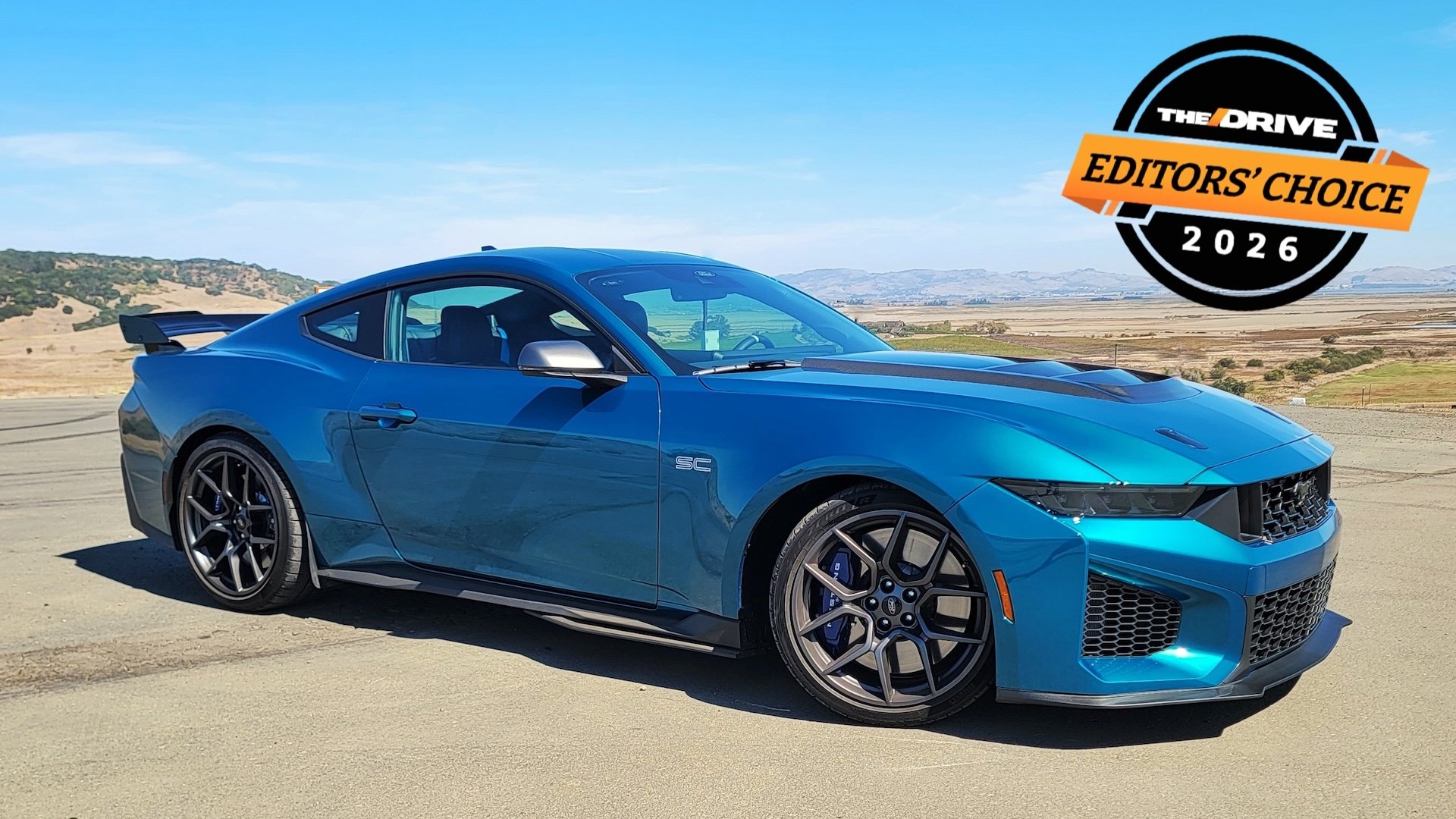
The evolution of the supercharged halo-spec Mustang has produced a wild spectrum of machines. Whether it’s Eleanor or something a bit less elegant , the formula has undeniably shaped the automotive landscape. And now there’s a new twist: the 2026 Ford Mustang Dark Horse SC throws out old naming conventions, but the formula remains intact.
Despite the name change, you can draw a straight line between the now-departed Cobra and the new Dark Horse SC. The underlying S650 Mustang chassis is an evolution of the S550, which originally hit the market as a 2015 model. That generation gave us a Bullitt, Mach 1 , GT350, and, of course, the 760-horsepower GT500 .
Dark Horse SC picks up where GT500 left off. The supercharged, 5.2-liter V8 returns with 795 hp and 660 pound-feet of torque. That power still reaches the rear wheels through a seven-speed dual-clutch automatic and an electronically controlled Torsen limited-slip rear differential. To keep all of that in check, Ford upped the ante on cooling and braking. Check the Track Pack option, and you’ll get 16.5-inch carbon ceramic brakes up front and 14.6 in the rear. The standard car gets equally enormous rotors and the same piston counts (six up front; four in the rear), but they’re made of old-fashioned iron.
The S650’s redesigned nose gave Ford’s engineers more space to draw in air, helping feed the auxiliary radiator and oil cooler mounted in the outboard cut-outs in the SC’s front bumper. Like the standard Dark Horse, the SC carries over the massive heat-extraction vent in the hood. It’s bigger here than on the naturally aspirated Dark Horse, and you can remove the rain tray underneath if you plan to track it. That vent channels heat out of the engine bay and reduces lift on the hood’s underside.
In the half-decade since Ford introduced the old GT500, we’ve seen another high-output Mustang variant arrive: GTD . In developing that $325,000 track machine, Ford introduced a new speed-dependent traction control system that it later ported to the Dark Horse SC. If the DCT made the GT500’s performance significantly more accessible relative to previous Shelby models, the SC’s new software leans even further in that direction. The GTD also drove the SC’s carbon brake upgrade.
Ford made plenty of other changes and small adjustments, including an overhauled MagneRide suspension and numerous adjustments to the car’s aerodynamic profile. Inside, Ford put together what it describes as a “function-first” cockpit. The S550 DNA shines through brightly in the cabin; it even smells like my old 2015 Mustang GT. I’m pretty sure I could disassemble this interior blindfolded.
Opt for the Track Package, and in addition to the aforementioned performance upgrades, you get teal brake calipers and interior elements, including the seat belts but, curiously, not the upholstery stitching. You also lose the rear bench seat. Add the lighter wheels and brake components, and this spec comes in 150 pounds lighter—much of that unsprung.
I’m a big believer in adaptive dampers, but I’ve never quite been sold on how they’re executed in the Mustang. In the S550, the car often felt like it was being led around by the nose—not necessarily an appealing sensation in an already front-heavy car.
The primary job of any well-engineered suspension is keeping your tires in contact with the pavement. To accomplish that, it needs to respond quickly to surface bumps and dips. Unfortunately, if you want a stiff setup to minimize weight transfer on a track, that brief can run counter to the suspension’s secondary mission: not liquefying your organs in the process. That dichotomy is what makes adaptive damper tech so clutch.
Ford’s revised MagneRide comes in two flavors: one for the base car and another specific to the Track Pack. And this time around, both are sublime . My memories of corralling a tram-lining S550 Mach 1 through every rutted intersection in southeast Michigan vanished the instant I found bad pavement in the SC.
The testing ground was Napa Valley—far from the environment I just described, but no stranger to lumpy asphalt. The mountain roads are often smooth as glass at their crowns but littered with whoop-de-dos at their margins, especially in shaded spots where temperatures more often dip below freezing.
I expected the constant, uneven undulations to bully the SC’s front end off-line, but those annoying tugs never came. Attacking a long, 55-mph uphill climb, I started with my palms firmly on the wheel. Halfway up, I found myself confidently throwing the wheel around with just my fingertips.
The Track Pack ships with Michelin Pilot Sport Cup 2 Rs. The track-ready rubber didn’t balk at the cold, damp surfaces below the fog layer. The SC feels smaller than it is—a rarer and rarer sensation these days—but not so much that it deceives you into pushing harder than you should. Sure, you might need a good stab of the brake if a stop sign sneaks up on you, but those 305/30R20s up front are reluctant to push unless you’re willing to cross the line into truly anti-social driving behavior; the 315s out back likewise pacify the rear.
That’s a common theme with the SC, as it turns out. Hell, even if you want to use all of its throttle, simply finding space to do so is a challenge. The short straights in the mountains invite maybe a second or two of sustained, wide-open throttle before the next rock face starts coming up at you awfully quickly. But you do it anyway, of course, because of that noise. It’s intoxicating. Hearing each upshift crack off the exposed rock is the sort of thing that might entice you to abandon your objective and double back for another round—unless your destination is Sonoma Raceway.
And remember: Sonoma isn’t just a road course . We split our day at the track into two modules. In the morning, quarter-mile passes with a sportsman tree. In the afternoon, the main event: flying laps on the road course’s long configuration . That’s a lot of track, and this is a lot of car. Time to boogie.
If you ask the internet, Sonoma’s quarter-mile strip is a quicker surface than most. Its location in California’s Bay Area is pretty ideal, climate- and elevation-wise. That goes double if you can run it mid-morning, after the sun has started to warm the pavement but before it encourages heat soak. Coincidentally, that lined up perfectly with my itinerary.
You can launch the car one of two ways. You can simply roll into the box and, y’know, do one , or you can get an assist from the SC’s digital line lock. The latter’s pretty neat, but might rival some Tesla gimmicks for the time needed to set the correct mode via the touchscreen and steering wheel. Speaking of which, these animations don’t need to last so long. Bronco, Tremor, and Raptor suffer from the same vanities. Too much fanfare. Do less and do it quicker—a perfect motto for what comes next, because after you’ve warmed your tires and lined up with launch control enabled, all that’s left to do is commit.
With the revs set to 1,600 and both pedals mashed to the floor, I watched the yellow lights trickle down the tree. When the last one winked out, I yanked my left foot off and gripped the wheel firmly. I hit the traps 11.060 seconds later. That was my first official, timed run in a straight-line event, ever . What can I say? I tend to spend time chasing cones and carving corners. After a false start on the second attempt, I managed a clean 10.947 at 131 mph on the third. Ford thinks the stock Track Pack is probably at least 0.3 seconds quicker than the GT500, which hovered around a 10.4-10.5. In the right conditions and in the right hands, it should easily be in the low 10s.
Accessible performance? Check . And if that generational improvement doesn’t sound too impressive, remember two things. First, the Dark Horse SC is more than just a straight-line car. Second, many of the advances that made the S550 GT500 so much quicker than its predecessor (the DCT, launch control, etc.) are baked into the formula this time around. There’s a lot less low-hanging fruit.
Sonoma’s long course shouldn’t be taken lightly. It’s fast and surprisingly narrow in places, and dropping into the carousel will give you butterflies the first time you commit blindly to the entry. Several spots put the rear end downhill in a fast transition, and this is precisely where you don’t want a numb, hunting front end. Just as it did on the street, the MagneRide shines here. I could just as readily drive it with my fingertips as I could on those back roads.
Ford’s new traction control system will be familiar to those who follow high-feature performance cars. It’s dubbed Variable Traction Control (VTC), and it behaves similarly to GM’s Performance Traction Management (PTM) and BMW’s M Traction Control, leaning toward the former in granularity. You can easily select five levels of stability assist (from full to zero) via the steering wheel. Since it’s only enabled in the SC’s track mode, Variable Traction Control simply borrows the cruise control toggles rather than relying on a separate toggle, à la PTM. Either way, at least it’s not buried in an infotainment menu.
Be as finicky as you like about the control implementation, but know that the system works a treat. Dialing back from level 4 (the highest level of dry-weather assist) gives you license to apply throttle with more steering angle. We weren’t on track long enough to get a full lap in on each level, but the successive upticks in power available coming out of Turn 11 were immediately apparent. That’s also a reasonably safe place to experiment with a playful rear end. There may be walls (where are there not any walls?), but at least it’s flat and straight—plus, if you screw up, you’ll wreck right in front of the corner workers. Nothing beats quick service.
This car has a stupidly unnecessary amount of power, rendering these new digital tricks less gimmicky and more mandatory. You may not care for it, but without them, some of these cars would be borderline unmanageable on the street. With this much capability, things can go wrong fast . It’s better to bruise egos than bystanders.
Today’s Mustang exists in a weird niche of Ford’s own creation. It’s somehow a $33,000 car and a $330,000 car at the same time, and consequently, it competes with a whole lot of things and with nothing at all. Is that a cop out? Maybe. At $155,825 as-tested, with the Track Pack, it sits right alongside a well-optioned Z06. A speed contest is another matter; I suspect the Corvette’s 400-pound weight advantage would help alleviate its 125-horsepower deficit. It certainly rotates quicker, and PTM is every bit as capable as Ford’s new traction software. But until the Camaro returns, there’s no true 1:1 comparison.
This thing kicks ass, full stop. If I could snap my fingers and change anything, I’d axe the rotary shifter and the unnecessarily long screen animations, and add a bit of pizzazz to the rest of the interior. Sure, it has big screens now, but if you look anywhere inside the cabin except the dash, it’s a lightly reskinned S550.
Ford provided The Drive with travel, accommodations, access to Sonoma Raceway, and the use of a vehicle for the purpose of writing this review.
The last GT500 was a near-perfect performance Mustang. The Dark Horse SC is even better.
The post 2026 Ford Mustang Dark Horse SC First-Drive Review: The Perfect Mustang Doesn’t Need a Stick appeared first on The Drive .