Apollo Dash review: A modestly priced scooter made for hills
Latest from Tom's Guide ·
Michael A. Prospero is the U.S. Editor-in-Chief for Tom’s Guide. In his spare time, he also tests out the latest drones, electric scooters, and smart home gadgets, such as video doorbells. Before his tenure at Tom's Guide, he was the Reviews Editor for Laptop Magazine, a reporter at Fast Company, the Times of Trenton, and, many eons back, an intern at George magazine. He received his undergraduate degree from Boston College, where he worked on the campus newspaper The Heights, and then attended the Columbia University school of Journalism. When he’s not testing out the latest running watch, electric scooter, or skiing or training for a marathon, he’s probably using the latest sous vide machine, smoker, or pizza oven, to the delight — or chagrin — of his family.
If you live in a hilly area, you need an electric scooter that has enough muscle to get you to the top. However, if you’re a commuter, or just someone on a budget, you also need a scooter that’s relatively light and affordable.
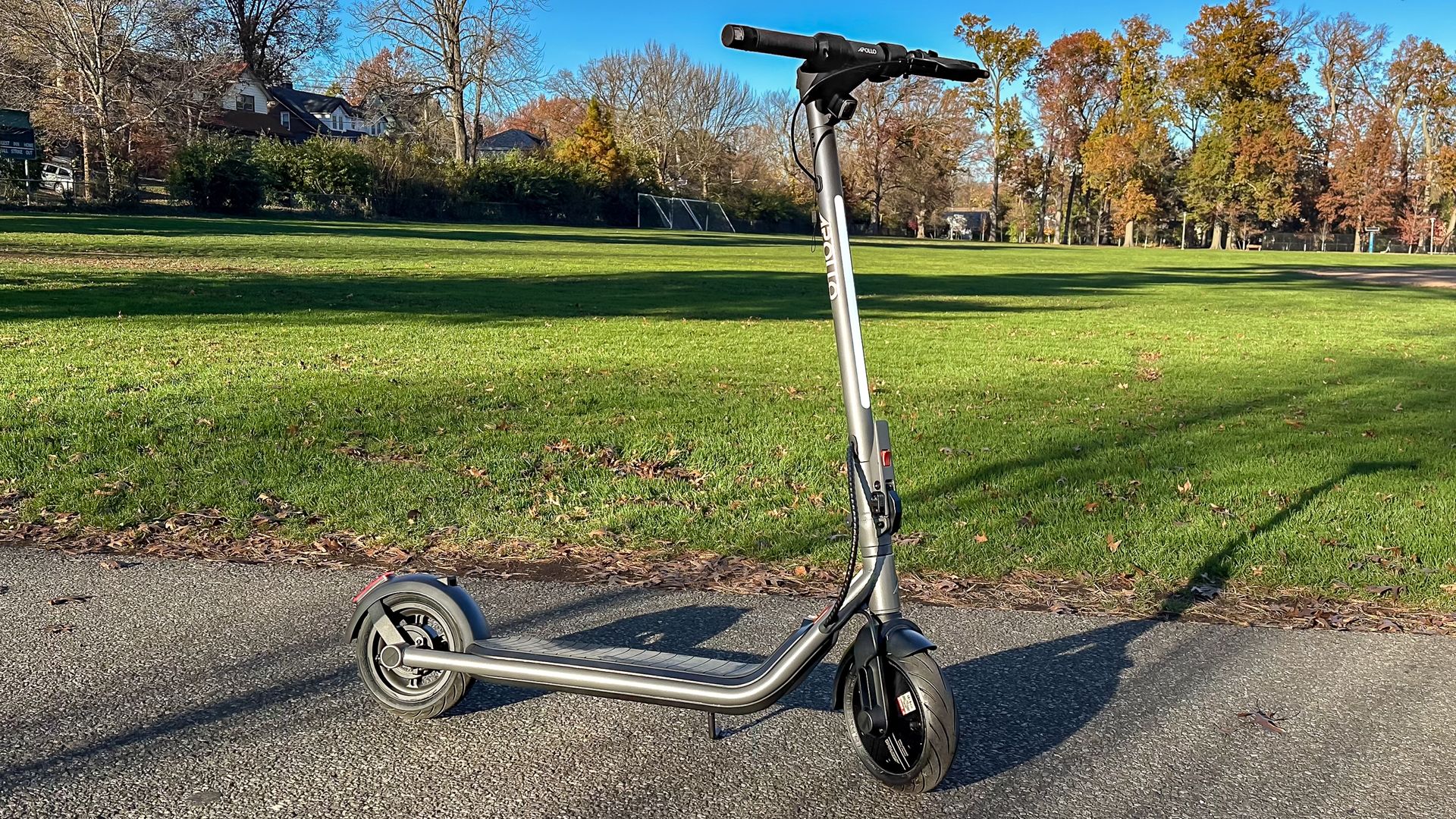
The Apollo Dash hits those notes well. While its 600W motor won’t be competing in any Mr. Universe contests, it’s muscular enough to power you up all but the steepest inclines at a reasonable pace. It’s also very customizable via Apollo’s app, and even has Apple FindMy, so you can keep tabs on its whereabouts. Even better, you can often find it for around $500, making it very reasonably priced for what it offers.
But how does it compare to the best electric scooters ? I tested the Apollo Dash for a couple of weeks to find out.
The Apollo Dash, which went on sale in 2026, is normally priced at $699, but for Black Friday and other sales, I've seen it as low as $529 at Apollo's site . If you can get it for that price, it's a pretty good bargain.
Top speed
22 MPH
Max range
25 miles
Motor
600W (1200W peak)
Battery
480 Wh
Apple FindMy
Yes
Suspension
None
Tires
9.5-inch tubeless
Charging time
5 hours
Weight
43
Size (unfolded)
45.7 x 43.7 (L) x 19.7 in
Max rider weight
220 pounds
Water resistance
IP66
Thanks to its 600W motor, the Apollo Dash is pretty good at getting up hills. While it’s not a speed demon like the Apollo City , it did manage to zip me up a 10% grade at around 8 MPH, which is much better than the similarly-priced Segway E3 Go . On a 6% grade hill, the Dash dashed me up at around 12-14 MPH.
Apollo says that the Dash is good for up to 25 miles, using its lowest speed setting; that’s not for me. You can set the Dash to “Ludo” mode, which boosts its top speed to 22 MPH, but at that setting, the max range drops to a still-respectable 17 miles.
Of course, range depends on a lot of factors; after a 5.5-mile jaunt, I had 55% battery remaining, so realistically, I would be able to get a little over 10 miles before the Dash would need a recharge.
Apollo’s app gives you a ton of control over how you want the Dash to perform. For starters, you can set the speed for each speed mode, so if you want to cap Sport mode at 15 MPH, you can do so.
But, you can also adjust things such as the throttle response — how fast you want the scooter to start moving — as well as the amount of regenerative braking. You can also specify how long the turn signals remain on, and how long it takes to activate cruise control.
It’s a lot of granularity that in truth, I’ll rarely touch, but it’s nice to know that it’s there.
One of the things I worry about most when riding a scooter is that cars won’t be able to see me, especially around dusk. So I really like the very large lightbar that extends the length of the Apollo Dash’s downtube; it’s bright enough to really stand out.
If that weren’t enough, the Dash also has a dedicated headlight that’s also quite powerful, and you can adjust it, so that it hits the road where it’ll be the most effective for you.
While the Dash has 9.5-inch air-filled tires, its lack of suspension was definitely noticeable compared with scooters which had some sort of shock absorption. When I was riding over bumps and potholes, it was a much more jarring experience, especially when I was moving at full speed.
I was testing the Apollo Dash the same time as I was testing the Segway E3 Go, and there were a few things that seemed small, but that I appreciated on the Segway. For instance, the Segway’s handlebars are angled back slightly (Apollo’s are straight) and are about three inches longer, which gave me more control when going over bumps.
I also liked that the Segway’s turn signal switch is on the left handlebar. On the Apollo, the left turn signal is on the left, and the right is on the right, so you can’t activate the right turn signal if your thumb is on the throttle.
I’ve rode plenty of low-cost scooters that have struggled to make it to the top of hills in my town; the Apollo Dash is not one of them. It proved more than capable on my tests, and while it’s not going to win any long-distance contests, its range is more than suitable for a few runs to the train station or office and back.
I do wish the ride were more comfortable — the Segway E3 Go has it beat there — but as long as your commute doesn’t involve pothole-strewn streets, you should be ok.
If you want something with more zip, the Apollo Go has dual 750W motors, a higher top speed, and twice the range as the Dash; it’s also a few hundred dollars more. If you need a great mid-range scooter that punches a bit above its weight, then check out the Dash.